Showing posts with label First World War. Show all posts

Saturday, 21 September 2024

City of patience

I had it all planned so well. After publishing my first travel post last Sunday, I would be making a start with the second one on Monday evening after work, selecting photos and assembling a couple of collages each day, ultimately finishing and publishing the thing on Friday. 

Well, what can I say? Courtesy of a stressful week, which left me tired and uninspired, things didn't quite work out that way. Other than catching up with blogland, everything else was put on the back burner until at last I made a half-hearted start with browsing my photos on Wednesday. The first batch of collages was made on Thursday, while the rest followed on Friday. And that's before I was able to put pen to paper, so to speak. 

In other words, it soon became clear that there was no way I'd be meeting my self-imposed deadline, so thank you for your patience and for bearing with me.


Unfortunately, this wasn't the only plan that went awry! 

Originally, a trip across the border to France was on the menu for Tuesday the 3rd of September. However, one look through our window confirmed the forecasted weather for that day. The sky was sulking and denying the sun a look-in. What's more, according to our phone's weather app there would be rain on the horizon.

The day's highs of 23°C didn't sound too bad, though, so I selected my linen-blend Zara skirt (Vix has its twin!) from my travel capsule and paired it with a charity shopped short-sleeved King Louie jumper.


My travel capsule also contained a selection of accessories, which have found the perfect home in this gorgeous patchwork washbag, a present from my lovely friend Claire. I just had to take a picture of it sitting on our balcony's railing and send it to her!

Seeing our plans for our trip to France thwarted once more, we opted for a visit to Ypres. Only twenty minutes up the road, the town has has plenty of wet weather options if needed. So, after breakfast, we kindly asked Truus, our Dutch-speaking Satnav, to take us the free car park at the town's station.

Although we've used this car park many times before, it just wasn't our lucky day. As all available spaces seemed to be taken, we started driving around in circles until a kind local directed us to another car park which admittedly she wasn't sure was still in use. According to her directions we would have to pass a level crossing, which strangely enough we never did. But then our patience finally paid off and we were able to park our car on a largely abandoned plot with weeds growing between its cobbles, where we joined a handful of other cars and some mobile homes. It had actually taken us longer to find parking space than it did to drive over to Ypres!


Crossing the road, we soon arrived at one of the entrances to the ramparts. These are among the best preserved in the country and now provide a green belt which garlands most of the historic town centre.

Although taking the main roads leading to the town centre would have taken us a mere 15 minutes or so, the 2,6 kilometer walk which meanders along the ramparts makes for a much more pleasant approach.

Almost instantly, remnants of the First World War can be found in a pair of British pillboxes, concrete structures with loopholes through which weapons could be fired. It is thought that the name "pillbox" derives from their similarity to the kind of circular cardboard box in which chemists of the time supplied pills.


Soon afterwards we came across the Peace Bridge. Opened in April 2023 and constructed from weathering steel, its guard rails are artistically embellished with the word "peace" in 86 languages: a statement of universal tolerance reinforcing Ypres’s message of peace.

The path then meanders past lakes and ponds, which are the remains of the moat, and the walk is an absolute delight: a perfect blend of nature and history, with the odd work of art thrown in.


Initially, the ramparts were little more than an earth wall with a moat. Later, stone walls and towers were added, until it was developed into a complex structure with bastions, advance redoubts, moats and walls.

In the photos (above, top left, and below, bottom left and right), Jos is standing on the edge of the Predikherentoren (Preacher's tower), which wasn't something vertigo-suffering me was quite comfortable with. 

If it doesn't look much like a tower, it's because in the French era both of the towers which were part of the 14th century Burgundian ramparts were lowered and transformed into artillery platforms.


A modern set of stone steps descends to the bottom of the tower. After having been closed off for many years, we were delighted to find the entrance gate once again opened to the public. You can spot a Lilliput yours truly (above, top left) snapped by Jos with his phone's camera. It's a good thing I'd had the presence of mind to wear a bright orange cardigan!


Idyllically situated on the banks of the moat is Ramparts War Cemetery, a small British cemetery where 198 Commonwealth soldiers, of which 188 are identified casualties, are resting.

From February 1915 to April 1918 Ramparts Cemetery was used by Commonwealth Forces. Most of the casualties buried here were killed in February, March and April and then in July and August of that year. The casualties from 1917 include a number of Australian and New Zealand soldiers.


This is just one of the literally hundreds of military cemeteries which arose in Flanders Fields after the First World War, reminding us of the staggering human toll the conflict took.


As always after having visited one of these moving sites, it was in a somewhat subdued frame of mind that we continued our walk. In these beautiful surroundings, however, nature soon managed to soothe our souls.

As we neared our destination, we came across the entrance to an ice house, a Madonna and Child in a cobwebbed shrine, a sculpture of Tibeert the cat and Reynaert the fox - characters from a major work of Middle Dutch literature dating from 1250 - and an Indian Memorial dedicated to the 130.000 troops of the Indian Forces who served in Flanders during the Great War. Oh, and there was a playful red squirrel too!


The Ramparts Route ends at the iconic Menin Gate, the sight of which always halts us in our tracks. This time, however, we were totally unprepared to see the Memorial covered in scaffolding. Designed by Sir Reginald Blomfield and unveiled on 24 July 1927, it is undergoing a two-year restoration programme, started in April 2023.

Here and here you can see what it looked like on some of our previous visits.


Having finally reached the town centre, our first priority was filling our rumbling stomachs and find a place to have lunch. Obviously, there's plenty of choice on and around the Market Place, but we opted for Café Les Halles, where we'd eaten on our last visit in September 2021. 


Popular with both tourists and locals on their lunch break, we needed to exercise patience as we had a rather long wait until our food arrived. This was somewhat redeemed, however, by our view of the newly renovated Cloth Hall, not to mention the fact that Jos's favourite alcohol free beer was on the menu.


After 18 months of renovations which were completed earlier this year, the front of the Cloth Hall can once again be admired in all its glory 

The Cloth Hall was built in the Gothic style in the 13th century and epitomised the wealth generated by the cloth industry that was heavily reliant on the wool trade with England. One of Europe's largest Gothic civil buildings, it served as a covered market and storage depot for Flemish cloth, a fabric prized across the continent.

The building - as in fact was most of the town - was completely destroyed during the First World War when the city stood at the heart of the Great War battlefields. It was rebuilt after the conflict and only completed as recently as 1967.  


She was a city of patience; of proud name,
Dimmed by neglecting Time; of beauty and loss;
Of acquiescence in the creeping moss.
But on a sudden fierce destruction came
Tigerishly pouncing: thunderbolt and flame
Showered on her streets, to shatter them and toss
Her ancient towers to ashes. Riven across,
She rose, dead, into never-dying fame.
White against heavens of storm, a ghost, she is known
To the world's ends. The myriads of the brave
Sleep round her. Desolately glorified,
She, moon-like, draws her own far-moving tide
Of sorrow and memory; toward her, each alone,
Glide the dark dreams that seek an English grave.

- Laurence Binyon, Ypres, 1918 - 


It was when we were proceeding towards the Cloth Hall after lunch that it started drizzling. We ducked inside the passage running under the Cloth Hall, emerging on the other side in front of the Gothic St. Maartenskathedraal (St. Martin's Cathedral). Admiring its soaring interior, it's almost impossible to believe that the church - which like the Cloth Hall was reduced to rubble after the war - was actually completely rebuilt in the 20th Century!


While Jos took a breather, me and my camera explored the church and marvelled at its glorious architectural details as well as the modern artwork which was on display.

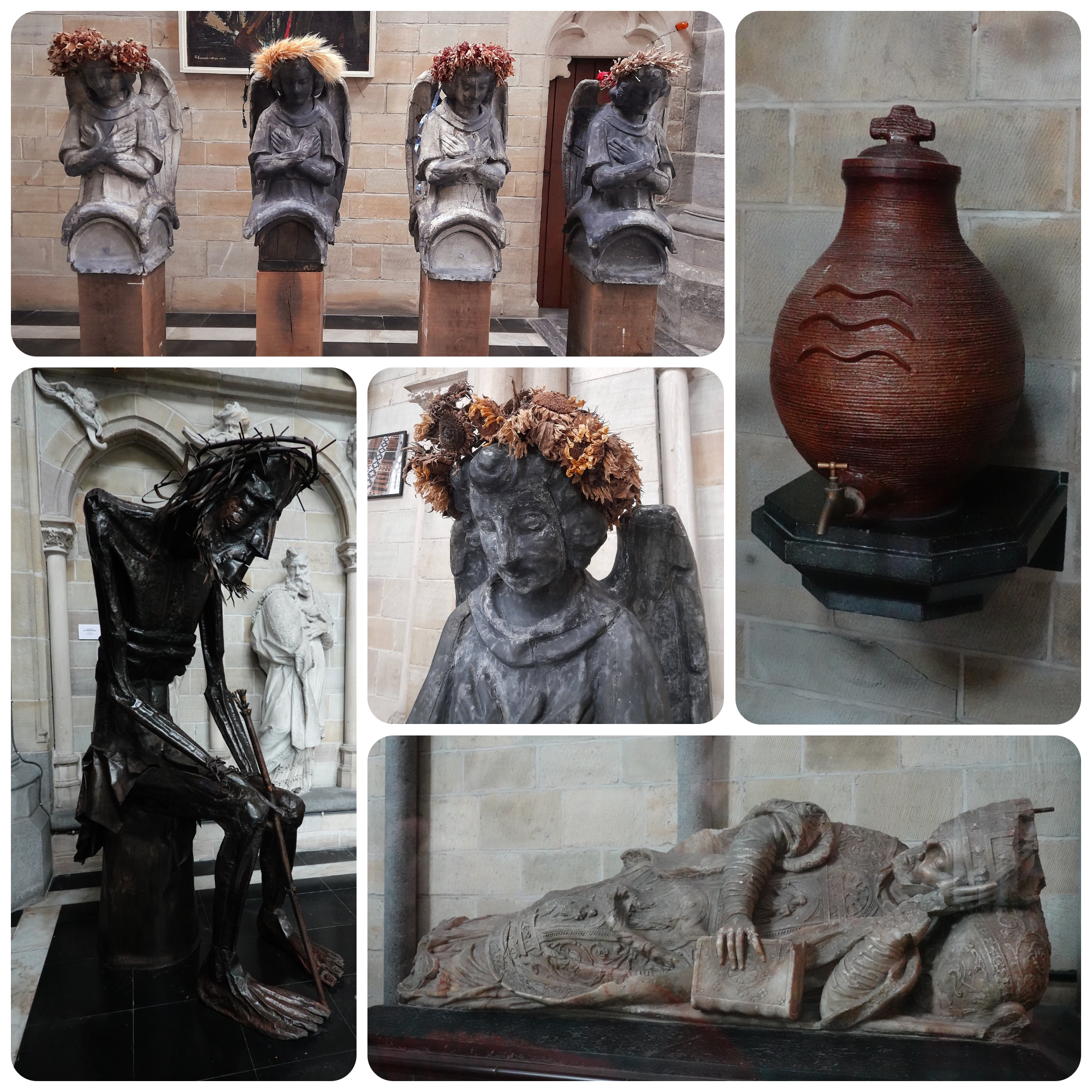
The wrought iron sculpture, The Suffering Christ by local artist Adhémar Vandroemme (1917-2009) is particularly haunting and has received its permanent place here since Good Friday 2018.

I loved the row of angels - dating from 1934 but looking much older than their 90 years - with their dried flower headdresses, and was intrigued by the barrel on the top right. Holy water on tap, perhaps?


Outside the drizzle still continued so we made our way back to the Market Place and around the corner to the Ypres Museum, which had a temporary exhibition going on called Vrij, Vrolijk en Vunzig (transl. Free, Jolly and Filthy), lauded as a multifaceted discovery of the Middle Ages.


I thought the layout was rather confusing and, combined with the fact that it was quite warm and airless inside the venue, I'm afraid we rather rushed through.

It boggles my mind that one was able to walk at all and not trip up wearing those long pointed shoes, called poulaines. Apparently all the rage for men, they originated in the 13th century and reached extreme proportions in the 15th century. The points became longer while jackets got shorter. Poulaines were highly impractical and demonstrated that you were a man of leisure.

The object on the bottom left is the runner of a so-called jaw sledge for children, which was made by mounting a wooden board on the lower jawbone of a horse. 


The drizzle had turned into full-blown rain when we left the museum so any further plans for the day were shelved. Instead, we returned to the car park via the shortest route, hoping that our car would still be there. Much to our relief it was!


The weather gods, however, were having the last laugh that day, parting the clouds for a September sunset, illuminating the hop fields across the road and the hills across the border in France.

And look who was patiently waiting at the bottom of the stairs for her dinner!


Friday, 24 September 2021

West Side Story, Part 3

Once again, we were greeted by the sun when we woke up on Tuesday the 7th of September.

After our customary fruit and yogurt breakfast - we'd stocked up on fruit at the local supermarket after we'd returned from France on Monday - we repaired to our balcony, enjoying our morning coffee while making plans for the day. 

The weather forecast kept insisting that we were in for another scorcher that day, which ruled out doing anything too taxing like uphill walking. Well, we'd already had our fair share of the latter in France the other day and we were definitely feeling the strain.


As luck would have it, there was a leaflet among our cottage's holiday brochures which immediately caught our eye. The castle domain in Zonnebeke, established on the site of a former Augustinian abbey (1072-1796), and incorporating the Memorial Museum Passchendaele 1917. A leafy walk and a chunk of World War I history sounded right up our street.

We wasted no time in packing a picnic, but before embarking on our 20-minute or so journey to Zonnebeke, let me show you what I was wearing first.


The blue organic cotton skirt I'd picked up in the Mango sales turned out to be such a joy to wear during our little getaway in August, that packing it for our holiday was a no-brainer. The funky floral top I combined it with was a purchase from the high street as well. By retro label Zoë Loveborn, it has been a Summer staple for years. The belt is again one of my favourite stretchy ones. On my feet, another pair of sales bargain Clarks, as I'd exchanged my comfy sandals for my even more comfy Cloudsteppers!

The sun was already climbing towards its zenith by the time we'd parked our car in one of the domain's car parks, a searing orb in a brilliant blue sky. 


Making our way towards the cover of some trees, we passed the 8-metre-tall memorial honouring the role of New Zealand’s Māori in the First World War. The pou maumahara (memorial carving) was created over four years from 4500-year-old native New Zealand timber by master carvers, tutors and students from the New Zealand Māori Arts and Crafts Institute in Rotorua, New Zealand. 

Our leaflet contained a map indicating a 1,9 kilometer walking trail around the estate, and as it seemed to start at the museum and information centre, we walked into its direction. Both are located in a lake-fronted Normandy-style mansion which was built in 1922 to replace a castle bombarded into rubble during the war.

The faintest of alarm bells started going off in our heads when we couldn't find any signs and our fears were confirmed when the nice lady at the information desk informed us that the walk was indeed not signposted. You can't go wrong, she said. You can see the house at all times, she said. But we have a track record of getting lost, we said. I could see her smiling behind her mask.


We walked towards the lake as instructed and took the path skirting it, happily breathing in the scent of the late Summer air, a hint of Autumn carried along a whisper of a breeze. Soon we were faced with a choice of woodland paths which we selected at will, without a glance at the map. 

Arriving at a clearing, we detected random pools of red picket fences. Some head-scratching followed by a look at the map revealed that these were the Passchendaele Memorial Gardens, a series of eight poppy-shaped remembrance gardens created for the Battle of Passchendaele's centenary in 2017, each one designed by one of the nations that took part in the battle.

The one immediately in front of us turned out to be the United Kingdom's. Sitting down on a conveniently placed garden bench, we looked at the map, which confirmed that we'd already taken a wrong turning.


We were supposed to pass in front of Villa Zonnedaele, which we could see shimmering between the trees beyond the gardens, so we made our way towards it with the intention to continue the walk from there. The villa, commissioned by the castle's owner for his eldest daughter in 1933, turned out to be another sad case of neglect. 


After this false start, we resumed our walk, this time correctly passing all eight gardens, starting with the Belgian one, which you can see above.

The New Zealand garden (below, top left and bottom right) was my favourite, its centre piece a hollow concrete column, the scale of the door requiring visitors to bend low to enter, echoing the physical confinement of the battlefield trenches. 


I was also enamoured by the swathes of Echinacea juxtaposed with the red picket fence at the Canadian garden (top right and bottom left).

Two of the gardens were laid out separately from the others, and were somewhat hidden by lush thickets of shrubs and trees, and it was here that we had another wobble. Eventually we arrived back at the chalet, err ... castle, where we searched out a shady bench to have our picnic on.


Thus fortified, we were ready for the haunting experience which awaited us at the Memorial Museum Passchendaele 1917.

Aided by audio guides, the museum presents the history of the First World War in a poignant and vivid way, with a particular emphasis on the Battle of Passchendaele. 


This battle in 1917 is known as one of the most horrific of the First World War, with almost 600.000 casualties for a frontline movement of merely 8 kilometers. ‘Passchendaele’ not only became a concept in the history of the First World War, it also became a symbol of the great futility of the violence of war in all its horror. 


After the museum section, the tour continues with he unique Dugout Experience.  As a visitor, you discover how the British went to live underground in 1917, an oppressive experience that creates a disconcerting picture of the miserable and claustrophobic living conditions at that time. 


The final part of the museum constitutes a faithful reconstruction of German and British trenches, complete with  original shelters.


After this almost physical ordeal we felt worn out, which wasn't at all aided by the relentless heat of the sun, as the temperature continued to flirt with the high twenties. We sat down on a bench on the museum's verandah to recover before returning to our sauna-like car and driving home to our mercifully cool cottage.


On Wednesday the 8th, the weather thermostat was turned up even higher, the mercury forecasted to reach a scorching 30°C.

Nursing our morning cups of coffee on our balcony and mulling over the day's possibilities, I announced to Jos that I wanted to take some outfit photos in the hopfield across the road. So, before we started the day's adventures, that is exactly what we did.


As we'd planned a walk in the woods, I was wearing one of the pairs of lightweight wide-legged trousers I'd thrown into my suitcase. They are Zara by way of a charity shop, and I've worn the pussy-bow top - an ancient retail buy - with it many times before. A tried and tested no-brainer of an outfit. On my feet, barely visible in the photos, my pair of charity shopped pink floral sneakers.


The woods we'd selected for our walk were called Praetbos (bos is the Flemish word for wood), about half an hour's drive from Poperinge. On the outskirts of the small village of Vladslo, near the town of Diksmuide, it's adjacent to Vladslo German Military Cemetery.

Here, 25.638 German soldiers have found their final resting place. With stone tablets bearing multiple names, interspersed with roughly hewn stone crosses, there is a poignant sense of sadness and loss here, yet it feels soothingly peaceful in the dappled shade of the trees.


Among the soldiers who rest here is Peter Kollwitz, son of renowned German artist Käthe Kollwitz, who was killed at just 18 years old on October 23, 1914.  

For nearly twenty years, Käthe Kollwitz struggled to find a way to memorialize her dead son, discarding draft after draft, and putting the project aside temporarily in 1919. When she returned to the project in 1924, she settled on two simple figures, a mother and father with the features of Käthe and her husband Karl, who would kneel in mourning before the graves. Their son Peter's name is on the tablet just in front of the mourning father.


Our walk in the woods turned out to be only a very brief one, as once again, in spite of the leaflet outlining the walk, it was not signposted. 


So we just wandered at will and sat down on a bench where I gathered materials for a seasonal display.

The woodland paths were part of a 10,5 kilometer Käthe Kollwitz walk and indeed, her life and artwork ended up being the theme of the day, which continued with a visit to a museum dedicated to the artist in the nearby town of Koekelare.


In a unique former brewery setting, the Käthe Kollwitz Museum houses a collection of her original artwork.

Through these, one discovers how Käthe rebelled against war and poverty through her expressionist work. 


Being directly under the eaves, it was quite warm at the museum, and we were glad to have the space mostly to ourselves, so that we could take off our masks.

We declined a visit to another museum on the same site, which was included in the ticket price, as it was even hotter in there. So, after refreshments on a terrace on the town square, we made our way to the final leg of our day's adventures.


The day ended with a very leisurely walk in Koekelare Arboretum. Here we just had to follow the yellow signs ... Easy peasy!

Needless to say, we still managed to get lost, so when we caught sight of the car park, we decided to call it a day and made a beeline for a our car.

See you next time!


Monday, 21 September 2020

Far from the madding crowd

Hello, and welcome to the third episode of my latest travelogue! 

We have now arrived on the Wednesday of our week away, which the calendar told us was 2 September. With schools having restarted the previous day, the worst of the tourist season was well and truly over, but we still opted to spend our time as far away from any lingering crowds as possible.

The weather gods kept treating us kindly, so that we could continue to indulge in one of our favourite pastimes and go for socially distanced rambles in the beautiful countryside surrounding us.

What's more, the weather forecast insisted that this would be the best day of the week, with balmy temperatures well into the twenties. 


That morning, I pulled another pair of wide-legged trousers out of my suitcase, in a cheerful cherry red strewn with blowsy flowers in pink, peach and green. Same as my other pair, it is from New Look, this one bought brand new in the sales a couple of years ago. 

They were actually not the only retail item in my outfit, as my Clarks Cloudsteppers, my blue crossbody bag and my necklace were all bought on the high street. My King Louie top was charity shopped, though, while the flower embroidered denim jacket came from Think Twice.


We'd picked a walk starting from De Palingbeek, a provincial estate of about 250 hectares on the outskirts of Ypres. We'd done the same walk six years ago, but when I was googling the exact address of the estate's car park, I saw that the walking map of the area had recently been updated. So, before we set off that morning we went into Poperinge, our nearest little town, to get a new map from the tourist office located in the town's stunning neo-Gothic town hall (top left). 

Since we were there, we went to a local bakery and bought a loaf of bread which came packed in a very Polyester Princess-worthy paper bag!

Armed with our map and the picnic Jos had prepared that morning, we entered the car park's address into our car's Satnav and were on our way. Easy-peasy! Or so we thought. But no: the bloody thing took us to a golf course on a single track road and announced that we were there. Of course, there was no car park in sight, so there we sat, hemmed in by the golf course which stretched out on both sides of the road. In desperation we drove around the area's myriad of country lanes until, propelled along by a stroke of luck and a good look at the map, we ultimately made it to the car park.


By then, it was past midday, so after having parked our car - which was further thwarted by on-site construction work - we made our way to a picnic site for a bite to eat.

Then, after making use of the on-site hand sanitizing station at the edge of a playground, we were finally ready to start our walk.


The estate offers a varied landscape of sloping woodland, orchards and meadows, marches and pools.

The latter are often not quite the peaceful pools they appear to be at first sight, owing their existence to mines which were detonated underneath the German positions at nearby Hill 60 in June 1917.


Our walk eventually took us to the most famous of these pools, known as Caterpillar Crater, but once again this had seriously suffered from the ongoing drought, which left the 79,2 meter wide and 15,5 meter deep crater (bottom left) only partly filled.


The return journey passed the impressive art installation Coming World Remember Me by artist Koen Vanmechelen. Originally consisting of 600.000 clay heads sculptured by thousands of people from across the globe, representing the 600.000 victims who lost their lives as a result of WWI in Belgium, it was displayed in the estate between March and November 2018.

Many people went home with one of the hand-sculpted heads, but the central sculpture (the egg) as well as 200.000 heads have now received a permanent resting place here.


With our walk finished sooner than we'd expected, we thought we'd check out one of the many military cemeteries which are such a feature of the area.  While we were lost on those country lanes that morning, our attention had been caught by the sight of the ubiquitous rows of white headstones nestling in the gently rolling countryside, punctuated by two gazebo-like structures and shimmering like an oasis in the glaring midday sun. Intrigued, we tried to find out its name and exact location, which we soon did. It turned out driving there was only a matter of minutes.


Bedford House Cemetery is one of the largest British cemeteries in the area. It stands in what was once the park of Rosendael Castle, which the British troops renamed "Bedford House" during the war, when it served as a headquarters and a medical aid post. It never fell into enemy hands, but the house was gradually destroyed by shell fire. 

The magnificent garden architecture, and the fact that the castle's moat and the remains of its ice house are incorporated into the design, makes Bedford House Cemetery a unique and poignantly beautiful site.


The next day, Thursday, was a total contrast on the weather front, with a dull grey sky and significantly cooler temperatures greeting us when we stepped out onto our balcony.

I was wearing my other pair of wide-legged trousers again, this time combined with a pale green floral vintage skirt, topped by a charity shopped coral polka dot cardigan and accessorized with a vintage necklace and leaf brooch. 

No rain seemed to be on the horizon, so we picked another walk for the day, for which I exchanged my ankle boots for my boring yet comfortable walking shoes.


For the start of our walk, we drove down to a different provincial estate, called De Blankaart, which lies just outside the town of Diksmuide, and is about half an hour's drive from our cottage.

Its visitors centre is housed in a picturesque castle, originally built in 1860-1870, although the current construction dates from the 1920s as the destruction of the First World War had only spared its façade.

Located on the edge of the River IJzer's flood plains, the castle is surrounded by a magnificent park. The castle has a permanent exhibition on the area's fauna and flora, but its doors were firmly closed. Free walking leaflets, however, were readily available, as was a hand sanitizing unit cleverly built into a tree.


The picnic area was deserted so, while eating our sandwiches at one of the tables, we proceeded to study the map supplied with the leaflet, opting for the 5,6 kilometer walk instead of the longer 10 kilometer one. The shorter walk would follow the longer one's path for a stretch, and would then require a right turn instead of a left at some point. Easy-peasy, no?


Confidently, we started our walk, following the hexagonal sign posts which initially lead us through some woodland. It didn't take long until we came to the first of many bird hides offering a view of the area's watery grass and reedlands, with the vast IJzer wetlands behind them. 

The weather had turned quite windy by now, so that by the time we made it to a decorative iron bridge offering the most enchanting of views of the castle across a waterlily pad filled lake, we were almost blown away in both senses of the word.


It was here that we met a couple walking their dog, whom we would later meet again at a turning, looking at the rather rudimentary map and scratching their heads. They told us they were still debating whether to do the shorter or the longer walk, and that a right turn indicating diagonally across the meadows would take us to the shorter circuit. With our impressive track record of getting lost, we took no chances, agreed that this was the anticipated right turn, and went ahead, soon followed by the dog-walking couple.

Much to or surprise, though, we found ourselves back at the castle within minutes. Surely we couldn't have walked 5,6 kilometers already, only about a kilometer at a rough guess. The dog-walking couple didn't seem to think anything was wrong, and were last seen cycling off with their dog in one of those carts, but after studying the map once again, we decided to recross the meadow and continue left instead of right at the turning.


From here, the walk was getting more and more adventurous, leading us through meadows and along stretches of boardwalk, one of them quite higgledy piggledy, with some of the wooden slats broken or missing. Fortunately, the whole thing was supported by sturdy iron grilles! At one point, a gnarled old tree was doing its best to catch careless walkers unawares and reward them with a bump on the head.

Not us, I hasten to add, but on our way back we did meet a lady who was clutching her head after a painful collision with the tree in question.


At this point, we still weren't sure we were on the right track and hadn't inadvertently missed the elusive right turning. Stubbornly, we plodded on, alternately propelled along and hampered by the wind which by then had greatly increased in force. When we spotted the tower (bottom right), which apparently was another bird hide, in the distance, we decided to make this our goal and then see if we could climb it and make out our exact location. 


The wind blowing through the open structure was making our ears sting and our eyes water, but climbing to its top floor, which thankfully was not in the open, rewarded us with the most stunning of views over the wetlands. Studying the map once more, we determined we were still on the right track and proceeded until, hey presto, we came to the very spot where the two paths diverged. 

Here, the shorter circuit initially took us along a narrow tarmacked lane until we reached a path leading to another meadow, which we had to cross to arrive back at the wonky boardwalk. 

We were quite proud of ourselves for having persevered and finished the walk without actually getting lost a second time. As the visitors centre had opened by now, we even treated ourselves to a celebratory takeaway coffee.

"We shall not cease from exploration
And the end of all our exploring
Will be to arrive at where we started
And know the place for the first time."
-   T. S. Eliot,  Little Gidding


Then it was back to the cottage, where much to our delight, hop picking had started in the fields opposite. 

We watched proceedings for a while, while in our turn being watched by the owner's cat, Chablis, who was making the most of the last rays of the sun, which had suddenly appeared out of nowhere.

Another day gone by, and how we wished we could have stopped time, but alas, two more days and it would be all over.

Please do join me again for the final episode of my travelogue in a couple of days. Until then, do stay safe, my friends!