Showing posts with label rain. Show all posts

Friday, 20 December 2024

Wrapping up November

By the time this post is published the countdown to Christmas has well and truly begun. There's just one more working day to struggle through as my boss insisted we come to the office on Monday, and that's it: I'm only expected back in January! Not having much affinity with Christmas at the best of times, I might not be feeling particularly festive, but let me tell you that these days of leisure - a seemingly never-ending nine of them - will be very welcome indeed!

In a bid to get ourselves into the mood, we did succumb to putting up the tree last Sunday. As we currently don't have space for our regular "faux fir", we picked up a smaller and significantly slimmer one at the garden centre, one which neatly fits into our sitting room. We were living in hope that Bess would refrain from attempting to climb this one, but I think you can take an educated guess at how that  worked out ... **


In the meantime, my blog hasn't even made it to December yet, which means I'll have to get my skates on and whizz through those final two November weeks.

The weather had definitely taken a turn for the worse in the month's penultimate week, with highs of around 3°C and lashings of rain, hail and sleet. We even had some proper snow one evening, which thankfully didn't stay around for long and was all but gone by morning.

As sunny spells remained the rarest of commodities, I whipped out my phone to take this snapshot of Antwerp's Stock Exchange during one of my lunch breaks. What a treat that lovely blue sky was!


The sky reverted to its customary granite grey for the rest of the week, the weather gods upping the ante with flurries of snow while I was waiting at the dentist for a check-up on Friday.

We left it too late for outfit photos that day, but here is what I was wearing on Saturday 23 November.

It's always a joy to wear this vintage blue and off-white tile-patterned dress on such a wintry day, its textured polyester fabric perfect to combat the low single digit temperatures.


I kept it simple by adding just a handful of accessories in toffee shades: a vintage enamelled butterfly brooch and tiger eye pendant from the indoor flea market and a charity shopped top stitched belt with gold rimmed buckle. The eagle-eyed among you may catch a glimpse of my mustard opaques while my tan boots - my most-worn pair so far this season - are making yet another appearance on the blog.

With the weather once more playing spoilsport there was nothing for it but to go for a rummage, for which we selected the charity shop at the edge of our town. 


Pickings were slim, but I still managed to fall head over heels with a navy and orange Zara skirt, which you'll get to see me wearing the very next day. A chunky buttonless orange cardigan by Belgian designer Nathalie Vleeschouwer also ended up in my trolley. You'll get to see me wearing that too.

My final find was this wounded vintage swallow brooch, which was begging me for mercy. At just € 1,50 I was more than willing to give it a home in my modest collection. When I posted her on Instagram, several people initially thought she was made of chocolate. Well, someone has clearly been nibbling the tip of her wing!


Sunday was a day of sunny spells and a couple of light showers. Incredibly, the mercury had climbed to 17°C, making it the mildest 24 November since records began!

Bess was making the most of a ray of sunshine by basking in it while she was claiming Jos's lap for a cat nap.


No cat nap for yours truly, who had a couple of chores to tick off her list. Then, after lunch, we decided to return to the park in Duffel for a stroll.

In spite of the unseasonably warm temperature, it was all but blowing a hoolie out there. On top of that, it had started to drizzle the minute we'd stepped from our car. Not to be deterred by such details, we walked into the direction of the castle ruins which, much to our amazement, are finally being restored.


What with all the rain, the paths were far too muddy for a closer inspection. 

We returned to the main part of the park via the towpath of the River Nete (below, bottom right) which runs adjacent to it, the menacing sky holding the promise of yet more downpours.


At one point, the sun made a feeble and short-lived attempt to break through the multiple layers of grey, briefly lighting up the few remaining russet leaves hanging on for dear life on the odd tree.


As always, I was in awe of the tenacity of this ancient split and hollow tree, looking brittle and frail, yet refusing to give in to the inevitable. The things it must have witnessed in its lifetime would make for captivating stories, I think. Why don't we pause a while and listen to its whispering conversations with the wind?


I was wearing the Zara skirt I'd scored in the charity shop on Saturday. My vintage burgundy tweed jacket with its knitted sleeves and yoke was supplied by the gods of the charity shops as well, as was the fluffy bubblegum pink scarf, both of which were more than sufficient for the mild temperatures of that day. My red Kangol beret was picked up from Think Twice about a year ago.


Back at Dove Cottage, it was time to show you the Zara skirt - and the rest of my outfit - in detail, although we did struggle a bit with the failing daylight.

I just love the texture of that skirt, which reminds me of bubble wrap. I've got a cardigan with a similar texture lined up for its next outing. 

Incidentally, the thin Norwegian style jumper is charity shopped Zara as well. As an extra layer, I wore the orange Nathalie Vleeschouwer cardigan which had also made its way home with me on Saturday.

Oranges and navy blues were the obvious choices for my accessories, a mix of vintage (brooch), second hand (necklace) and high street finds (ring and belt).


November's final week brought moderate temperatures of around 12°C accompanied with yet more and often quite torrential rain. It was on the news that week that 2024 had so far been the wettest year in Belgium ever. Or at least since records began on 1 January 1833.
 
This was my view from the tram on my way home on Wednesday afternoon ...


Thankfully, some sunshine at last on Thursday which, as it was Thanksgiving and our head office is in Miami, was a bit of a quiet day. 

As the tower crane used for renovating the Art Deco skyscraper opposite our office building has finally been removed, we've got an uninterrupted view towards Antwerp's cathedral once more. The morning sun was painting its tower in liquid gold and made me reach for my phone, inwardly cursing its camera's limitations and regretting that I didn't have my proper camera with me. This, therefore, will have to do!


The sunny spells continued on Friday, clearing up after its initial foggy start with the garden covered in a flimsy layer of hoarfrost.

My journal insists that we went to the supermarket and that I gave the downstairs rooms a quick once over. Oh, what an exciting life I've been leading lately.  


But at least I dressed up, like I always do, picking a previously tried and trusted combo of a vintage polyester and mohair blend skirt and a charity shopped rose-patterned King Louie jumper.

Accessories were a sales bargain green suede belt, a charity shopped green wooden Les Cordes necklace, a vintage brooch from the indoor flea market and a green plastic ring which was a gift from my wonderful blogging friend Claire.


So, that's November all wrapped up. December, I think I am ready for you!


** Don't worry, photos of her exploits will be in my next post!


Saturday, 21 September 2024

City of patience

I had it all planned so well. After publishing my first travel post last Sunday, I would be making a start with the second one on Monday evening after work, selecting photos and assembling a couple of collages each day, ultimately finishing and publishing the thing on Friday. 

Well, what can I say? Courtesy of a stressful week, which left me tired and uninspired, things didn't quite work out that way. Other than catching up with blogland, everything else was put on the back burner until at last I made a half-hearted start with browsing my photos on Wednesday. The first batch of collages was made on Thursday, while the rest followed on Friday. And that's before I was able to put pen to paper, so to speak. 

In other words, it soon became clear that there was no way I'd be meeting my self-imposed deadline, so thank you for your patience and for bearing with me.


Unfortunately, this wasn't the only plan that went awry! 

Originally, a trip across the border to France was on the menu for Tuesday the 3rd of September. However, one look through our window confirmed the forecasted weather for that day. The sky was sulking and denying the sun a look-in. What's more, according to our phone's weather app there would be rain on the horizon.

The day's highs of 23°C didn't sound too bad, though, so I selected my linen-blend Zara skirt (Vix has its twin!) from my travel capsule and paired it with a charity shopped short-sleeved King Louie jumper.


My travel capsule also contained a selection of accessories, which have found the perfect home in this gorgeous patchwork washbag, a present from my lovely friend Claire. I just had to take a picture of it sitting on our balcony's railing and send it to her!

Seeing our plans for our trip to France thwarted once more, we opted for a visit to Ypres. Only twenty minutes up the road, the town has has plenty of wet weather options if needed. So, after breakfast, we kindly asked Truus, our Dutch-speaking Satnav, to take us the free car park at the town's station.

Although we've used this car park many times before, it just wasn't our lucky day. As all available spaces seemed to be taken, we started driving around in circles until a kind local directed us to another car park which admittedly she wasn't sure was still in use. According to her directions we would have to pass a level crossing, which strangely enough we never did. But then our patience finally paid off and we were able to park our car on a largely abandoned plot with weeds growing between its cobbles, where we joined a handful of other cars and some mobile homes. It had actually taken us longer to find parking space than it did to drive over to Ypres!


Crossing the road, we soon arrived at one of the entrances to the ramparts. These are among the best preserved in the country and now provide a green belt which garlands most of the historic town centre.

Although taking the main roads leading to the town centre would have taken us a mere 15 minutes or so, the 2,6 kilometer walk which meanders along the ramparts makes for a much more pleasant approach.

Almost instantly, remnants of the First World War can be found in a pair of British pillboxes, concrete structures with loopholes through which weapons could be fired. It is thought that the name "pillbox" derives from their similarity to the kind of circular cardboard box in which chemists of the time supplied pills.


Soon afterwards we came across the Peace Bridge. Opened in April 2023 and constructed from weathering steel, its guard rails are artistically embellished with the word "peace" in 86 languages: a statement of universal tolerance reinforcing Ypres’s message of peace.

The path then meanders past lakes and ponds, which are the remains of the moat, and the walk is an absolute delight: a perfect blend of nature and history, with the odd work of art thrown in.


Initially, the ramparts were little more than an earth wall with a moat. Later, stone walls and towers were added, until it was developed into a complex structure with bastions, advance redoubts, moats and walls.

In the photos (above, top left, and below, bottom left and right), Jos is standing on the edge of the Predikherentoren (Preacher's tower), which wasn't something vertigo-suffering me was quite comfortable with. 

If it doesn't look much like a tower, it's because in the French era both of the towers which were part of the 14th century Burgundian ramparts were lowered and transformed into artillery platforms.


A modern set of stone steps descends to the bottom of the tower. After having been closed off for many years, we were delighted to find the entrance gate once again opened to the public. You can spot a Lilliput yours truly (above, top left) snapped by Jos with his phone's camera. It's a good thing I'd had the presence of mind to wear a bright orange cardigan!


Idyllically situated on the banks of the moat is Ramparts War Cemetery, a small British cemetery where 198 Commonwealth soldiers, of which 188 are identified casualties, are resting.

From February 1915 to April 1918 Ramparts Cemetery was used by Commonwealth Forces. Most of the casualties buried here were killed in February, March and April and then in July and August of that year. The casualties from 1917 include a number of Australian and New Zealand soldiers.


This is just one of the literally hundreds of military cemeteries which arose in Flanders Fields after the First World War, reminding us of the staggering human toll the conflict took.


As always after having visited one of these moving sites, it was in a somewhat subdued frame of mind that we continued our walk. In these beautiful surroundings, however, nature soon managed to soothe our souls.

As we neared our destination, we came across the entrance to an ice house, a Madonna and Child in a cobwebbed shrine, a sculpture of Tibeert the cat and Reynaert the fox - characters from a major work of Middle Dutch literature dating from 1250 - and an Indian Memorial dedicated to the 130.000 troops of the Indian Forces who served in Flanders during the Great War. Oh, and there was a playful red squirrel too!


The Ramparts Route ends at the iconic Menin Gate, the sight of which always halts us in our tracks. This time, however, we were totally unprepared to see the Memorial covered in scaffolding. Designed by Sir Reginald Blomfield and unveiled on 24 July 1927, it is undergoing a two-year restoration programme, started in April 2023.

Here and here you can see what it looked like on some of our previous visits.


Having finally reached the town centre, our first priority was filling our rumbling stomachs and find a place to have lunch. Obviously, there's plenty of choice on and around the Market Place, but we opted for Café Les Halles, where we'd eaten on our last visit in September 2021. 


Popular with both tourists and locals on their lunch break, we needed to exercise patience as we had a rather long wait until our food arrived. This was somewhat redeemed, however, by our view of the newly renovated Cloth Hall, not to mention the fact that Jos's favourite alcohol free beer was on the menu.


After 18 months of renovations which were completed earlier this year, the front of the Cloth Hall can once again be admired in all its glory 

The Cloth Hall was built in the Gothic style in the 13th century and epitomised the wealth generated by the cloth industry that was heavily reliant on the wool trade with England. One of Europe's largest Gothic civil buildings, it served as a covered market and storage depot for Flemish cloth, a fabric prized across the continent.

The building - as in fact was most of the town - was completely destroyed during the First World War when the city stood at the heart of the Great War battlefields. It was rebuilt after the conflict and only completed as recently as 1967.  


She was a city of patience; of proud name,
Dimmed by neglecting Time; of beauty and loss;
Of acquiescence in the creeping moss.
But on a sudden fierce destruction came
Tigerishly pouncing: thunderbolt and flame
Showered on her streets, to shatter them and toss
Her ancient towers to ashes. Riven across,
She rose, dead, into never-dying fame.
White against heavens of storm, a ghost, she is known
To the world's ends. The myriads of the brave
Sleep round her. Desolately glorified,
She, moon-like, draws her own far-moving tide
Of sorrow and memory; toward her, each alone,
Glide the dark dreams that seek an English grave.

- Laurence Binyon, Ypres, 1918 - 


It was when we were proceeding towards the Cloth Hall after lunch that it started drizzling. We ducked inside the passage running under the Cloth Hall, emerging on the other side in front of the Gothic St. Maartenskathedraal (St. Martin's Cathedral). Admiring its soaring interior, it's almost impossible to believe that the church - which like the Cloth Hall was reduced to rubble after the war - was actually completely rebuilt in the 20th Century!


While Jos took a breather, me and my camera explored the church and marvelled at its glorious architectural details as well as the modern artwork which was on display.

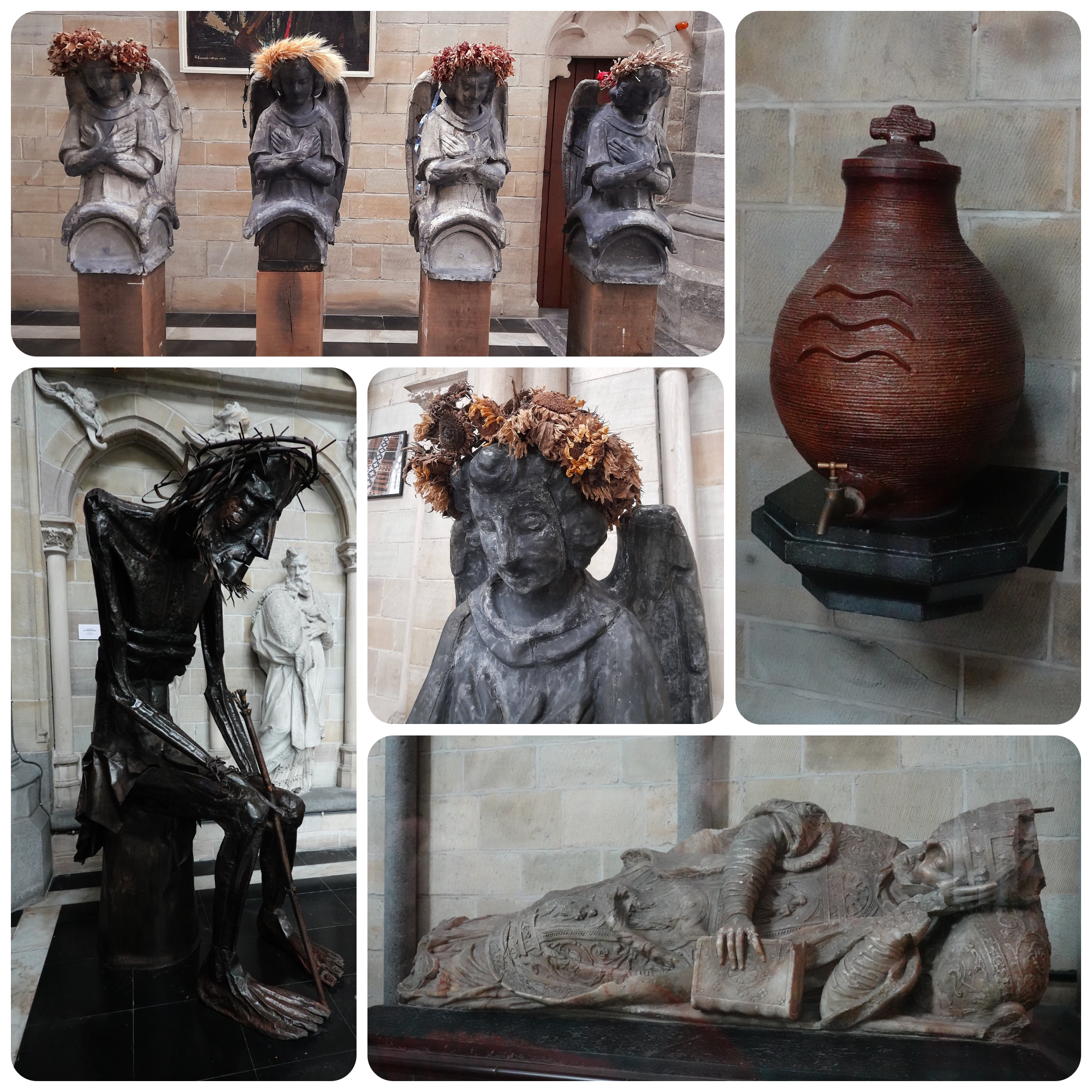
The wrought iron sculpture, The Suffering Christ by local artist Adhémar Vandroemme (1917-2009) is particularly haunting and has received its permanent place here since Good Friday 2018.

I loved the row of angels - dating from 1934 but looking much older than their 90 years - with their dried flower headdresses, and was intrigued by the barrel on the top right. Holy water on tap, perhaps?


Outside the drizzle still continued so we made our way back to the Market Place and around the corner to the Ypres Museum, which had a temporary exhibition going on called Vrij, Vrolijk en Vunzig (transl. Free, Jolly and Filthy), lauded as a multifaceted discovery of the Middle Ages.


I thought the layout was rather confusing and, combined with the fact that it was quite warm and airless inside the venue, I'm afraid we rather rushed through.

It boggles my mind that one was able to walk at all and not trip up wearing those long pointed shoes, called poulaines. Apparently all the rage for men, they originated in the 13th century and reached extreme proportions in the 15th century. The points became longer while jackets got shorter. Poulaines were highly impractical and demonstrated that you were a man of leisure.

The object on the bottom left is the runner of a so-called jaw sledge for children, which was made by mounting a wooden board on the lower jawbone of a horse. 


The drizzle had turned into full-blown rain when we left the museum so any further plans for the day were shelved. Instead, we returned to the car park via the shortest route, hoping that our car would still be there. Much to our relief it was!


The weather gods, however, were having the last laugh that day, parting the clouds for a September sunset, illuminating the hop fields across the road and the hills across the border in France.

And look who was patiently waiting at the bottom of the stairs for her dinner!


Wednesday, 1 May 2024

Oooh! Bruges

Hello, and welcome to the second installment of our Bruges adventures.

It was the morning of Thursday the 18th of April and the sun streaming in through our windows was making us all a giddy. We'd slept like the proverbial logs, so, well-rested and solar powered, we jumped out of our kingsize bed and, driven by the first stirrings of hunger pangs, got ready in record time.

Then we made our way from our room in the annex to the breakfast area in the B&B proper. 

As always, Veronique managed to spoil us rotten with her breakfast menu of fruit and yoghurt, followed by a choice of home-made bread, rolls and croissants, a selection of cheeses, charcuterie and smoked salmon and, of course, tiny pots of Veronique's mouth-watering jams.

Fuelled by a caffeine hit, we were then ready for anything the day would have in store for us!


The weather forecast for the day was for sunny and largely dry weather and highs of 12°C, which sounded nothing short of exotic after the chilly single digit temperatures of the last couple of days.

And so it was that Truus, our Dutch-speaking Satnav, guided us along secondary roads to Bruges and neatly deposited us in the huge underground car park at the 't Zand square. 

But wait: what about those dark and menacing clouds which had suddenly appeared on the horizon? Surely they were meant to take their liquid load elsewhere? By the time we'd parked our car and emerged in the daylight of the square, the bright blue sky we'd woken up to had been replaced by a blanket of dullest grey. What's more, a sea of open umbrellas greeted us once we'd stepped outside. 


Inwardly cursing, we ducked inside the Tourist Office located in the Concert Hall building on the square as we wanted to pick up the new Oooh! Bruges walking guide (above, top left). Then, after being reassured by the weather app on Jos's phone,  we opened our umbrellas, took deep breaths and braved the last of the rain.

We walked into the direction of the Market Square via the city's main shopping thoroughfare - still reasonable negotiable at 10.30 am - passing Saint Saviour's Cathedral (above, bottom left) and making a tiny detour around the square named after mathematician and physicist Simon Stevin (1548-1620). He invented the decimal system for fractions and created the mathematical basis for the construction of fortifications, and that's him up there on the plinth!


As we continued up the street and I pointed my camera upwards to photograph the exquisite façades rising above the shops, the patches of blue which had reappeared in the sky were multiplying until we were walking under a dome of bright blue dotted with strands of candy floss clouds.

Just then, as if by magic, the top of the belfry tower appeared behind the row of gables. Dating back to the 13th Century and standing 83 meters tall, the belfry is one of Bruges' most iconic and definitely most visible buildings.


Rounding a final corner, we arrived at the city's epicentre, the stunning Market Square. Dominated by the belfry and lined with magnificent neo-Gothic buildings and rows of picture perfect step-gabled houses, it was nevertheless the heaving crowd of tourists which instantly caught our attention. 


At the square's centre is the statue of Jan Breydel and Pieter de Coninck, who played leading roles in the Flemish resistance against the French in the 1302 Battle of the Golden Spurs. They seemed to be watching the throng of people milling around on the square and talking in a cacophony of languages with a healthy dose of disdain.

Sharing Jan and Pieter's sentiments, we couldn't get away fast enough. A glance at the belfry's clock told us we still had plenty of time for a wander before lunch. 


The belfry clock, by the way, is not the only means of telling the time on the Market Square. On top of House Bouchoute (above, top left) dating from 1482, is a sphere covered in gold leaf. When the Brussels-Ghent-Bruges railway line was opened in the 1830s, people noticed that not all Belgian clocks were synchronised. This, of course, was not conducive to a punctual timetable. The problem was solved by installing a noon hand and a noon line in various Belgian cities. In Bruges, this was done in 1837. Nowadays, the noon line is indicated with a line of copper nails on the square. When the shadow of the sphere falls directly on the 12 o’clock line, it is noon, or 12 o’clock local solar time.

Walking away from the square, we passed a chemist, its façade adorned with a veritable floral extravaganza (above, top right) as well as a Think Twice shop completely ignored by moi, until we reached the Royal City Theatre (1869) with its neo-Renaissance façade (1869), one of the best-preserved city theatres in Europe (above, bottom right).


In front of the theatre is a sculpture by Jef Claerhout (1937-2022) dating from 1980 and picturing the character ‘Papageno’ from Mozart’s opera ‘Die Zauberflöte’ (The Magic Flute). The sculptor 
represented the bird catcher Papageno dressed in a bird-like costume with wings and a bird’s head and long beak over his head. Papageno is holding pan pipes in his right hand, while a cage containing several, rather weird-looking, captured birds dangles from his belt.

You can find part of the opera's score etched on the pavement across the street. Last time we were here, in February 2023, we were treated to a rendition by my lovely friend Kezzie and her husband CBC! 


Once past the theatre, we took a right turn and strolled into the direction of the Jan van Eyck square, which ends quite abruptly at one of Bruges' picturesque canals. In fact, the Spiegelrei, as this stretch of canal is called, used to run where the square is now and was connected to the Dijver canal, which lies behind the Burg square. The square was named after the famous Flemish painter Jan Van Eyck (ca. 1390-1441), whose statue is looking out over the square towards the Poortersloge (Burghers' Lodge).


Turning our backs on the canal for now, we walked around the Burghers' Lodge, which was built between 1395 and 1417 and was commissioned by the commercial elite of the time, the patricians and merchants. In those days, this area was at the very centre of international trade. This was where ships were loaded and unloaded and traders could see their ships approaching from the tower.

Lunch time was approaching by now, but instead of retracing our steps, we took some back streets and  walked into the general direction of the Market Square. Well, that was the plan, but knowing us it was written in the stars that we would get lost at least once during our wanderings.


After much head scratching and consulting of maps, we eventually found ourselves at the Groenerei (Green Quay canal), whose cobbled quayside we followed until a view towards the belfry opened up - can you spot it in the photo on the top left ? - and we were back in tourist-land.


As usual, we were having lunch in one of the step-gabled restaurants lining the Market Square. In spite of only coming here once a year, our favourite waiter recognized us and not only welcomed us with open arms but treated us as royalty. 

While Jos was going for witloof in de oven, a classic Belgian dish featuring chicory rolled in ham and baked in the oven with mashed potatoes and a cheesy Béchamel sauce, I opted for pasta.


That morning, I'd been poring over the map and planning an itinerary for our afternoon walk away from the so-called Golden Triangle.

For this, we had to make our way to the Dijver canal and the Rozenhoedkaai (Rosary Quay), which must be the city’s most popular spot for photography and an Instagrammable hotspot. Once upon a time, rosaries were sold here but today it offers one of the city’s loveliest views. 

Consequently, it is always thronged with sightseers, with a constant stream of canal tour boats churning up the water, and the inevitable queues at the various landing stages.


Our walk took us along back streets until we reached the quiet Queen Astrid Park, its eyecatcher an ornate cast iron band stand dating from 1859, one of the oldest in the country, which was restored and repainted in its original colours in 2015.


Quite unexpectedly, we stumbled upon one of the many Godshuizen (Almshouses) in Bruges. These charitable dwellings were built from the 14th century onwards, set up by the guilds to lodge their elderly members, or by widows or well-to-do burghers who wanted to ensure their place in heaven.

Although they are usually oases of peace and quiet, the bench Jos was sitting on turned out to be a bit of a hazard with that lethal looking protruding bolt!


At the end of the street, the stretch of water called the Coupure awaited. We walked alongside moored barges until we reached the Groenerei (Green Quay canal) once more. Here, we crossed the street and walked along the Verversdijk (Dyers' Quay) where in medieval times, the famous Flemish cloth was dyed. 

In one of the side streets we caught a glimpse of the tower of the Jerusalem church (above, top left) which is part of the atmospheric Adornes Estate we visited back in 2023. See my post here, but do scroll down towards the end. 


We returned to the city centre via the peaceful Gouden-Handrei (Golden Hand canal), which was excavated in the 12th Century and was part of Bruges’ first city walls. 

This brought us back to the Burghers' Lodge and  Jan van Eyck square, where we sheltered from a sudden downpour.


Then, somewhat tired and in need of sustenance, we took deep breaths and dived into the crowds again until we reached a favourite tearoom. 

Surely we deserved those waffles after traipsing around Bruges all day?


It was too early to return to our car, but as Jos was tired on his feet, I proposed a visit to Saint Saviour's Cathedral, where he could have a sit-down while I wandered all around the church and took far too many photographs.


The cathedral is Bruges’ oldest parish church (12th–15th century) and has amongst its treasures a rood loft with an organ, medieval tombs, Brussels tapestries and a rich collection of Flemish paintings dating from the 14th to the 18th Century. 

The most fragile and precious of these works, which included paintings by Dieric Bouts, Hugo van der Goes and other Flemish primitives, are on display in the Treasury, the only part of the church where photography is not allowed.

There is no entrance fee to the church but collection boxes for its maintenance can be found at regular intervals.


Still reeling from all that splendour we finally rejoined our car and returned to Het Soetewater.

Before our evening meal which consisted of the remainder of that plentiful tapas board, there was time for some outfit photos. The Diolen dress I'm wearing was plucked from my Winter wardrobe and well-known to most of you as it's a regular on the blog. My mock croc boots have been awarded first prize for comfort after having been on my feet all day. Still, I wouldn't have minded exchanging them for sandals by now!


Please do join me again for the final installment in a couple of days!

See you soon!