Showing posts with label Ypres. Show all posts

Thursday, 2 October 2025

New adventures in the west

Hello, and welcome back to this year's September travelogue. 

Having been rudely interrupted by an August outfit catch-up which didn't exactly go as planned, my blogging mojo had temporarily deserted me. I'm grateful to the Blogger Team for taking my feedback seriously and removing the unjustified warning for sensitive content. 

So, back to the first week of September it is!


We woke up to a sunny but again quite windy morning on Tuesday the 2nd of September. 

The forecast was for highs of just 19°C with a high chance of rain in the afternoon.

After a botched attempt at fried eggs for breakfast (don't ask!), we were ready for another day of adventures. 


A leisurely 35 minute drive from our cottage, our chosen destination was border town Wervik. 

With the combined attractions of a nature reserve and a museum, it's astonishing that we've never visited the town before in the 14 years that we've been holidaying in this part of Belgium.

Wervik is one of the oldest towns in Belgium, going back to the Romans, who called it Viroviacum.

During the First World War, the town was occupied by the German Army for four years. Wervik was for the Germans what Poperinge was for the British: a place to rest, behind the lines.


However, the town's greatest claim to fame lies in a very different direction: tobacco! 

Once Belgium's main tobacco-growing region, today only a handful of tobacco fields remain.

Happily, the story of the industry's past has been preserved in the National Tobacco Museum, which was part of our reason for visiting the town. The museum has been housed in the annexes of an 18th-century windmill called the Briekenmolen - which you can see in the first collage - since 1987. A new, modern wing was added in 2003.


Wervik has had a long tradition as a tobacco-growing region. In fact, tobacco has been cultivated here since around 1650. 

The industry experienced a boom in the 18th century. As France levied very high excise duties on tobacco, the town's situation near the border made it the perfect operating base for smugglers!


Today, over 98% of Belgian tobacco is still produced here, but its heyday has definitely come to an end as tobacco cultivation is no longer profitable, particularly due to the gradual reduction in EC subsidies given to Belgian tobacco farmers.


Apart from the history of tobacco, and how it conquered the world, the museum also charts the history of smoking as well as other, forgotten forms of tobacco use.

The advert on the top left actually encourages young men to start smoking a pipe as it was beneficial for both one's heart and one's purse strings. How times have changed!


There's also a reconstruction of a tobacconist’s shop from the 1920s and a very covetable collection of advertising signs from a bygone age.

Although both non-smokers - Jos has never smoked in his life and I quit nearly 30 years ago - we found the museum interesting and endlessly fascinating.


It was well past midday by the time we'd finished our tour, so the on-site retro café, In den Grooten Moriaen, was beckoning us with its lunch menu and extensive choice of non-alcoholic beers. We would return to this delightful café, which was clearly frequented by tourists and locals alike, for a shared waffle and our customary cappuccinos in the afternoon.


The sun was still shining in a patchy blue sky when we made our way to the back of the museum towards the footbridge leading into nature reserve De Balokken.

The straightening of a bend in the River Lys (Leie in Flemish) in 1990 resulted in the formation of a 36-hectare island which is nestled between two arms of the river. It was laid out as a varied landscape park with footpaths and a boardwalk through a marshy area.


France lies on the other side of the river and, in fact, a small part of the island is French territory. 

I'd downloaded a walk from the town's tourist website, which would take us into France after crossing the little footbridge you can see on the centre right in the below collage. According to the walk's instructions, we would then be able to walk along the river's towpath on the French side and return to Belgium via the main bridge a little further on.


The instructions, however, turned out to be outdated as, crossing the footbridge, we had no choice but to keep walking along a path which was fenced off on both sides, until we reached the outskirts of the French village called Wervicq-Sud.

Neither the village nor the rapidly darkening sky were appealing to us, so that we decided to return to the island and, ultimately, to the cozy café for the aforementioned waffle and cappuccinos.

But not before admiring some local artwork (above, centre left and bottom right). And my outfit, of course: I was wearing my linen blend embroidered Zara skirt again, this time combined with a charity shopped yellow patterned long-sleeved t-shirt and my denim jacket from Think Twice.


It finally started raining while we were driving back to the cottage and apparently we couldn't get away fast enough as we received a speeding ticket about two weeks later! Oh well ...

On Wednesday the 3rd, the weather that greeted us as we opened our curtains was a bit of a letdown. The blustery wind and granite grey sky weren't exactly spurring us into action, so that we stayed in bed a bit longer until we'd decided on our plans for the day.

After eggs and soldiers for breakfast, we drove to Ypres, about twenty minutes up the road from our holiday home. Unlike last year, finding a parking spot was a doddle, as we left our car in the edge of town car park we'd ultimately stumbled upon last year.


It was still dry by then, and we were even treated to a couple of short-lived sunny spells. Still, we decided to walk to the town centre the direct way instead of taking the 2,6 kilometer ramparts walk.

Our first port of call was St. George's Memorial Church. The church was designed by architect Sir Reginald Blomfield and built to commemorate the over 500,000 British and Commonwealth troops who died in the three battles fought for the Ypres Salient during the Great War. It was completed in 1929.


Walking through the Kloosterpoort (Cloister Gate) across the square, the stone garden of the Lapidarium is reached. Lying in the shadow of St. Martin's Cathedral, it contains the older ruins of St. Martin’s monastery and cloisters. One of the few remaining ruins in the town centre, the Lapidarium is a permanent reminder of the destruction caused by the First World War.

The Cloister Gate (above, top left), which dates from about 1780, was one of the few structures which was not completely demolished by the end of the war. It was still standing while almost everything around it was reduced to piles of rubble.


It had started drizzling by now so, still a tiny bit too early for lunch, we took refuge inside St. Martin's Cathedral, whose entrance lies around the corner from the Lapidarium.


No matter how many times we've visited, we can't help but being impressed by it sumptuous and lofty interior. It's rather mind-boggling that the cathedral, which like most of the brave city of Ypres was in ruins after the war, was actually completely rebuilt in the 20th Century!


Lunch was had at a brasserie called In het Kleine Stadhuis, which is tucked into the corner of the main square, next to the Cloth Hall. 

It had started raining in earnest while we were waiting for the bill, but had virtually stopped by the time we were back outside. Not for long though. In fact, it would be raining on and off for the rest of the afternoon.


Thankfully we'd come armed with our umbrellas - mine a poppy one I'd actually bought here in Ypres back in 2017 - so out they came. 

The Menin Street - which leads towards the impressive Menin Gate - was suitably decorated with garlands of filigree umbrellas.


The largest memorial to the First World War, the Menin Gate is the spot where the Last Post has been sounded every evening at 8 o’clock since 1928.

This memorial, which is in the form of a Roman triumphal arch, and was designed - again - by Sir Reginald Blomfield, displays the names of 54,896 soldiers of the then British Empire who went missing in action. It lists the names from the beginning of the war until 15 August 1917.


One cannot be but moved by those interminable lists of names carved into the stone of the walls and the surrounding loggias.

After a two-year restoration project designed to bring the monument back to its best in time for its centenary in 2027, the Menin Gate was re-opened to the public earlier this year. It now has a living roof’ with vegetation planted on top as part of a new waterproofing system.


In spite of the stormy weather conditions, we decided to walk back to the car park the long way, via the delightful ramparts walk, which can be accessed from the Menin Gate.

The sign in the centre of the collage made me smile. For my non-Dutch speaking readers, the word Ergens translates as Somewhere ... 

The somewhere we were going to was back to our cottage!

I'll be back with further adventures soon.


Saturday, 21 September 2024

City of patience

I had it all planned so well. After publishing my first travel post last Sunday, I would be making a start with the second one on Monday evening after work, selecting photos and assembling a couple of collages each day, ultimately finishing and publishing the thing on Friday. 

Well, what can I say? Courtesy of a stressful week, which left me tired and uninspired, things didn't quite work out that way. Other than catching up with blogland, everything else was put on the back burner until at last I made a half-hearted start with browsing my photos on Wednesday. The first batch of collages was made on Thursday, while the rest followed on Friday. And that's before I was able to put pen to paper, so to speak. 

In other words, it soon became clear that there was no way I'd be meeting my self-imposed deadline, so thank you for your patience and for bearing with me.


Unfortunately, this wasn't the only plan that went awry! 

Originally, a trip across the border to France was on the menu for Tuesday the 3rd of September. However, one look through our window confirmed the forecasted weather for that day. The sky was sulking and denying the sun a look-in. What's more, according to our phone's weather app there would be rain on the horizon.

The day's highs of 23°C didn't sound too bad, though, so I selected my linen-blend Zara skirt (Vix has its twin!) from my travel capsule and paired it with a charity shopped short-sleeved King Louie jumper.


My travel capsule also contained a selection of accessories, which have found the perfect home in this gorgeous patchwork washbag, a present from my lovely friend Claire. I just had to take a picture of it sitting on our balcony's railing and send it to her!

Seeing our plans for our trip to France thwarted once more, we opted for a visit to Ypres. Only twenty minutes up the road, the town has has plenty of wet weather options if needed. So, after breakfast, we kindly asked Truus, our Dutch-speaking Satnav, to take us the free car park at the town's station.

Although we've used this car park many times before, it just wasn't our lucky day. As all available spaces seemed to be taken, we started driving around in circles until a kind local directed us to another car park which admittedly she wasn't sure was still in use. According to her directions we would have to pass a level crossing, which strangely enough we never did. But then our patience finally paid off and we were able to park our car on a largely abandoned plot with weeds growing between its cobbles, where we joined a handful of other cars and some mobile homes. It had actually taken us longer to find parking space than it did to drive over to Ypres!


Crossing the road, we soon arrived at one of the entrances to the ramparts. These are among the best preserved in the country and now provide a green belt which garlands most of the historic town centre.

Although taking the main roads leading to the town centre would have taken us a mere 15 minutes or so, the 2,6 kilometer walk which meanders along the ramparts makes for a much more pleasant approach.

Almost instantly, remnants of the First World War can be found in a pair of British pillboxes, concrete structures with loopholes through which weapons could be fired. It is thought that the name "pillbox" derives from their similarity to the kind of circular cardboard box in which chemists of the time supplied pills.


Soon afterwards we came across the Peace Bridge. Opened in April 2023 and constructed from weathering steel, its guard rails are artistically embellished with the word "peace" in 86 languages: a statement of universal tolerance reinforcing Ypres’s message of peace.

The path then meanders past lakes and ponds, which are the remains of the moat, and the walk is an absolute delight: a perfect blend of nature and history, with the odd work of art thrown in.


Initially, the ramparts were little more than an earth wall with a moat. Later, stone walls and towers were added, until it was developed into a complex structure with bastions, advance redoubts, moats and walls.

In the photos (above, top left, and below, bottom left and right), Jos is standing on the edge of the Predikherentoren (Preacher's tower), which wasn't something vertigo-suffering me was quite comfortable with. 

If it doesn't look much like a tower, it's because in the French era both of the towers which were part of the 14th century Burgundian ramparts were lowered and transformed into artillery platforms.


A modern set of stone steps descends to the bottom of the tower. After having been closed off for many years, we were delighted to find the entrance gate once again opened to the public. You can spot a Lilliput yours truly (above, top left) snapped by Jos with his phone's camera. It's a good thing I'd had the presence of mind to wear a bright orange cardigan!


Idyllically situated on the banks of the moat is Ramparts War Cemetery, a small British cemetery where 198 Commonwealth soldiers, of which 188 are identified casualties, are resting.

From February 1915 to April 1918 Ramparts Cemetery was used by Commonwealth Forces. Most of the casualties buried here were killed in February, March and April and then in July and August of that year. The casualties from 1917 include a number of Australian and New Zealand soldiers.


This is just one of the literally hundreds of military cemeteries which arose in Flanders Fields after the First World War, reminding us of the staggering human toll the conflict took.


As always after having visited one of these moving sites, it was in a somewhat subdued frame of mind that we continued our walk. In these beautiful surroundings, however, nature soon managed to soothe our souls.

As we neared our destination, we came across the entrance to an ice house, a Madonna and Child in a cobwebbed shrine, a sculpture of Tibeert the cat and Reynaert the fox - characters from a major work of Middle Dutch literature dating from 1250 - and an Indian Memorial dedicated to the 130.000 troops of the Indian Forces who served in Flanders during the Great War. Oh, and there was a playful red squirrel too!


The Ramparts Route ends at the iconic Menin Gate, the sight of which always halts us in our tracks. This time, however, we were totally unprepared to see the Memorial covered in scaffolding. Designed by Sir Reginald Blomfield and unveiled on 24 July 1927, it is undergoing a two-year restoration programme, started in April 2023.

Here and here you can see what it looked like on some of our previous visits.


Having finally reached the town centre, our first priority was filling our rumbling stomachs and find a place to have lunch. Obviously, there's plenty of choice on and around the Market Place, but we opted for Café Les Halles, where we'd eaten on our last visit in September 2021. 


Popular with both tourists and locals on their lunch break, we needed to exercise patience as we had a rather long wait until our food arrived. This was somewhat redeemed, however, by our view of the newly renovated Cloth Hall, not to mention the fact that Jos's favourite alcohol free beer was on the menu.


After 18 months of renovations which were completed earlier this year, the front of the Cloth Hall can once again be admired in all its glory 

The Cloth Hall was built in the Gothic style in the 13th century and epitomised the wealth generated by the cloth industry that was heavily reliant on the wool trade with England. One of Europe's largest Gothic civil buildings, it served as a covered market and storage depot for Flemish cloth, a fabric prized across the continent.

The building - as in fact was most of the town - was completely destroyed during the First World War when the city stood at the heart of the Great War battlefields. It was rebuilt after the conflict and only completed as recently as 1967.  


She was a city of patience; of proud name,
Dimmed by neglecting Time; of beauty and loss;
Of acquiescence in the creeping moss.
But on a sudden fierce destruction came
Tigerishly pouncing: thunderbolt and flame
Showered on her streets, to shatter them and toss
Her ancient towers to ashes. Riven across,
She rose, dead, into never-dying fame.
White against heavens of storm, a ghost, she is known
To the world's ends. The myriads of the brave
Sleep round her. Desolately glorified,
She, moon-like, draws her own far-moving tide
Of sorrow and memory; toward her, each alone,
Glide the dark dreams that seek an English grave.

- Laurence Binyon, Ypres, 1918 - 


It was when we were proceeding towards the Cloth Hall after lunch that it started drizzling. We ducked inside the passage running under the Cloth Hall, emerging on the other side in front of the Gothic St. Maartenskathedraal (St. Martin's Cathedral). Admiring its soaring interior, it's almost impossible to believe that the church - which like the Cloth Hall was reduced to rubble after the war - was actually completely rebuilt in the 20th Century!


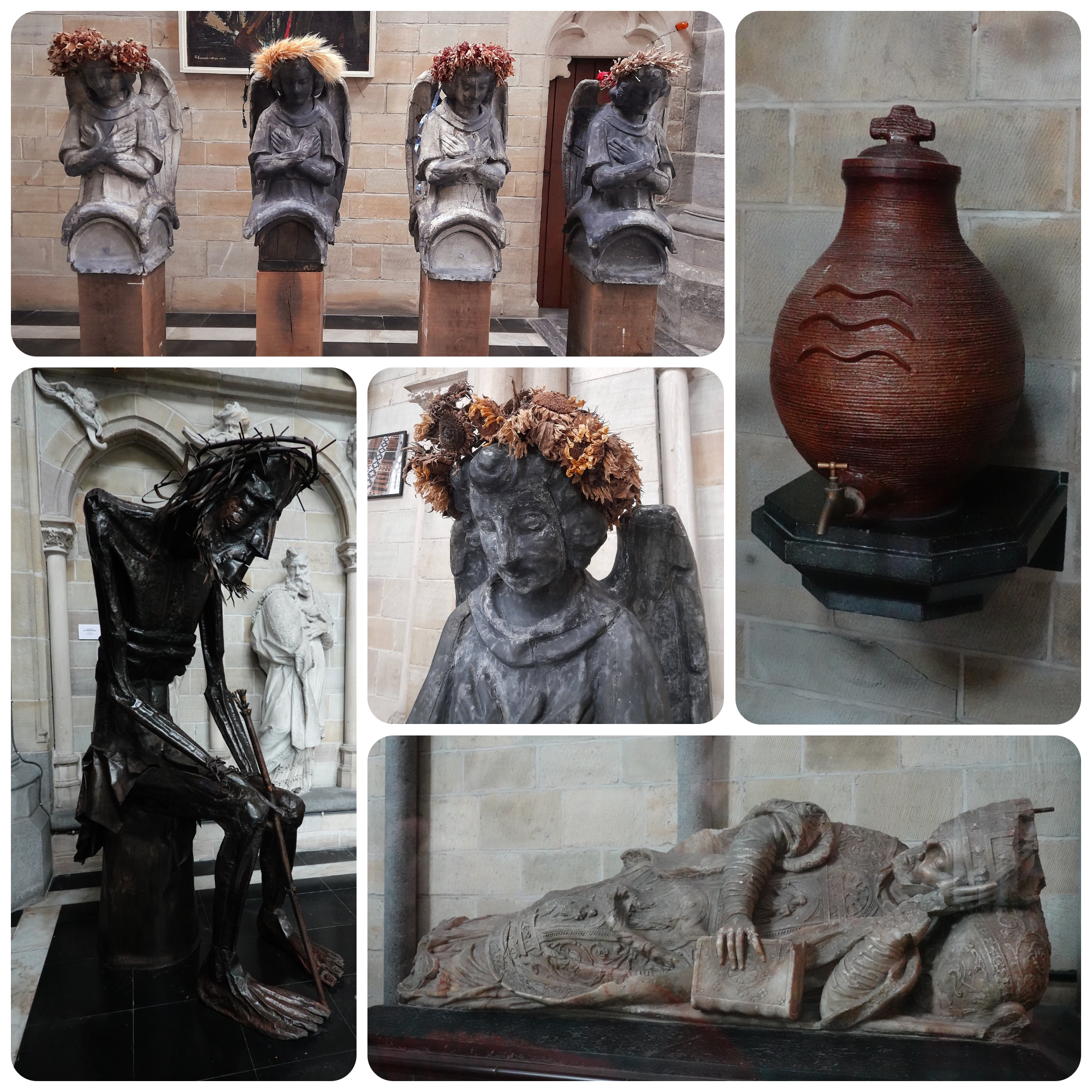
While Jos took a breather, me and my camera explored the church and marvelled at its glorious architectural details as well as the modern artwork which was on display.

The wrought iron sculpture, The Suffering Christ by local artist Adhémar Vandroemme (1917-2009) is particularly haunting and has received its permanent place here since Good Friday 2018.

I loved the row of angels - dating from 1934 but looking much older than their 90 years - with their dried flower headdresses, and was intrigued by the barrel on the top right. Holy water on tap, perhaps?


Outside the drizzle still continued so we made our way back to the Market Place and around the corner to the Ypres Museum, which had a temporary exhibition going on called Vrij, Vrolijk en Vunzig (transl. Free, Jolly and Filthy), lauded as a multifaceted discovery of the Middle Ages.


I thought the layout was rather confusing and, combined with the fact that it was quite warm and airless inside the venue, I'm afraid we rather rushed through.

It boggles my mind that one was able to walk at all and not trip up wearing those long pointed shoes, called poulaines. Apparently all the rage for men, they originated in the 13th century and reached extreme proportions in the 15th century. The points became longer while jackets got shorter. Poulaines were highly impractical and demonstrated that you were a man of leisure.

The object on the bottom left is the runner of a so-called jaw sledge for children, which was made by mounting a wooden board on the lower jawbone of a horse. 


The drizzle had turned into full-blown rain when we left the museum so any further plans for the day were shelved. Instead, we returned to the car park via the shortest route, hoping that our car would still be there. Much to our relief it was!


The weather gods, however, were having the last laugh that day, parting the clouds for a September sunset, illuminating the hop fields across the road and the hills across the border in France.

And look who was patiently waiting at the bottom of the stairs for her dinner!


Wednesday, 29 September 2021

West Side Story, Part 4

Time marches on relentlessly. Summer has made way for Autumn and in just a matter of days the calendar's page will be turned to October.

Apart from those which appeared in the episodes of my travelogue, I haven't shared any September outfits with you yet, nor did I tell you about the exciting life (NOT!) I've been leading since we came back from our holidays. Nevertheless, all this will have to wait another couple of days, while I regale you with another post of holiday adventures.

Although the previous episode ended on the afternoon of Wednesday the 8th of September, the day's excitements weren't finished just yet. As we happened to glance through our cottage's front door window, we saw that hop picking had commenced in the field across the road. The one I'd posed in only that morning! 

As usual, as the evening progressed, the resident sheep were joined by a fluffle of bunnies. Yes, that really is the collective noun for them!


Now let's move swiftly to Thursday! If the weathermen were for once to be believed, it would be a slightly cooler day, the temperature struggling to reach the mid-twenties, and with a strong possibility of rain towards the end of the afternoon.

Hoping the forecasted change of weather would have prevented the worst of the crowds of flocking to the seaside, that was our destination for the day sorted! So, off we went to De Panne, the nearest Belgian seaside resort to Poperinge, just under 35 kilometers away.


Having found ourselves a spot on a free car park just outside the town centre, we proceeded towards the promenade, where we soon spotted the colourful candy-striped cabins and parasols typical for this resort. 

It was busier than we'd expected but probably not much more so than on previous September visits. Not being very good with crowds to put it mildly, Covid-19 certainly seems to have exacerbated my dislike of them. What crowds, I can hear you thinking, there hardly seems to be anyone about! Well, I just happen to be an expert in framing my photographs just so that it seems as if we had the place practically to ourselves! The odd gull notwithstanding, obviously ...


Like most of the Belgian coastline, De Panne's skyline is marred by ugly apartment buildings to cater for the tourists and second-homers. Pranged between these, and holding on for dear life, are some delightful villas from a bygone age. 


After a stroll along the promenade, we were ready for a spot of lunch at De Kursaal, a long-time favourite whenever we come to De Panne. Originally one of the oldest hotels on the promenade, built in the 1870s, Grand Hotel du Kursaal was completely rebuilt after its destruction in the second war, the floors above the restaurant converted into yet more apartments. 

As a nod to our seaside rendez-vous, Jos was wearing a sailing boat patterned shirt ...


... while I honoured the occasion by wearing a lobster patterned top!

In spite of the sea breeze, it soon got too warm for the jackets we were originally wearing, especially when seated behind the glass screens enclosing De Kursaal's beach terrace. I had a most delicious fish gratin, which was served in a boat shaped dish! 


Our plan for the afternoon was a walk along the beach into the direction of France - De Panne is the final Belgian resort before the French border - as it is much quieter there, away from the hustle and bustle of the promenade. 

Our first mission, though, was to go and buy a hat, as once again I'd left mine behind in the car. Available in a range of colours, I went for this jaunty orange one!


The tide was coming in, and after a game of tag with the rolling waves, we soon had to desert what was left of the beach and make for the safety of the sea dyke. 

Meanwhile, ominous looking clouds with a definite promise of rain were advancing from France so, quickening our steps, we hurried back to our car, driving off just as the first raindrops were spotting our windscreen. 


The rain had turned into a veritable deluge by the time we reached Poperinge, where we waited until the worst had passed while parked opposite the town's charity shop.

In spite of its small size, we always seem to strike lucky here. This time, half an hour's rummage yielded two blouses - the one I'm wearing a King Louie - a red raffia belt, a blue wooden beaded necklace and a copper and turquoise cuff. There was also a retro tin for our kitchenalia collection and a delightfully kitschy plaster statue of Our Lady of St. Jan, local to Poperinge. 


The weather forecast on Friday was quite uncertain and after a bit of dithering we decided that our best bet would be a day trip to Ypres. Not having visited this poignantly beautiful town for a couple of years, we were looking forward to reacquainting ourselves with its delights and perhaps indulge in a spot of shopping.

Sadly, our decision turned out to be a big mistake!

Having parked at the railway station, we walked towards the town centre when, just before reaching the Market Place, we were halted in our tracks by a huge hole in the road where extensive sewer works were taking place. But that wasn't all. There were road and construction works everywhere we turned, the Cloth Hall's magnificent belfry was covered in scaffolding and the Market Place itself was cordoned off due to a car show! 


We comforted ourselves with a spot of retail therapy, buying a poppy tapestry bag and wooden poppy brooch at the In Flanders Fields Museum shop. Then we had lunch at one of the restaurants lining the Market Square. Catering for the many British tourists who used to visit here pre-Covid, fish and chips was on the menu, so this is what I went for. And quite delicious it was too!


The morning's disappointments were somewhat redeemed by walking back to the railway station the long way, taking the designated footpath along the town's ramparts and moat. 

It was a lot busier than usual here too. As luck would have it, a three-day music festival taking place on the outskirts of Ypres was about to go off to a start that day, and we met several groups of youths making their way into town from the railway station. 

The same festival made us drive around in circles on our way home, as quite a few roads were closed off. To add insult to injury, the town's charity shop where we briefly stopped for a rummage turned out to be rather disappointing as well.


By the time we finally made it back to Marjolein the sun had decided to put in an appearance after all, offering the perfect opportunity for outfit photos on the balcony.

The new-to-me zig-zag skirt I wore earlier that week was now accompanied by a red and white floral top by Belgian retro label Wow To Go, which I think I once bought in the sales, and the red raffia belt I found in the charity shop in Poperinge.


A slate grey sky and a steady drizzle greeted us on Saturday morning. As there was no let-up in sight by mid-morning, we abandoned our plans of going for a local walk and, after checking their website to see whether we needed to book ahead, we set off for a visit Talbot House in Poperinge instead. 

Talbot House was founded in 1915. During World War I, Poperinge was used as a garrison town for the British soldiers, with thousands of soldiers passing through the town each day when going to and returning from the front;


Thus, Talbot House was opened as a club house for all soldiers, regardless of rank, by chaplain Philip "Tubby" Clayton. For many, this place became their home away from home. "An oasis of serenity in a world gone mad", is probably the best way to describe it.

This being our 10th stay in the area, it obviously wasn't out first visit to the house and its garden, but it definitely was as hauntingly moving as ever.


For the afternoon, we'd booked a tour at a hop farm in the neighbouring village of Proven, where we were initiated into the secrets of hop growing.


’t Hoppecruyt is a modern hop farm growing 11,5 hectares of environmentally friendly hops. 

The harvest is dried and pelletized on the premises, and as we were visiting during hop picking season, we were able to see part of that process up close.


Jos was delighted to learn that his favourite beer, the alcohol-free version of Brugse Zot, is made with hops grown at this particular farm! 

At the end of the visit we were offered a free beer from the range produced with the local hops, while farmer's wife and tour guide Benedikte regaled us with an old hop picking song accompanied on accordion.


In continuation with the beer theme, our final port of call for the day was Malt Tower St. Joris in Reningelst, another one of Poperinge's satellite villages. 

Built in 1913, the brewery malt house now offers exhibition space, as well as a magnificent panorama of the village and the West Flemish hills from its viewing platform.

As a nod to the weather, I was wearing my floral trousers from New Look again, this time combined with a sage green Breton top and a coral polka dot cardigan. 


Quite windy it was, as you can see ...

I hope you'll join me again on our final day, followed by some of the promised September outfits, in my next post!