Tuesday the 18th of June looked set to be another day of endless grey skies. Those who are supposed to be in the know spoke of highs of around 15°C, but it felt much colder than that. I was reduced to wearing multiple layers again but even topped with my relatively wind-proof orange leather jacket and with my scarf wrapped around my neck I would be feeling the cold all day.
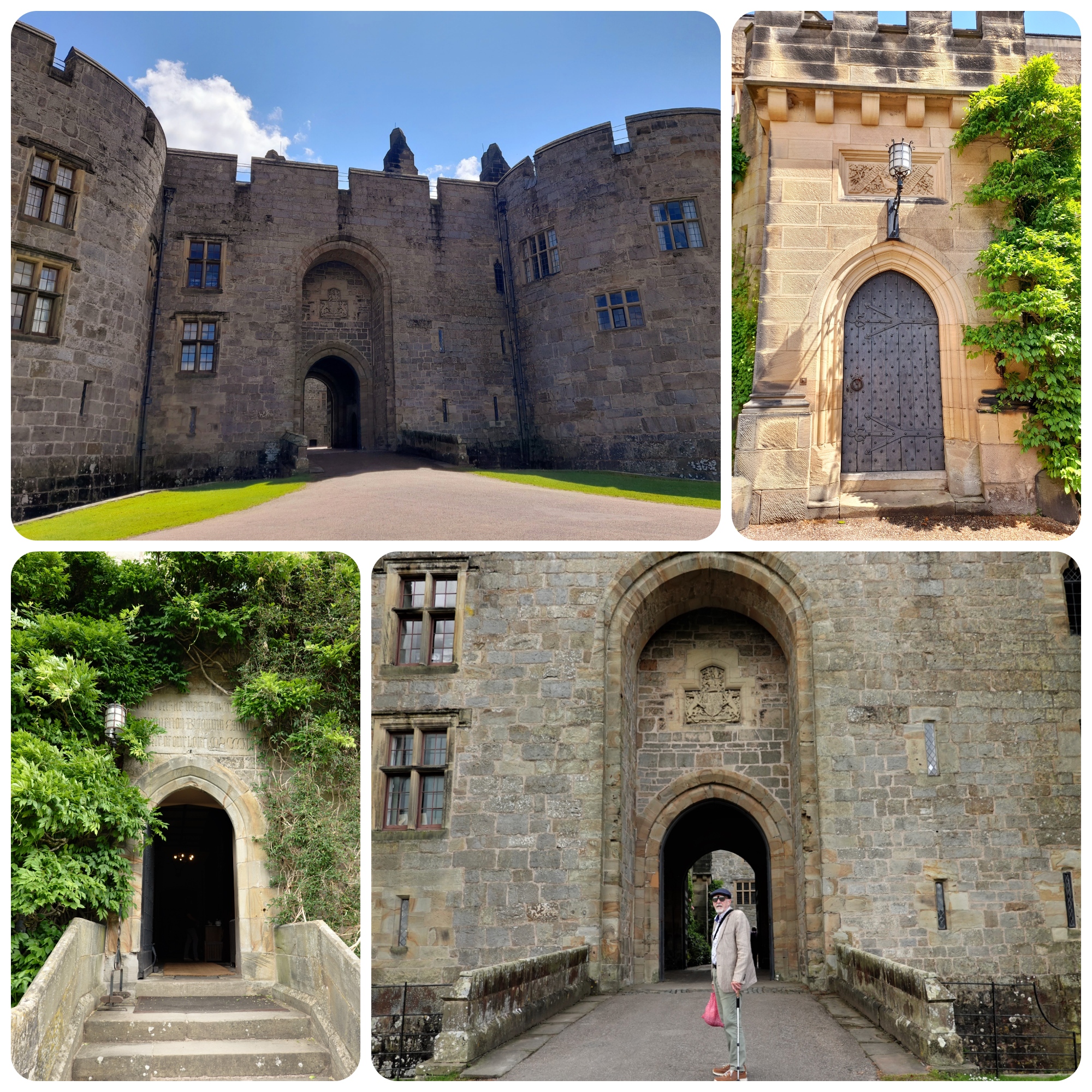
The journey to the day's chosen destination, the National Trust owned Erddig, a Grade-1 listed property set in a 486-hectare (1,200-acre) landscape park near Wrexham in North Wales, takes about an hour and a quarter. If traffic allows and there aren't any roadworks to cause disruption, that is, so consequently lunch time wasn't far off when we finally arrived.

We milled around the estate buildings and stable yard, browsed the second-hand bookshop, earmarking a couple of likely candidates to pick up later, and had a nosey at Erddig's collection of carriages from a bygone ages before making our way to the Hayloft restaurant to grab a bite to eat.

Next up was a tour of the house, which here at Erddig begins with the "downstairs", or servants' quarters, hinting at the unusual relationship between "upstairs" and "downstairs" at Erddig. The Yorke family seems to have regarded their servants with affection and recognized them as individuals to be celebrated and recorded for posterity. As a result, there's an astonishing number of servants' portraits lining the walls.
Hanging under some of the now silent servants’ bells is the Erddig Prayer. It hints at Philip Yorke I’s (1743-1804) horror of fire, but also suggests the concern that the family showed for everyone who lived and worked on the estate:
‘May Heav’n protect our home from flame,
Or hurt or harm of various name!
And may no evil luck betide to any who therein abide!
As also, who their home have found
On any acre of it’s ground,
Or who from homes beyond it’s gate
Bestow their toil on this estate!’
– P.Y.

We wandered along and through a series of carefully preserved rooms capturing life below stairs in the early 20th century. However, we couldn't help but notice that a lot of these were cordoned off, and thus could only be viewed from the doorway, which we don't remember being the case at the time of our first visit back in 2018.

Architecturally one of the grandest rooms at Erddig is the so-called New Kitchen, which was built in the early 1770s and was originally completely detached from the rest of the house, due largely to Philip Yorke I's fear of fire. By the 19th century, however, a linking block had been built and the windows on the north wall were blocked in to form cupboards.
The room is dominated by the large Venetian window on the east side (below, bottom right) and three great rusticated arches on the south, the centre one housing the range, installed ca. 1900 (above, top right).

A little bit of history before we proceed upstairs.
Erddig Hall was originally constructed in the 1680s for Joshua Edisbury, High Sheriff of Denbighshire, but Edisbury overstretched himself and by 1709, he was bankrupt. Erddig was subsequently bought by John Meller, a wealthy London lawyer, in 1716. He extended the house and in 1733 passed it on to his nephew, Simon Yorke.

This began an unbroken line of ownership which lasted for nearly 250 years. The last Yorke, Philip Yorke III, died in 1978. Unmarried and childless, he'd begun negotiations with the National Trust, who took ownership in 1973 and began a four-year restoration project.
On this day marred by inclement weather, I wouldn't have minded installing myself in the cosy library and selecting a book from its well-filled shelves. I loved it that the calendar on the desk (above, top right) is correctly showing the day's date as the 18th of June!
One of my favourite objects at Erddig, however, is the 19th century shower (below, top centre and right), which worked by releasing hot water from the cylindrical tank supported on pipes painted to imitate bamboo. The water was then recirculated by use of the handpump. It was still very much in use in the last Philip Yorke's day!

Erddig's is a fully restored 18th-century garden, with trained fruit trees, exuberant annual herbaceous borders, avenues of pleached limes, formal hedges and a nationally important collection of ivies.
The gardens and parkland were largely the work of landscape designer William Emes, who worked at Erddig from 1768-1780. Emes created gravelled walks, planted many trees which are still thriving today, and manipulated the flow of water across the park through a series of cascades and weirs, including the unusual "Cup and Saucer" water feature which we first laid eyes on back in 2018.

Unfortunately, plans for another glimpse of the latter and a walk around the estate needed to shelved due to the unfavourable weather conditions. As our multiple layers were no match for the blustery wind, we limited ourselves to a visit to the kitchen garden and its Victorian glasshouses.
Here, our eye was caught by a miniature Erddig fit for insects. We also took a shine to the gorgeous little thatched summer house elsewhere in the garden.

We ended our visit by warming ourselves up with cups of cappuccino and picking up the books which had piqued our interest in the second-hand bookshop that morning.

Although the temperature was on the up again on Wednesday the 19th, we were initially disappointed to be met with grey skies once more when we got up that morning. But lo and behold, Mme. Soleil decided to grace us with her presence after all! In fact, she was already showing us her pretty little face while we were having breakfast.
We were making a return visit to Shrewsbury and, as opposed to the previous week's debacle, finding the Park & Ride's entrance was now a doddle.

We were planning to do some sightseeing rather than shopping ... so what was the first thing we did? Well, we could hardly pass by the Shrewsbury Antiques Centre in Princess Street without going in for a mooch, could we?
We spent a happy half-hour or so browsing the myriad of stalls and needless to say we didn't leave empty handed, our finds being this vintage dress and the carved jade brooch (above, third from left).
We then proceeded along Mardol towards the river, making a detour to Memory Lane Antiques and Vintage on Roushill, where I purchased two more brooches: the enamelled ones on the far left and right. Apparently, the shop would be moving to new premises on Mardol mid-July which must have been quite an undertaking as it is literally crammed full of treasure,

Having arrived at the River Severn, we made our way to the local Wetherspoon's, The Shrewsbury Hotel, where we ordered lunch. Mine was a small fish and chips, while Jos opted for bangers and mash, which he assured tasted pretty good but looked so unappealing that I didn't take a photo.

Then we strolled along Victoria Quay towards the 29-acre parkland called The Quarry and the sunken garden - The Dingle - which lies at its heart. Here we sat and watched the world go by for a while before leaving at the garden's town end.

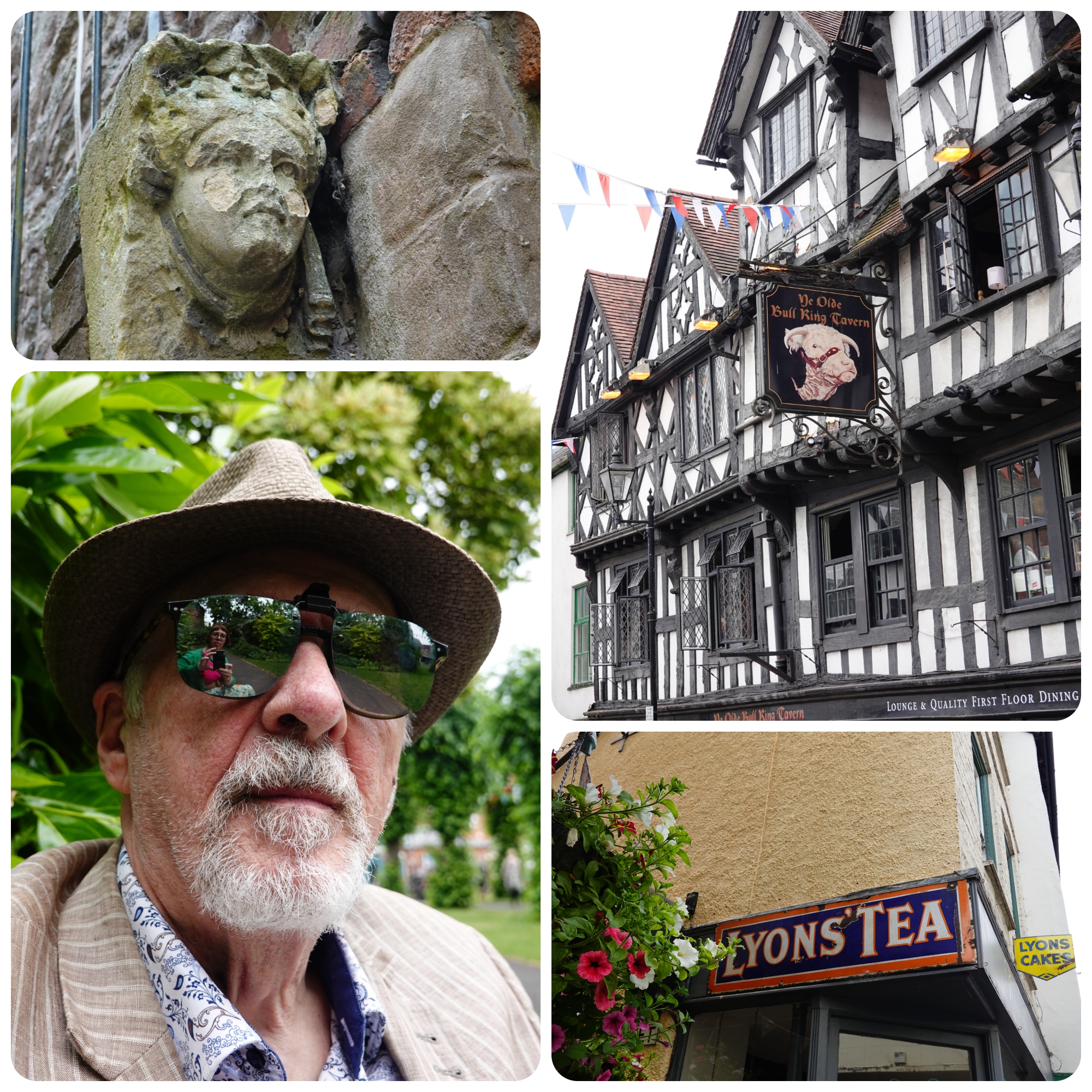
Across the road, we spotted the distinctive round shape and high tower of St. Chad's, which was built in 1792 and is a well-known landmark of the town.
I love the atmospheric wild and unkempt churchyard which lies at its back, its overgrown gravestones including one bearing the name Ebenezer Scrooge (above, top right). This is a prop left over from the filming of "A Christmas Carol" in 1983 but is still a magnet for tourists and locals alike. At the time of our visit, a small group of giggling school girls was making its way towards it.

St. Chad's is a classical church, but one with a difference: its nave is completely round! The interior is light, bright and uncluttered. Slender white columns made of local cast iron support a gallery that sweeps right round the church.
The stunning Arts & Crafts style pulpit in copper and brass (above, top right), which dates from 1892, caught my attention in particular.
Apparently, the stained glass window in the sanctuary (above, bottom left) is a copy of Rubens' "Descent from the Cross" in Antwerp's cathedral, which I'm not sure the gentleman I got talking to - who might possibly have been a church warden - was aware of, particularly as he turned out to be quite ignorant about Belgium.

Before making our way to the Park & Ride bus stop, we strolled through the award-winning Market Hall and sat down for coffee and cakes in the Bird's Nest café.
My final brooch of the day, the jewelled tree, was picked up from one of the stalls on the gallery upstairs.
As for my outfit, I was wearing a cotton maxi dress by the London based Louche label bought in the closing-down sale of a pop-up shop back in February. Not only did it receive many compliments, it was an absolute joy to wear.

If Wednesday's 20°C had made us all giddy, we couldn't believe our luck when the weather gods cranked up the thermostat to 23°C on Thursday.
We decided to make use of our National Trust passes one more time, ticking off no less than five properties visited, and saving us a whopping £ 54 on entrance fees!

We would be making another return trip, this time driving south of the border into Herefordshire to visit Berrington Hall, a fine Georgian mansion which sits within Capability Brown’s final garden and landscape.
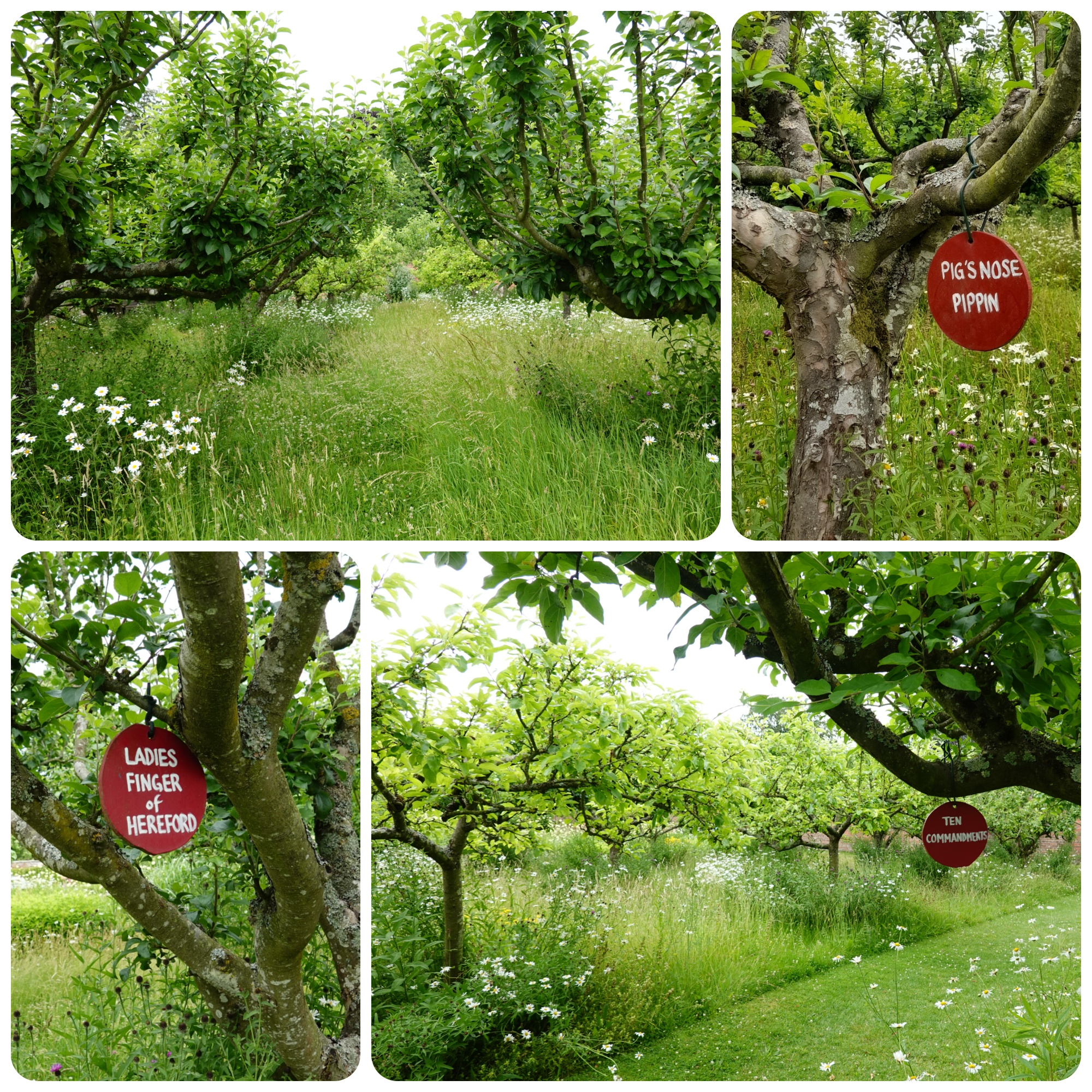
Just like it did on our previous visit last year, the walled garden delighted us with its mix of glorious herbaceous borders, kitchen garden and orchard, the latter's heritage apple and pear trees standing knee-deep in wildflowers.
The wicker "mantua" (two collages above, top left) is a new addition, a reference to the property's show piece, a magnificent mid-18th century court mantua or formal gown acquired by the Trust in 2016.

After lunch at the Old Servants' Hall tea-room, we decided to stretch our legs and go for a walk in Berrington's Capability Brown designed parkland. Berrington was the culmination of his life's work. He was appointed by Thomas Harley in the 1770s to lay out a park and make the most of the spectacular Herefordshire views west towards Wales and the Black Mountains.

We selected the Red Walk, a gentle stroll down to and around the lake. Herons were nesting on a wooded island in the lake, which is home to one of the largest heronries in the West Midlands. At one point we spotted one on a gate post in front of us, only for it to fly off into the direction of its nest on the island.

No longer used to these extreme +20°C, we needed some time to cool off before a whirlwind visit to the house proper. However, much to our disappointment, the servants' quarters which were last year's undisputable highlight weren't open that day.
Our final round of refreshments at the café was curtailed by a fire drill, even if we were among the lucky ones who had almost finished their drinks!

But that wasn't the day's final adventure!
Just after turning off the A489 and onto our 2-mile single-track lane which eventually takes us to the cowshed, a dead-end lane leads off to the right, with a brown tourist sign pointing towards the 12th century Myndtown church. We must have passed that sign dozens of times over the years, but had never made the effort to check it out until now.

St. John the Baptist church at Myndtown dates from the 12th century or perhaps even earlier. It is considered to be unique as a country church, not only within Shropshire but within the whole country, as it was not spoilt by Victorian restoration and thus retains its thoroughly rural, simple look and feel.
Once a substantial medieval village, the hamlet of Myndtown, which lies at the end of the dead-end lane at the foot of the dramatic Long Mynd, now only contains the former rectory and a farmhouse with its barns. Interestingly, in 1066, Myndtown had a value three times that of Birmingham!
Services continue to be held here on a monthly basis - except in March, because that's lambing season!

And then, inescapably, our last day dawned. The weather gods had decided to commiserate with us by treating us to a moody day with a considerable drop in temperature.
In order to try and cheer myself up, I was wearing an aubergine Breton top and handmade floral skirt, both of which were charity shopped in Shrewsbury.
Our plans for the day were quite laid-back and involved a rummage in the handful of charity shops in Church Stretton, about half an hour from the cowshed. Finds were few and far between, but included the brooch on the right. I picked up its red sister at Memory Lane Antiques and Vintage in Shrewsbury last year and although I don't remember its price, it was definitely quite a bit more than the £ 1,50 I paid for the green one.
So, that was it, Shropshire 2024. I'm missing those views from the cowshed already ...