And so the last day of our holiday dawned on Friday the 23rd of June.
Upon drawing the cowshed's curtains, it instantly became clear that the weather gods had decided to commiserate with us, having prepared a grey canvas of a sky and even shedding a few tears. Now, although we could definitely have done without the latter, we were adamant not to let the weather nor the inevitable last-day-of-the-holiday blues, spoil the day.
In order to occupy our minds and fill our hearts with gladness instead of sadness, we were off to make use of our National Trust Touring Pass one final time and visit the 8th property of our two-week stay.
We even left Shropshire behind, crossing the border into Herefordshire. Our property of choice: Berrington Hall, a Neo-classical mansion about 3 miles from Leominster, set in Capability Brown's final landscape and gardens.
A steady drizzle accompanied us on our way up and still persisted while we were parking our car, so we took our umbrellas with us. I'm pleased to report, however, that they never made it out of the bag Jos was carrying them in.
There was the usual excitement about our Touring Pass at the ticket office, the person in charge taking the opportunity to explain the procedure to a trainee.
Having finally been admitted, our first port of call was the Walled Garden, which we entered through the ornamental gate on the bottom left in the first collage. Rabbits were once again denied entry so we were admonished to make sure to close the gate behind us.
The National Trust has recently launched an ambitious campaign to conserve Capability Brown's rare surviving Walled Garden, which was built of warm red brick in an unusual horseshoe shape.
Like many kitchen gardens, it fell into disuse during the Second World War, but it still contains flower borders, an orchard of historical local varieties of apple, and an extensive vegetable plot, which continue to serve the needs of the house.
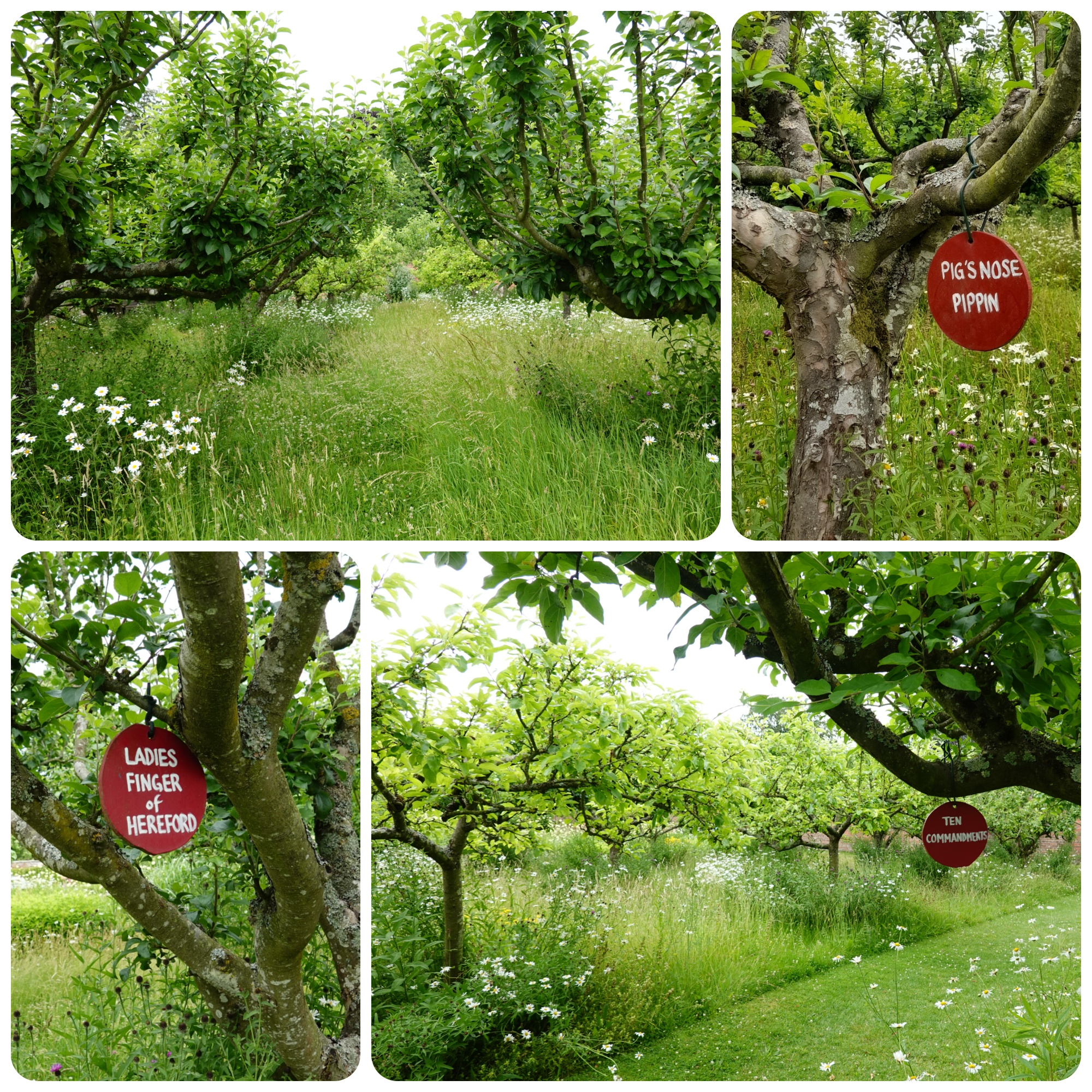
However glorious the flower borders were, it was the orchard which particularly enchanted us.
Herefordshire is historically famous for its orchards, so it's only fitting that heritage varieties of apples that have fallen out of modern cultivation have been replanted here. We loved wandering around on the pathways cut through the meadow grass and wildflowers - No Mow May had apparently been continued well into June here - and delight in the apples' often weird and wonderful names.
What about Pig's Nose Pippin, Ladies Finger of Hereford, or Maiden's Blush?
And no, Jos wasn't tired already. Nevertheless, he made sure to enjoy one of the famous National Trust deckchairs for a final time this year.
With forecasted highs of 20°C, I'd started out wearing both a cardigan and my denim jacket, but I'd already removed the latter by then, sufficiently warmed up by excitedly darting around the garden.
My denim maxi skirt from Think Twice got another outing, this time combined with a pink short-sleeved thin knit jumper (a retail sales bargain), a green wooden necklace by Les Cordes by way of a charity shop, and my beloved bargain-of-the-century Clarks Cloudsteppers.
Reluctantly tearing ourselves away from the garden - and making sure we closed that gate behind us - we made our way towards the courtyard at the back of the mansion. Here, a set of stone steps leads down to the Servants' Quarters in the basement.
Always a favourite part of our visits to such properties, we loved exploring where the butler, footmen, housekeeper and maids worked, offering a sense of what working life was like for people in service during the Georgian period and beyond.
The wooden sink is where the maids would wash up and, according to the label attached to the tap, it was designed to reduce the risk of chipping or cracking the expensive tableware used upstairs.
I particularly loved the fascinating array of quirky old-fashioned cures which would have been kept by the housekeeper.
Although I won't be keeping an onion as a cure for baldness, the cures for noise of the ears and giddiness might come in handy. But even if Dr. Quincy recommended the slimy juice of snails as a cure for weakness and consumption in the 18th century, the mere thought of snail water or syrup of snails is enough to make me feel ever so slightly faint!
Back on ground level, we decided it was time for a spot of lunch, so we purchased egg and cress sandwiches from the tea-room in the Old Servants’ Hall.
After eating these outside on the courtyard terrace, we rounded the corner for a visit to the mansion proper.
Berrington Hall was created as a country retreat more than 230 years ago for city banker and businessman, Thomas Harley and his wife Ann Bangham, who wanted to escape to the country. After buying the estate in 1775, Harley commissioned Capability Brown to lay out the park, which has spectacular views west towards Wales and the Black Mountains.
In 1778 he also called in Brown’s son-in-law, Henry Holland, to design him a new house in the latest French-influenced Neo-classical style.
There's quite a contrast between the red sandstone exterior, which is austere and deceptively plain, and the richly decorated light and elegant interior.
The interior is characteristic of Holland’s refined Louis XVI style which, not having visited Paris until after the completion of Berrington Hall, he gleaned from the illustrations in contemporary French Neo-classical pattern books.
Holland brought in the finest craftsmen: there was a specialist painter and slater, carver and gilder, and even a scagliolist from Italy. Scagliolia was a technique for making plasterwork columns, sculptures and other such features resemble more expensive stones such as marble.
The blue marbled columns in the boudoir (above, top left and right) and those in the Staircase Hall with their Corinthian capitals (below, top and bottom right) are perfect examples.
The Staircase Hall is the core of the house, rising through its full height to the domed skylight above.
Henry Holland was a master of dramatic staircases and the Staircase Hall at Berrington Hall is amongst his most spectacular achievements. It is a cantilever staircase, meaning it appears to be unsupported, and the stair rises clockwise around three sides of the room, while the fourth is spanned by a shallow arch.
One of the jewels in Berrington's collections is the magnificent mid-18th century court Mantua or formal gown, which came up for auction in 2016. Because it was described as having belonged to Ann Bangham, wife of the Hon. Thomas Harley, it was bought for Berrington.
The fabric is cream ribbed silk brocade with coloured silk and gold threads woven through it, and is in extremely good condition. Indeed, it may have been worn only once, probably at court, as Thomas Harley served as a Privy Councillor to King George III.
The deconstructed Mantua gown arrived at Berrington Hall in 10 pieces. To understand its construction and structure, the team at Berrington commissioned Michelle Barker of The Georgian Costume Company to make a replica, before their own conservators carefully reconstructed the original.
Several Mantua replicas are on display on the first floor, together with a handful of replicas of other gowns believed to have been worn by Ann Bangham, in an exhibition called 'A Dress Fit for a King'.
There are dress-up opportunities galore, which obviously we were unable to resist!
Back outside, we contemplated going for one of the waymarked walks on the estate but in the end we decided against it, vowing we would come back for these next year.
Instead, we sat ourselves down on a bench overlooking the undulating sweep of grassy parkland with the lake shimmering in the distance. We were starting to feel a bit maudlin by now ...
Nevertheless, we thought one final round of shortbread and cappuccinos wouldn't hurt!
So, that was it. We packed our bags that evening and set our alarm clock for early the next morning, when we reluctantly said goodbye to the cowshed for another year.
As we'll be going on another adventure in about a week's time, I'll be starting another series of travelogues very soon. However, before we go, I'll be squeezing in another catch-up post, in which you'll be glad to note I'm slowly but surely starting to feel like my old self again.
See you soon!