Showing posts with label Shrewsbury. Show all posts

Wednesday, 7 August 2024

Two stately homes and a Shrewsbury stroll

Tuesday the 18th of June looked set to be another day of endless grey skies. Those who are supposed to be in the know spoke of highs of around 15°C, but it felt much colder than that. I was reduced to wearing multiple layers again but even topped with my relatively wind-proof orange leather jacket and with my scarf wrapped around my neck I would be feeling the cold all day.

The journey to the day's chosen destination, the National Trust owned Erddig, a Grade-1 listed property set in a 486-hectare (1,200-acre) landscape park near Wrexham in North Wales, takes about an hour and a quarter. If traffic allows and there aren't any roadworks to cause disruption, that is, so consequently lunch time wasn't far off when we finally arrived.


We milled around the estate buildings and stable yard, browsed the second-hand bookshop, earmarking a couple of likely candidates to pick up later, and had a nosey at Erddig's collection of carriages from a bygone ages before making our way to the Hayloft restaurant to grab a bite to eat.


Next up was a tour of the house, which here at Erddig begins with the "downstairs", or servants' quarters, hinting at the unusual relationship between "upstairs" and "downstairs" at Erddig. The Yorke family seems to have regarded their servants with affection and recognized them as individuals to be celebrated and recorded for posterity. As a result, there's an astonishing number of servants' portraits lining the walls.

Hanging under some of the now silent servants’ bells is the Erddig Prayer. It hints at Philip Yorke I’s (1743-1804) horror of fire, but also suggests the concern that the family showed for everyone who lived and worked on the estate:

‘May Heav’n protect our home from flame,
Or hurt or harm of various name!
And may no evil luck betide to any who therein abide!
As also, who their home have found
On any acre of it’s ground,
Or who from homes beyond it’s gate
Bestow their toil on this estate!’
– P.Y.


We wandered along and through a series of carefully preserved rooms capturing life below stairs in the early 20th century. However, we couldn't help but notice that a lot of these were cordoned off, and thus could only be viewed from the doorway, which we don't remember being the case at the time of our first visit back in 2018.


Architecturally one of the grandest rooms at Erddig is the so-called New Kitchen, which was built in the early 1770s and was originally completely detached from the rest of the house, due largely to Philip Yorke I's fear of fire. By the 19th century, however, a linking block had been built and the windows on the north wall were blocked in to form cupboards.

The room is dominated by the large Venetian window on the east side (below, bottom right) and three great rusticated arches on the south, the centre one housing the range, installed ca. 1900 (above, top right).


A little bit of history before we proceed upstairs.

Erddig Hall was originally constructed in the 1680s for Joshua Edisbury, High Sheriff of Denbighshire, but Edisbury overstretched himself and by 1709, he was bankrupt. Erddig was subsequently bought by John Meller, a wealthy London lawyer, in 1716. He extended the house and in 1733 passed it on to his nephew, Simon Yorke. 


This began an unbroken line of ownership which lasted for nearly 250 years. The last Yorke, Philip Yorke III, died in 1978. Unmarried and childless, he'd begun negotiations with the National Trust, who took ownership in 1973 and began a four-year restoration project.

On this day marred by inclement weather, I wouldn't have minded installing myself in the cosy library and selecting a book from its well-filled shelves. I loved it that the calendar on the desk (above, top right) is correctly showing the day's date as the 18th of June!

One of my favourite objects at Erddig, however, is the 19th century shower (below, top centre and right), which worked by releasing hot water from the cylindrical tank supported on pipes painted to imitate bamboo. The water was then recirculated by use of the handpump. It was still very much in use in the last Philip Yorke's day!


Erddig's is a fully restored 18th-century garden, with trained fruit trees, exuberant annual herbaceous borders, avenues of pleached limes, formal hedges and a nationally important collection of ivies. 

The gardens and parkland were largely the work of landscape designer William Emes, who worked at Erddig from 1768-1780. Emes created gravelled walks, planted many trees which are still thriving today, and manipulated the flow of water across the park through a series of cascades and weirs, including the unusual "Cup and Saucer" water feature which we first laid eyes on back in 2018.


Unfortunately, plans for another glimpse of the latter and a walk around the estate needed to shelved  due to the unfavourable weather conditions.  As our multiple layers were no match for the blustery wind, we limited ourselves to a visit to the kitchen garden and its Victorian glasshouses.

Here, our eye was caught by a miniature Erddig fit for insects. We also took a shine to the gorgeous little thatched summer house elsewhere in the garden.


We ended our visit by warming ourselves up with cups of cappuccino and picking up the books which had piqued our interest in the second-hand bookshop that morning.


Although the temperature was on the up again on Wednesday the 19th, we were initially disappointed to be met with grey skies once more when we got up that morning. But lo and behold, Mme. Soleil decided to grace us with her presence after all!  In fact, she was already showing us her pretty little face while we were having breakfast.

We were making a return visit to Shrewsbury and, as opposed to the previous week's debacle, finding the Park & Ride's entrance was now a doddle.


We were planning to do some sightseeing rather than shopping ... so what was the first thing we did? Well, we could hardly pass by the Shrewsbury Antiques Centre in Princess Street without going in for a mooch, could we? 

We spent a happy half-hour or so browsing the myriad of stalls and needless to say we didn't leave empty handed, our finds being this vintage dress and the carved jade brooch (above, third from left). 

We then proceeded along Mardol towards the river, making a detour to Memory Lane Antiques and Vintage on Roushill, where I purchased two more brooches: the enamelled ones on the far left and right. Apparently, the shop would be moving to new premises on Mardol mid-July which must have been quite an undertaking as it is literally crammed full of treasure,


Having arrived at the River Severn, we made our way to the local Wetherspoon's, The Shrewsbury Hotel, where we ordered lunch. Mine was a small fish and chips, while Jos opted for bangers and mash, which he assured tasted pretty good but looked so unappealing that I didn't take a photo. 


Then we strolled along Victoria Quay towards the 29-acre parkland called The Quarry and the sunken garden - The Dingle - which lies at its heart. Here we sat and watched the world go by for a while before leaving at the garden's town end. 


Across the road, we spotted the distinctive round shape and high tower of St. Chad's, which was built in 1792 and is a well-known landmark of the town. 

I love the atmospheric wild and unkempt churchyard which lies at its back, its overgrown gravestones including one bearing the name Ebenezer Scrooge (above, top right). This is a prop left over from the filming of "A Christmas Carol" in 1983 but is still a magnet for tourists and locals alike.  At the time of our visit, a small group of giggling school girls was making its way towards it.


St. Chad's is a classical church, but one with a difference: its nave is completely round! The interior is light, bright and uncluttered. Slender white columns  made of local cast iron support a gallery that sweeps right round the church. 

The stunning Arts & Crafts style pulpit in copper and brass (above, top right), which dates from 1892, caught my attention in particular.

Apparently, the stained glass window in the sanctuary (above, bottom left) is a copy of Rubens' "Descent from the Cross" in Antwerp's cathedral, which I'm not sure the gentleman I got talking to - who might possibly have been a church warden - was aware of, particularly as he turned out to be quite ignorant about Belgium.


Before making our way to the Park & Ride bus stop, we strolled through the award-winning Market Hall and sat down for coffee and cakes in the Bird's Nest café. 

My final brooch of the day, the jewelled tree, was picked up from one of the stalls on the gallery upstairs. 

As for my outfit, I was wearing a cotton maxi dress by the London based Louche label bought in the closing-down sale of  a pop-up shop back in February. Not only did it receive many compliments, it was an absolute joy to wear.


If Wednesday's 20°C had made us all giddy, we couldn't believe our luck when the weather gods cranked up the thermostat to 23°C on Thursday.

We decided to make use of our National Trust passes one more time, ticking off no less than five properties visited, and saving us a whopping £ 54 on entrance fees!


We would be making another return trip, this time driving south of the border into Herefordshire to visit Berrington Hall, a fine Georgian mansion which sits within Capability Brown’s final garden and landscape.

Just like it did on our previous visit last year, the walled garden delighted us with its mix of glorious herbaceous borders, kitchen garden and orchard, the latter's heritage apple and pear trees standing knee-deep in wildflowers.

The wicker "mantua" (two collages above, top left) is a new addition, a reference to the property's show piece, a magnificent mid-18th century court mantua or formal gown acquired by the Trust in 2016.


After lunch at the Old Servants' Hall tea-room, we decided to stretch our legs and go for a walk in Berrington's Capability Brown designed parkland. Berrington was the culmination of his life's work. He was appointed by Thomas Harley in the 1770s to lay out a park and make the most of the spectacular Herefordshire views west towards Wales and the Black Mountains.


We selected the Red Walk, a gentle stroll down to and around the lake. Herons were nesting on a wooded island in the lake, which is home to one of the largest heronries in the West Midlands. At one point we spotted one on a gate post in front of us, only for it to fly off into the direction of its nest on the island. 


No longer used to these extreme +20°C, we needed some time to cool off before a whirlwind visit to the house proper. However, much to our disappointment, the servants' quarters which were last year's undisputable highlight weren't open that day.

Our final round of refreshments at the café was curtailed by a fire drill, even if we were among the lucky ones who had almost finished their drinks! 


But that wasn't the day's final adventure! 

Just after turning off the A489 and onto our 2-mile single-track lane which eventually takes us to the cowshed, a dead-end lane leads off to the right, with a brown tourist sign pointing towards the 12th century Myndtown church. We must have passed that sign dozens of times over the years, but had never made the effort to check it out until now.


St. John the Baptist church at Myndtown dates from the 12th century or perhaps even earlier. It is considered to be unique as a country church, not only within Shropshire but within the whole country, as it was not spoilt by Victorian restoration and thus retains its thoroughly rural, simple look and feel.

Once a substantial medieval village, the hamlet of Myndtown, which lies at the end of the dead-end lane at the foot of the dramatic Long Mynd, now only contains the former rectory and a farmhouse with its barns. Interestingly, in 1066, Myndtown had a value three times that of Birmingham!

Services continue to be held here on a monthly basis - except in March, because that's lambing season!


And then, inescapably, our last day dawned. The weather gods had decided to commiserate with us by treating us to a moody day with a considerable drop in temperature.

In order to try and cheer myself up, I was wearing an aubergine Breton top and handmade floral skirt, both of which were charity shopped in Shrewsbury.

Our plans for the day were quite laid-back and involved a rummage in the handful of charity shops in  Church Stretton, about half an hour from the cowshed. Finds were few and far between, but included the brooch on the right. I picked up its red sister at Memory Lane Antiques and Vintage in Shrewsbury last year and although I don't remember its price, it was definitely quite a bit more than the £ 1,50 I paid for the green one.

So, that was it, Shropshire 2024. I'm missing those views from the cowshed already ...


Monday, 15 July 2024

A day on the tiles

It's been a bit of a hectic week since I last posted here, with most of it taken up by the demands of my day job as well as the preparations for yesterday's flea market. I'll be telling you all about the latter in a future post, but for now let's once again set the time machine's satnav to last month's Shropshire holiday.

By Friday morning - we were the 14th of June by now - all traces of the previous evening's stormy weather had gone, although it was still a grey sky which greeted us when we drew the curtains. Fully expecting a repeat of Thursday's rainy weather and seriously under par temperatures, I dressed warmly, adding one of the pairs of Snags from Vix's goody bag, as well as my black and white dotty Phase Eight raincoat. The latter was bought on a similarly rainy day in at Church Stretton charity shop back in 2018.


With my raincoat, at least I matched some of our destination's black and white half-timbered architecture, but with highs of about 17°C, I didn't need all the layers this time around!

We'd chosen Shrewsbury as a shopping destination that day, and as always we were fully planning to make use of the town's excellent park and ride facilities, the nearest to the cowshed being Meole Brace. So, imagine our consternation when after negotiating the rather tricky roundabout at Meole Brace Retail Park we found the car park's entrance closed. After fruitlessly driving around in circles and asking one or two locals for directions, we finally made it to the new entrance to the south of the retail park and made it onto the waiting bus with minutes to spare.


Not expecting delays, we'd once again made a late start, so that it was almost midday when we got off the bus at The Square. From here, we hurried along into the direction of the post office on Pride Hill, as it was due to close at 1 pm. Here, we were faced with another setback in the form of a long and slowly proceeding queue, which was serviced by a single, flustered-looking employee. But there was nothing for it but to play the waiting game - something I'm notoriously bad at - as I'd brought along some books to post to Vronni! 

Then, after a quick lunch at the nearby M&S café, we were ready for a rummage at the town's numerous charity shops. I was on the lookout for long-sleeved tops in particular - note to Beate: it being or supposed to be Summer, there weren't any decent woollen jumpers to be had. Apart from a couple of t-shirts for layering purposes, a short-sleeved jumper and an aubergine Breton top I found these two peasant-style blouses, from Zara (top left) and M&S (bottom right) respectively.


There was also a new-with-tags Cath Kidston bag as well as no less than eight brooches, three of which were picked up from the delightful Mummas Emporium below.

Touted on Facebook as Shrewsbury's latest best kept secret and located  above Vision Express on Pride Hill, it's a cozy café and antiques shop combined. We enjoyed our customary cappuccinos with yummy sticky Belgian chocolate cake, which obviously we just needed to taste.


We then trudged up to the Park & Ride bus stop further along on Pride Hill, where we had a chat with a lovely lady during the rather long wait.

Saturday looked set to be a total washout and it was so dark that we needed to have breakfast with the lights on. When finally at around 10.30 the rain started petering out, we made a dash for our car and entered the day's destination into our satnav.


During the 50 minute or so drive it took us to get to Jackfield, in the Ironbridge Gorge, not only did it stop raining, we were even treated to one or two sunny spells.

Nevertheless, our journey wasn't exactly a smooth one, as it took us on seriously pot-holed roads and through the odd minor flood. To say that we were in need of some caffeine by the time we arrived at the Jackfield Tile Museum is quite an understatement.


Apart from a couple who had just ordered some toasted sandwiches, we were the only customers. However, with only one guy being in charge of everything, it took absolutely ages before we'd been served with our coffees and a shared slice of Victoria sponge. We thanked our lucky stars that we'd had the foresight to bring a picnic, so that we wouldn't have to starve to death while waiting for lunch to be dished up!


Appropriately caffeinated, we then pushed our way through the double doors leading to the museum proper and started our explorations.

We were urged to check out the old offices first, where we made use of an old-fashioned telephone to listen to the accounts of former employees.


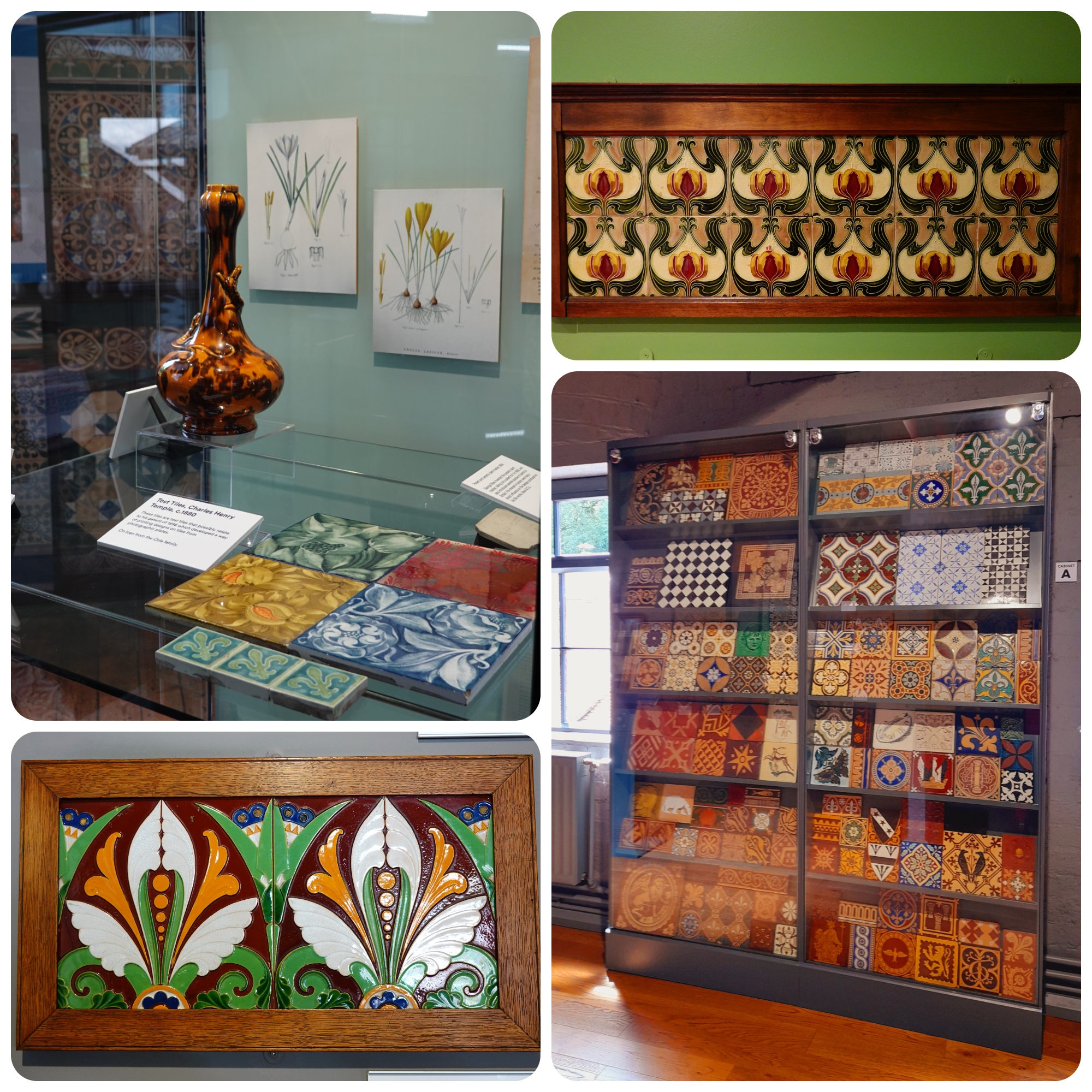
The museum is housed within the premises of Craven Dunnill, a working tile factory which is still producing decorative tiles on site to this day. It showcases the British decorative tile industry between 1840 to 1960, the era which was the heyday of Craven Dunnill and its neighbours Maw & Co. 


After giving up its Jackfield premises, Craven Dunnill moved to nearby Bridgnorth in 1950. The Ironbridge Gorge Museum Trust purchased the site in 1983 and tile manufacture restarted at Jackfield in 1989, with Craven Dunnill taking over the business again in 2001.


The museum lies in the village of Jackfield, near Broseley, on the south bank of the River Severn in the Ironbridge Gorge, the birthplace of the Industrial Revolution, and now a World Heritage Site. It is one of ten Ironbridge Gorge museums administered by the Ironbridge Gorge Museum Trust.


Jackfield Tile Museum is a treasure-trove of British ceramic design, fabulously curated and displayed in period room settings and beautiful galleries where the tiles are clearly labelled, both by period and style.

Like the Victorian Radicals exhibition we visited a couple of days prior, there was so much to take in that this definitely won't be our last visit.

I'm sure you won't be surprised that the Arts & Crafts tiles and ceramics, and particularly those produced by William de Morgan (including Antelope, ca. 1880, above, bottom right) were my absolute favourites.


One of the highlights of the museum is the collection of around 1700 tiles donated to the museum in 2013 by John Scott (1935-2020), who had been collecting Victorian tiles since the 1960s. Apparently, there's a book about the John Scott tile collection, which I definitely must seek out.


The museum also has some faithfully recreated premises, like a traditional butcher's shop (above, top left), a church interior (above, bottom left) and a Victorian pub with its curved tiled bar (below), all showcasing the creative use of tiles in the Victorian era.


The iconic glazed tiles used in several London tube stations — Covent Garden among them — were produced at this site, so it was only natural that this mock platform was included in the exhibits. 


The museum also has a huge room full of historic moulds, which enables the company to recreate the designs and thus assist with restoration works at historical properties. 


Some of the machinery and equipment used in tile-making, as well as the remains of the ancient kiln, can be viewed outside in the courtyard.

If you noticed the absence of other visitors in the photos, this time it definitely wasn't the result of my patience. In fact, we often had the rooms completely to ourselves!


By then, the sun was out in full force and had made short shrift with the remaining rain clouds. As we had our picnic waiting in the car, that's where we were headed, taking pity on the handful of people who were making their way to the Peacock Café.

Before heading to our next destination, less than ten minutes up the road, here's a little hint in the form of one of the tiles I photographed in the museum!


It is in fact the famous Iron Bridge, in a small town of the same name, which lies on the River Severn, at the heart of the Ironbridge Gorge. The town developed beside and took its name from the 30-meter cast iron bridge which spans the gorge.


Opened in 1781, it was the first major bridge in the world to be made of cast iron. Its success inspired the widespread use of cast iron as a structural material, and today the Grade I listed bridge is celebrated as a symbol of the Industrial Revolution.


In 1934 it was designated a scheduled monument and closed to vehicular traffic. Tolls for pedestrians were collected until 1950, when the bridge was transferred into public ownership. 

Having previously visited here in 2019, we reacquainted ourselves with the town, photographing the bridge, which was restored to its former glory in 2017 and 2018, from all angles. We even ended up kissing under the iron bridge (a reference to the Smiths' song, Still Ill - here on YouTube), something we neglected to do back in 2019.


After wandering around the town and having a peek in a tiny bric-a-brac shop selling vintage Craven Dunnill and Maw & Co. tiles at eye watering prices, we finished our visit with - you guessed it - cups of cappuccino, before travelling back to the cowshed by way of those potholed roads.


The day ended as it had begun, with torrential rain, which would last until half-way through the night.

And I'm ending this post as it began too, with a peek at my outfit. I was wearing the same denim midi skirt and the same mock croc ankle boots. My blouse is from the Belgian Who's That Girl label by way of a charity shop and my orange stretchy belt - a retail buy - was last seen here on our trip to Birmingham with Vix and Jon.

Although I've obviously got a couple more travel posts up my sleeve, I might take a brief break from them by a catch-up of what else has been happening in my life and what I've been wearing lately. 

See you soon!


Friday, 4 August 2023

The Shrewsbury loop

Are you sitting comfortably? Then please do fasten your seatbelts, as I'm taking you on a short trip in the time machine, back to the second week of our holiday in June.

For any new readers, or those joining me from outer space, we were in Shropshire, our holiday cottage being a former cowshed in a remote valley in the shadow of the Long Mynd, a heath and moorland plateau which is part of the Shropshire Hills.


It was Tuesday, the 20th of June, and the rain which had done its best to throw several spanners in the works when we were visiting Chirk Castle on Monday, had reached our little valley overnight and had been overstaying its welcome.

There was a brief lull in the downpour when Jos peaked through the curtains just before 5 am. The rain had left a veil of low-hanging cloud in its wake which effortlessly blotted out the landscape beyond the garden. The sun was doing its best to participate in the first light of day, adding to the otherworldly view in the process.


Soon we could hear the rain beating down on the cowshed's roof and lashing against our bedroom windows again and there seemed to have been no let-up by the time we dragged ourselves out of our bed a couple of hours later.

The landscape had been washed clean of any lingering snippets of mist but was otherwise looking quite dismal and bedraggled, the only sign of life two sad-faced rabbits sheltering beneath the hedge.


On the menu that day was a shopping trip to Shrewsbury, Shropshire's county town, and one of England’s finest medieval market towns.

Not all that far from the cottage as the crow flies, it still took us well over half an hour on a myriad of country lanes before we reached the main road leading into the town. As usual, we availed ourselves of its excellent Park and Ride service after tackling a rather tricky roundabout to get there.

The rain had eased off by the time we'd arrived, parked our car and made a run for the bus whose idling motor indicated that it was about to leave. In our haste, however, we forgot our umbrellas in the car, so that we could only hope for the best, the worst case scenario being that we would have to fork out for new ones.


It was drizzling slightly when the bus dropped us off at The Square, but it would soon stop altogether for the rest of the day, while the temperature would easily reach the forecasted 22°C.

We walked back into the direction we'd come, along the High Street and towards Wyle Cop, as I'd seen quite a few charity and other interesting shops while coming up on the bus. Our browsing, however, only yielded some books, by which time we'd started feeling peckish. After walking up again - and you can take that quite literally - to our starting point, we dived into Costa for a simple lunch of toasted cheese and ham sandwiches washed down with our usual cappuccinos.


Thus fortified, we continued our rummaging in the many charity shops lining Mardol, making a tiny detour to a delightful shop called Memory Lane Antiques and Vintage on Roushill which is literally crammed full of treasure. 

Here, I found two gorgeous brooches, while separately, Jos and I found vintage bottle: his an early 20th Century Coca Cola bottle and mine a Babycham one to keep my small collection of glasses company.


A rare as hen's teeth cotton petticoat, an orange, black and pink floral midi dress and several more brooches were our spoils from the Mardol charity shops. Let's have a closer look at the latter, shall we?


The two heavy silver-tone Brutalist style ones in the top photo unfortunately turned out to be scarf clips rather than brooches, but are definitely worthy of joining my collection. 

Like the faceted purple glass brooch in its pleated gold-tone frame and the early plastic cameo one, they were picked up for a mere snippet.


All shopped out and thirsty, our penultimate stop for the day was at the award-winning Shrewsbury Market Hall on Claremont Street, where we had a sit-down and a drink before exploring the eclectic mix of stalls.


This indoor market boasts over 60 stalls, which include cafés, artisan producers, vintage sellers, quality gift boutiques, as well as artists and craftspeople, all thriving alongside the traditional fresh fruit and veg stalls and family butchers.

We finished our day of shopping at Marks & Spencer and buying two more pairs of Clarks shoes for Jos, before hopping on the bus which would bring us back to the Park & Ride car park.


Shopping and sightseeing proved to be an impossible exercise so, fast forward two days to Thursday the 22nd of June, when we made a return visit which would just involve the latter.

With temperatures up to 25°C and sunshine from the word go, the weather gods definitely made up for their bad behaviour earlier that week.

Once again, we pointed our Satnav into the direction of the nearest Park & Ride, stopping for fuel along the way. The driver of the car in front of us at the petrol station, having clocked our car's Belgian licence plates, waited for Jos to return from the shop in order to strike up a conversation with him. Turned out that he'd lived in Brussels for 8 years and knew the country - and its flea market culture - quite well. What a nice guy he was!


This time, we had a wait at the Park & Ride as a bus was just seen driving off when we arrived. After the bus driver dropped us off at The Square, we strolled through narrow Grope Lane towards Bear Steps, which is home to many of Shrewsbury’s independent eateries and shops.

The 'polite' version of how Grope Lane got its name is that people had to grope their way along it in the dark to get from one end to the other. However, the real reason is down to the fact that it was once a very busy red light district!


Soon our meanderings took us past St. Mary's Church, whose spire is one of the tallest in England. The church is Shrewsbury's only remaining complete medieval church and, for over 500 years, it has dominated the town's skyline. Together with St. Chad's, St. Julian's and St. Alkmunds, it is part of the 'steepled crest' portrayed in A.E. Housman's A Shropshire Lad:

High the vanes of Shrewsbury gleam
    Islanded in Severn stream;
    The bridges from the steepled crest
    Cross the water east and west.


After our explorations of the church, it was high time for lunch, for which we were determined to walk towards the Welsh Bridge crossing the River Severn and the local Wetherspoon's, The Shrewsbury Hotel, which is directly opposite.

Creatures of habit that we are, we opted again for a small fish & chips (me) and lemon chicken with mash and peas (Jos). 


After lunch, we crossed the street to have a look at the The Quantum Leap (below, bottom left), a sculpture created to celebrate the bicentenary of the birth of evolutionist Charles Darwin, who was born in Shrewsbury in 1809. 


There's a fine view towards the Welsh Bridge from here. 

Crossing the bridge, my eye was drawn to the 'Commit No Nuisance' inscription on the bridge's parapet, which turns out to be archaic injunction to not urinate in public!

Continuing past the bridge, a backward glance is rewarded with a view of the Theatre Severn which was opened in 2009.


Walking on Victoria Avenue, away from the Welsh Bridge, we were overtaken by the Sabrina boat, Shrewsbury's only passenger boat, which you can board for a 45-minute river cruise to the English Bridge and back. We enjoyed the experience back in 2018, when we were lucky enough to grab the two last places going as we hadn't had the presence of mind to book ahead.

Here, it was just about to pass under Porthill Footbridge, a cable suspension footbridge constructed in 1922. The Bridge connects Porthill with The Quarry and the town centre and provides easy access to the Boathouse pub on the other side of the river. It vibrates significantly, even when only a few people are crossing it, which must be quite an experience when you're coming back from the pub!


We were aiming to walk towards The Quarry, a 29-acre parkland, encircled by the majestic loop of the river, which has been Shrewsbury's most important site for recreation since the 16th Century.

However, with the weekend's upcoming Food Festival, preparations were in full swing and most of the site was closed off. 


Thankfully, we were able to access the Dingle which lies at its heart, a floral extravaganza cultivated by Percy Thrower (1913-1988), a renowned gardener, horticulturist, broadcaster and writer who served here as Parks Superintendent for 28 years. 

It's a delightful sunken garden landscaped with alpine borders, bedding plants, shrubbery and charming water features.

And look, here's another bandstand! A proper old Victorian one this time, built in 1879 and donated to the park by the Shropshire Horticultural Society.


We climbed out of the Dingle and walked to the town end of the park, passing the St. Michael Archangel War Memorial (above, top right) which was unveiled in 1922.

Across the road, the mighty bulk of St. Chad's loomed. The current church building was built in 1792, and with its distinctive round shape and high tower it is a well-known landmark in the town. On November 15th 1809 Charles Darwin was baptized here.


We lingered for a while in its atmospheric churchyard, with the clock tower of the 1960s Market Hall peeking rather incongruously through the trees.

We did not search out the mysterious gravestone bearing the name Ebenezer Scrooge this time, but you can catch a glimpse of it here. The gravestone is a prop left over from the filming of  'A Christmas Carol' in 1983!


And with that, we'd come to the end of our Shrewsbury loop. From here it was just a question of walking up Claremont Hill, past the Market Hall and to the bus stop on the High Street.

I've two more Shropshire adventures to tell you about, both involving National Trust properties, for which I'm hoping to see you again!