Showing posts with label Wales. Show all posts

Wednesday, 26 July 2023

To the Marches

A mixture of sunny spells and clouds was on the menu on Sunday the 18th of June, and although the temperature would only climb to a moderate 23°C, it felt humid and sticky, as if rain was imminent. 

 Fortunately, the latter only materialized when we were back at the cottage, as obviously we had plans.


Last year, we spent the in-between Sunday in Ludlow, a gem of a town just over half an hour from the cowshed. As we'd had such a lovely day back then, we decided to repeat the experience, which had included a rummage in the handful of charity shops which were open on a Sunday, a picnic and a walk.

So, after a pleasurable drive through the hilly South Shropshire landscape, we grabbed what was possibly the last parking spot in the edge of town Upper Galdeford car park. From here, a short walk brought us to the Bull Ring, where the stunning timber-framed Feathers Hotel (above), whose origins go back to 1619, never fails to halt us in our tracks.
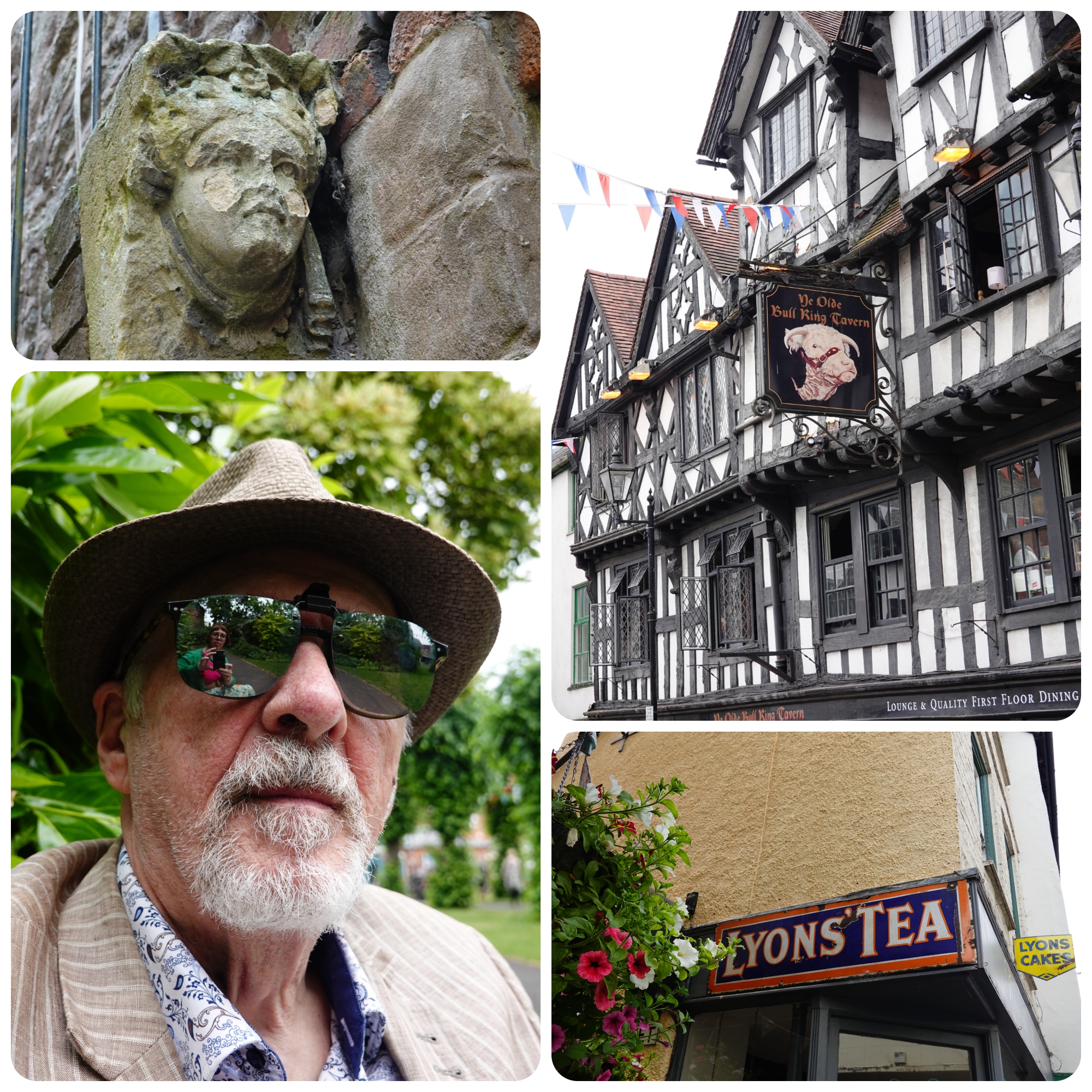


Reacquainting ourselves with the town, which we've visited many times before, we walked into the direction of Castle Square, dashing in and out of any charity shops which had opened their doors. Although we left most of them empty handed, Jos managed to find this flashy pair of mirrored clip-on sunglasses in the local Oxfam shop.

Instead of bringing a picnic, we had planned to grab a bite to eat, but the places which piqued our interest were either closed or full, so that in the end we gave up and bought sandwiches from the local Spar on Castle Square and found us a bench backed by the castle walls.


We briefly toyed with the idea of visiting Ludlow Castle, but decided against it and just walked around the perimeter of which might be one of the finest medieval ruins in England, built by the Normans in the 11th Century to repel a Welsh invasion. After all, we're never far from the Welsh border here!


Hardly a day goes by when there isn't a market of some kind taking place on Castle Square. We were in luck as the Antiques and Collectors fair going on that day was obviously right up our street. It's on every 1st and 3rd Sunday, should you be interested.

We happily browsed the many stalls full of treasure, my first buys being the brooches made from old pottery shards on the bottom left. And I couldn't possibly walk past a display of vintage brooches on another stall, from which I selected the ones on the top right. My final purchase was the mystery object on the bottom right, which is a Bakelite darning mushroom!

On our way back, we passed Nina & Co., a collective shop in Church Street offering vintage fashion and decorative antiques. Here, I showed much restraint, until I was wowed by the Welsh tapestry handbag on the top left. 


The weather on Monday the 19th of June initially looked like a repeat of Sunday's, but turned out to have more sunny spells as well as a couple of showers in store for us. It was only a measly 17°C when we stepped out of the cowshed, so I went back inside to don a pair of tights. However, the mercury would eventually climb to 22°C, which at one point made me regret my decision.

We were off to Wales once more, to visit our 5th National Trust property, described by them as a "magnificent medieval fortress of the Welsh Marches". They certainly weren't wrong!

Completed by Marcher Lord Roger Mortimer in 1310, Chirk Castle near Wrexham, about an hour's drive from our cottage, is the last Welsh castle from the reign of Edward I still inhabited today.

Entrance is via Home Farm, where we sat out in the courtyard with a drink (mine a sparkly elderflower) to get our bearings. From here, the castle can be reached by walking 200 meters up a steep hill, the pathway taking you up through a wooded area. The less nimble can take a mini shuttlebus which runs up and down throughout the day.


On our way up, we made a short diversion to the recently established kitchen garden, which has a small orchard with picnic benches and vegetable plots with a range of vegetables in season that are sold through the shop.

The exact function of the semi-ruined hexagonal tower half-concealed behind trees is unknown but the most likely explanation is that it once served as a dovecote, the date of construction predating the mid-18th century.


Some potted history of the castle while we continue on our way! 

Started in the late 13th century, Chirk Castle was never planned as a family home. Instead, it was one of several medieval Marcher fortresses along the Welsh-English border, built to keep the Welsh under English rule. 

In 1282, when the English King Edward I defeated the Welsh prince Llywelyn ap Gruffydd, he established the new Marcher Lordship of Chirklands. The Chirklands were granted to Roger Mortimer in recognition of his service in King Edward's wars against the Welsh and the Scottish, after which he built Chirk Castle in the late 13th century.

The castle then regularly changed hands between some of the most important men of the ages, usually granted to them in recognition of service and taken away again in disgrace. 


Sir Thomas Myddelton I was born in 1550, son of the governor of Denbigh Castle. With little hope of inheriting his father's position he left to make his fortune in London, which he did with remarkable success. In 1595 Sir Thomas bought Chirk Castle for £5000 with the intention of turning it into his family seat. In 1612, the castle passed to his son Sir Thomas Myddelton II.

In 1910 Thomas (Tommy) Scott-Ellis, 8th Lord Howard de Walden, fell in love with Chirk Castle, and negotiated a lease with the Myddelton Family, which continued until 1946. In 1946 Tommy left Chirk Castle and retired to his Scottish estates, dying that same year.

Chirk Castle has been owned and managed by the National Trust since 1981.

Almost there now! As it was past midday by now, we found a shady bench at the back of the castle to have our picnic of sandwiches loaded with big chunks of vintage Cheddar!
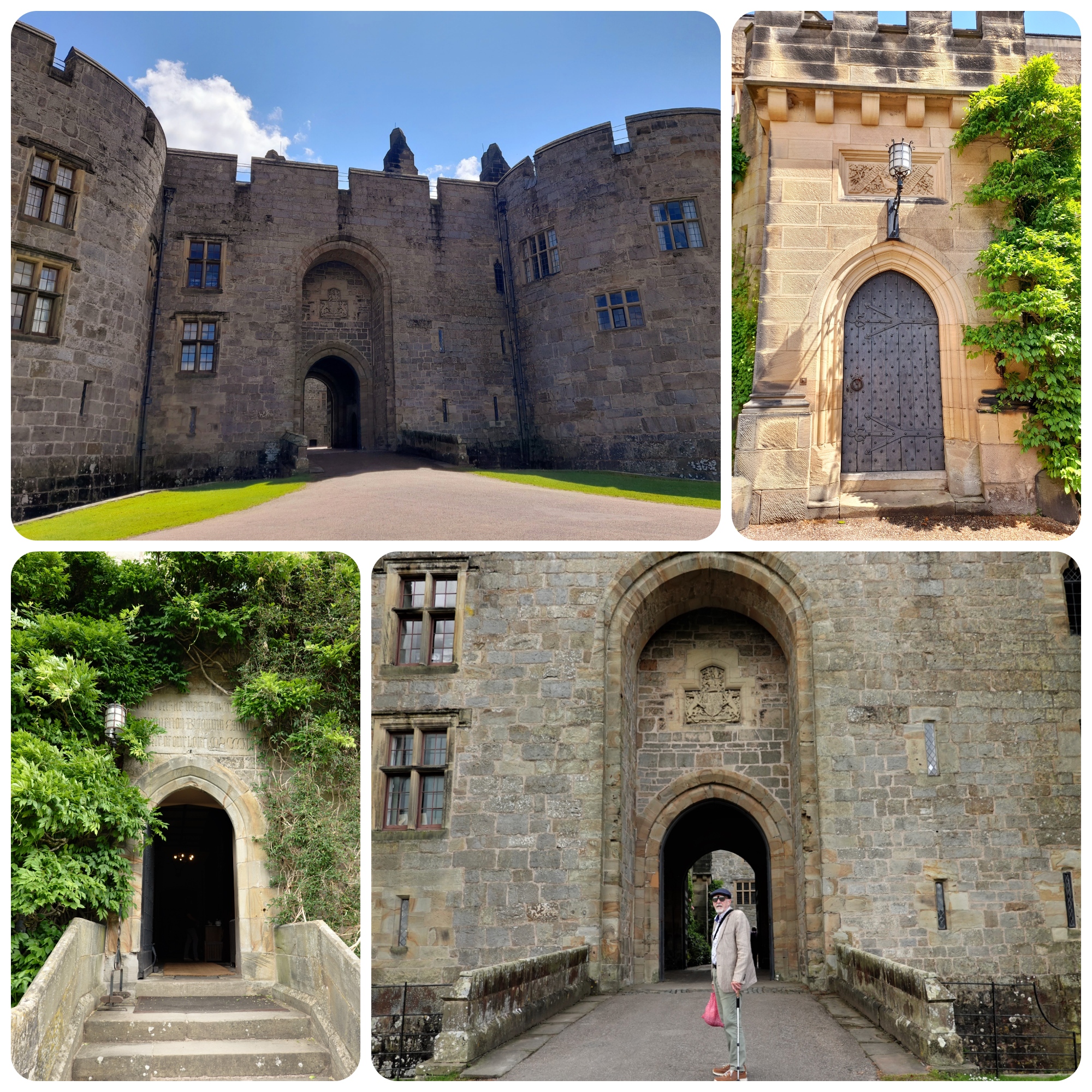


The final stretch of the uphill path circles the castle until the entrance is reached.  Here, a 17th-century stone bridge and archway lead you into a lovely courtyard, where an open door on the right-hand side beckons to explore the castle's interior. 

After leaving our walking sticks behind in the care of a volunteer - and almost forgetting to pick them up again later - we entered the ground floor Cromwell Hall, formerly the Servants' Hall.


Cromwell Hall, created in the 1840s by A.W.N. Pugin, with its curious mix of the medieval and the classical, doesn't fail to impress. 

The striking piece of folk art on the bottom left shows a view of Chirk Castle bordered with oak leaves. Dating from 1858, it was presented to the Myddelton family by William Roberts, the porter at Ruthin Castle, which was another family property. It was made by inlaying ebonised oak with delicate slivers of bone.


Contrasting with Pugin's neo-Gothic fantasy, the elegant neoclassical Grand Staircase was constructed in 1777-8 by Joseph Turner.

On the landing is an eight-foot elm and yew section of a pipe designed to carry London's first clean water supply completed in 1613 by the New River Company, founded by Sir Hugh Myddelton.


The State Rooms - Dining Room, Saloon and Drawing Room - were also created in a neoclassical design in the 1770s, but later Gothicised in the 1840’s, only to be returned to their classical elegance from the 1930s onwards by Tommy Scott-Ellis, 8th Lord Howard de Walden.

He and his wife Margherita, a fabulous party organiser and soprano singer, hosted glittering house parties in the 1930s, with Rudyard Kipling, George Bernard Shaw, Hilaire Belloc, Augustus John and a stream of musicians and actors on their guest lists. Today, the table is set out as if to receive such luminous guests, with 18th century Bohemian glasses and a fine mid-19th-century dinner service from Strasbourg.


The Saloon (above, top left and right, and bottom left) is another curious mixture of Turner's neoclassical style and Pugin's neo-Gothic. Turner's ceiling features scenes from Greek mythology, while the deep blue background and gilding were added by Pugin. 

On the bottom right is a glimpse of the Drawing Room which has similarly stunning blue and gold ceilings partnered with a sparkling chandelier. In a watercolour painting of the Drawing Room from 1862, the walls were covered with a red wall covering rather than the subdued wall paper that currently hangs in the room, which makes it somewhat plain when compared to the Saloon next door.


The imposing 30-metre Long Gallery fills the whole length of the East Range of the castle. 

One of its many treasures is the Kings Cabinet, traditionally said to have been given by Charles II to Sir Thomas Myddelton II in 1661, in thanks for his role in the Restoration of the monarchy. 

The 17th-century Dutch cabinet is made of ebony with tortoiseshell inlays and internal silver mounts with oil paintings on copper showing scenes of the life of Christ, the latter made in the Antwerp studio of Frans Francken the Younger.


The heavens, which had been darkening and threatening rain, had opened and dropped their liquid load while we were exploring the castle. Thankfully, it turned out to be only a short-lived shower and patches of blue had started to appear even before we'd made our way back outside. As exploring the gardens, and making our way towards the Hercules sculpture, which you might just be able to make out between the trees on top of the grassy incline (above, top left) we breathed sighs of relief.

But first we had a peek inside the Servants' Hall, and stopped for a round of cappuccinos and shortbread in the café located in the castle's historic kitchens on the other side of the courtyard.


One of the main attractions of Chirk castle are its award-winning gardens complete with clipped yew trees, rock garden, terrace, rose garden, pond and topiary, with  stunning views over the Cheshire and Shropshire plains. 

The gardens date back to 1657 but the view seen today is more reflective of the 18th Century when the garden and parkland was landscaped by William Emes.

In the 19th Century yew topiary, hedges and wrought iron gates were introduced, and then, under the guidance of Lord Howard de Walden in the early twentieth century, the celebrated gardener Norah Lindsay created a magnificent herbaceous border on the Upper Lawn.


Dotted around the formal gardens, there are several bronze nymph statues sculpted in the early 20th Century by Andrea Carlo Lucchesi.


Soon more clouds appeared and rain seemed once again imminent. But then we spotted what looked like the perfect shelter halfway across the lawns!

Hawk House was built in 1854 to an E.W. Pugin design. Originally a conservatory, Lord Howard de Walden added a thatched roof, to house birds of prey.

E.W. Pugin, by the way, is the architect son of A.W.N. Pugin who was responsible for Cromwell Hall. 
Pugin Jr. designed countless of churches and cathedrals, primarily in the British Isles. However, commissions for his exemplary work were also received from countries throughout Western Europe, Scandinavia and as far away as North America. We visited one of his works in Belgium, the Castle of Loppem, back in 2021 (see here).


We waited out another short-lived shower here, then proceeded towards the Farnese Hercules made in the workshop of John Nost (actually Jan Van Nost, as he was Flemish, born in Mechelen in 1655),  commissioned in June 1720. 

A striking lead figure set on a sandstone pedestal, 1.81 meters high, naked and leaning on his club draped in lion skin, he now looks out east towards Chirk village.

Hercules, however, is currently in his third location within the gardens. First of all, he was placed, a companion to another sculpture of the god Mars, at the entrance to the Castle itself. 

As part of William Emes’ work on the landscapes at Chirk, Hercules was removed from his original location to a prominent spur within the woodland of the estate. The fate of his companion statue is unknown, but overtime Hercules got "lost" in the woods, only to be rediscovered in 1983. He was installed in his present location in 1987, as an integral part of the eastern vistas to and from the castle and the gardens. 


We bade goodbye to Hercules, made our way back down the slope towards the garden and took the path leading us back to Home Farm. 

Purchases were made in the second-hand bookshop, while a browse in the shop in search of some thank-you presents for our loyal cat sitters, also yielded the felted daffodil and poppy brooches for my collection.

And with that, we've come to the end of another day. Please do tune in again for the next installment, in which we exchange country for town again, in a couple of days.


Thursday, 29 June 2023

Down into the valley and up to the high castle

Although we've been back for a couple of days now, having arrived home tired but happy on Saturday evening, it's only now that I'm ready for my return to blogland and for making a start with my travelogue.

After all, with only two days until my return to the office on Tuesday, there has been the usual whirlwind of unpacking, doing a wash load or two, putting some food into our fridge, taking stock of the garden's triumphs and casualties and generally re-adjusting to daily life at Dove Cottage. Not to mention having extensive cuddling sessions with Bess, who has been claiming our laps whenever we've dared to sit down!

To put your minds at rest, I will already divulge that we had the most fantastic holiday! The weather was just glorious, and the weather gods were kind enough to only send showers our way when we were  back at the cottage at night.

But let's begin at the beginning, and cast our minds back to Saturday the 10th of June, when we got up at the crack of dawn (4 am Belgian time to be exactly) to start our travels.

Arriving at the LeShuttle (their innovative new name replacing the former Le Shuttle - no kidding!) terminal well on time, we had our one and only hiccup of our journey when we tried to check in and the computer screen kept telling us there was an oversized vehicle in our lane. At the push of a button we were connected to a real life assistant who swiftly arranged the check-in for us. Then, after going through customs - where the UK official looked at us disbelievingly when told we were going to Shropshire - and stocking up on croissants and other delicacies at the Flexiplus lounge, we were able to take an earlier train than initially booked.

Before we knew it we were whizzing along a succession of  UK motorways, where traffic wasn't too bad all things considered. It was just after 3 pm when we made our descent into Adstone valley - consisting of the huddle of farm buildings Byre Cottage is part of - on the by now all too familiar narrow, winding and increasingly potholed lane. 


With temperatures expected to reach the low thirties back in Belgium, we were glad of the more reasonable 25°C in Shropshire, even if it had started feeling a bit muggy by now. Sure enough, shortly after our arrival clouds were gathering, thunder could be heard rumbling in the distance and the odd flash of lightning flared up in the sky above the Long Mynd before a brief but refreshing shower spitted raindrops against the cowshed's windows.


What with our early start and long journey, it wasn't all too long before we climbed into the cowshed's four poster, whose pillow and duvet covers were a testimony to the fact that we were staying on a working sheep farm. No need for counting sheep here, which would have been virtually impossible anyway!


The one-hour time difference between Belgium and the UK meant that we were wide awake earlier than we would have liked on Sunday morning. It wasn't even 5 am when, on my way back from the bathroom, a glimpse through the kitchen window made me grab my camera to photograph the magical light of dawn.


We hadn't made any plans for the day other than to drive over to Bishop's Castle, at just under 20 minutes by car the nearest town from the cowshed with a supermarket. Before stocking up on foodstuffs for the next couple of days, we went for a little mooch around the small but delightful market town and the handful of shops which were open on a Sunday.

One of these was Rosie's, a treasure trove of a vintage and antiques shop where I bought this gorgeous brooch last year. Back then, Rosie explained that the silk woven Heliotrope flowers at its heart were part of a range of such flowers given away inside packets of Kensitas Cigarettes in the 1930's. 

Intrigued by Rosie's explanation, I did some googling after I got home and found that there were whole websites devoted to Kensitas Silk Flowers. Secretly, I hoped that one day I would be able to find one or more of these flowers on their original cards ...


When I mentioned the brooch to Rosie, she not only remembered, but told me that, as luck would have it, she'd recently come across a batch of Kensitas Silk Flowers, which she now had for sale. It goes without saying that I didn't hesitate for one single moment and snapped up several of them. Aren't they absolutely delightful? And to think that she normally doesn't even open on a Sunday!


I also selected these two brooches, the first of many which came home with me this year.

To recover from the steep climb up the 1 in 6 gradient High Street, we had cappuccinos and cakes at Yarborough House, which combines a tiny tea shop with a large second hand book and record shop Then we had a browse at The Poetry Pharmacy, a wondrous independent bookshop which found its home in an original Victorian pharmacy (linking cause I love!).


On our way back to the cowshed, we had a stop the car moment in Wentnor, the village closest to our little valley, as I simply had to photograph the magnificent display of fiery Red Hot Pokers (Kniphofia) in front of the Grade II listed church of St Michael and All Angels. 


We had lunch at the cottage, then after a little lie-down we somewhat reluctantly dragged ourselves from the sofa for an afternoon outing, not wanting to admit defeat by already calling it a day.

Although our weather app insisted it was just 23°C, clouds had once again gathered, some of them angry-looking and heralding the brewing of a storm. The air was quite stifling when we made our way down yet another bumpy lane towards the Bog Visitor Centre. Housed in a 150 year old former Victorian school building, it is one of the few remnants of a once bustling mining village in the shadow of the Stiperstones, part of the Shropshire Hills Area of Outstanding Natural Beauty, and known for its quartzite tors.


It was a quick visit, though, as we were both feeling tired and a bit out of sorts. Time to go back to the cottage to recharge our batteries. But not before showing you my outfit, consisting of my Think Twice denim skirt, a charity shopped blue and yellow zig-zag top and one of my stretchy belts. 

Oh, and that storm eventually and inevitably arrived that night, the rain having cleansed the air by Monday morning.


A veil of mist was still cocooning the hills when we woke up, but soon the sun was playing peek-a-boo with the layer of grey. It was relatively chilly in our windswept valley, which made it hard to believe the weather people got it right in forecasting highs of 26°C.


But never mind the weather: we had things to do and places to go. Well, one place in particular, that is. Just like we did last year, we'd ordered a National Trust Touring Pass before we left so, armed with our confirmation email, we drove to Powys Castle. About half an hour's drive, and just over the border with Wales, this is one of the properties where one can have the actual Touring Pass issued.

It wasn't the first time we visited the stunning Medieval castle rising dramatically above its magnificent terraced gardens - we were here in 2018 and 2019 and after being rudely interrupted by Covid, back in 2022 - but it certainly wasn't a hardship to come here again. 

In spite of the excellent value for money (the pass costs £84 for 2 people for 14 days), not many overseas visitors seem to be aware of it. In fact, the pass was quite a novelty at some of the properties we visited and we were generally treated like royalty. I cannot stress enough how friendly, helpful and knowledgeable the NT staff and volunteers are.


The mercury climbed ever higher as morning progressed towards noon, so we soon took shelter under the arches of the aviary terrace, where shepherds and shepherdesses are dancing on the balustrade.

While Jos was taking a breather away from the relentless glare of the sun, I climbed the steps up to the terrace at the back of the castle offering a magnificent view across the garden. Here Offa (the late 8th Century King Offa of Mercia - top right) and Edgar (the 10th Century West Saxon monarch King Edgar the Peaceful - bottom left) are guarding the Northern entrance. No fly in the ointment, but there is one on poor Edgar's left foot!


Hunger pangs made us return to the castle courtyard, where we were greeted by Colin the peacock who was drawing quite a crowd by fanning out his spectacular tail feathers.


Almost rivalling Colin's feathers were the wondrous cushions, quilts and carpets by internationally renowned fine artist and textile designer Kaffe Fassett, which were exhibited inside the castle.

Photography is not allowed inside, so the photo of the stunning carpet draped on the castle's stairs are courtesy of the National Trust. The exhibition is still running until 3 September, should you be in the area.


After lunch at the on-site café (and yes, Vix, we both had jacket potatoes) and a tour of the castle and exhibition, we sought some shade in the woodland opposite the castle. 

As we sat on a bench near the pond, we took in the sensory delights we had missed for so long. The air was alive with the verdant scents of early Summer and the buzzing of bees as we walked on the woodland path hemmed in by banks of red and pink Rhododendrons.


There's a sudden clearing in the woods about half-way along the path, offering a magical view of the castle and its terraces in all their glory. Even if I must have snapped the castle from this exact vantage point on every previous visit, I couldn't help zooming in with my wonderful new Sony Cybershot. Isn't it just glorious?


I fell head over heels for this colourful zig-zag patterned maxi skirt when I spotted it in a charity shop in the Summer of 2021 and it has definitely become a holiday staple since.

My red and white floral blouse from the Belgian Wow To Go label is charity shopped as well, as are the black and white chevron patterned stretchy belt and the green beaded necklace. The green butterfly brooch, which has blue and pink sisters, was a retail buy from a quirky independent shop in Antwerp.

The hat, which has seen better days, was a flea market find which I upgraded with a hair band last seen as a #Coronahair solution back in 2020.


Back at the cottage that evening, we were treated to a torrential downpour complete with horizontal wind and a volley of hailstones. 

We could only watch in horror as our car was completely exposed to the elements and we breathed sighs of relief as soon the worst was over and our car didn't seem to have suffered any damages.

The weather forecast for the days ahead was for continued sunny and warm weather. Now, what would we be doing next? I'll be back with more adventures in a couple of days!


Sunday, 31 July 2022

Ups and downs

We could get used to this gentle pace of life, with nothing more taxing than deciding on the day’s itinerary, we mused, waking up on Thursday the 23rd of June. Gingerly lifting a corner of our bedroom curtain confirmed that the sun was already out in full force. 

Alas, the outlook on our phone’s weather app wasn’t exactly promising, forecasting rain, perhaps even a thunderstorm, later that day. What’s more, the forecast for the week ahead was a bit of a turn-up for the books, with a considerable drop in temperature and lots of rain to look forward to ... 


For now, the temperature was steadily climbing into the high twenties, and it looked set to be a bit of a muggy day. Our usual cooked breakfast was had with the patio doors thrown wide open, followed by a bowl of fresh fruit and mugs of coffee on the terrace.

Our destination for the day was selected with the possibility of rain in mind, opting for another National Trust property with lots of inside options. Again, it was one we had visited previously. 


Erddig Hall, a Grade-1 listed property set in a 486-hectare (1,200-acre) landscape park, and surrounded by a fully restored 18th-century garden, is just two miles south of the Welsh town of Wrexham, and a drive of about an hour and a quarter from the cowshed.

Courtesy of the ubiquitous roadworks, the morning was well advanced by the time we finally got there and, as we were parched, we decided to have coffees first. It was when we got out of the car that Jos realized he’d forgotten his straw hat in the cowshed and only had his wool cap at his disposal.


As neither this nor going bareheaded was an option on this sweltering day, we made our way towards the shop to see if they had anything suitable. However, the choice for men, other than baseball caps or safari-style hats, was rather limited, and the only hat which made the grade was far too big. We were just about to get desperate when I found one in a smaller size at the bottom of the pile.


That settled, we had a mooch around the estate buildings, which include a joiners' shop, smithy and saw mill, all of them left complete with all the fittings and tools inside, just as they were when the last craftsmen and artisans left.


Continuing to the Stable Yard, we explored the stables and tack room, before admiring the carriages, bicycles and vintage cars, including the red Rover, dating from around 1907 and the green Austin, which dates from 1927.


Then we walked to the creeper-clad front of the house, with its glorious view of the Welsh landscape.

Originally built in 1684-1687 for Josiah Edisbury, the High Sheriff of Denbighshire, the wings at each end of the central block were added by John Meller, a rich London lawyer, who bought the property in 1714.


 Obviously, I had to do my Lady of the Manor pose on the house’s curving double flight of steps. 

I was wearing the blue organic cotton maxi skirt I snaffled in the Mango sales last Summer, with my lobster printed top I found new with tags in a charity shop in May 2019. Apart from my trusty Clarks Cloudsteppers and the aforementioned skirt, everything was either charity shopped or found on flea markets. And yes, that includes the hat, which is from the German Mayser brand.


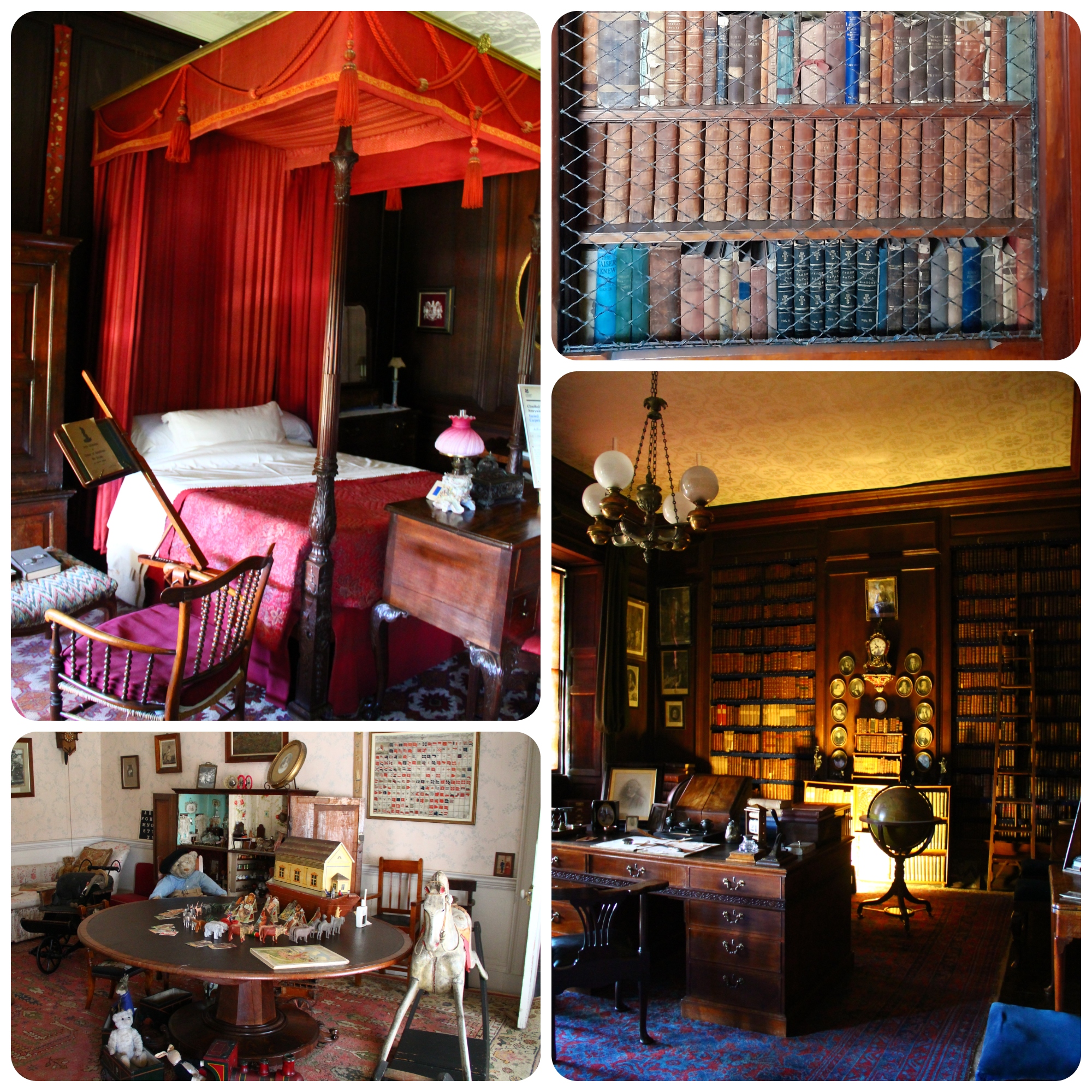
After lunch, we escaped from the afternoon heat into the relative coolness of the house which, unusually, is entered via the servants’ quarters.

Meller's original interiors have been left intact. On his death in 1733, unmarried and childless, the property went to his nephew, Simon Yorke, and the house was subsequently passed down through generations of the Yorke family.


In the servants’ quarters, the walls are filled with paintings and photographs of the people who worked below stairs. From the kitchen porter and housekeeper to the gardener and gamekeeper, the Yorke family had a close relationship with their servants and celebrated their loyalty, length of service and hard work. The portraits were commissioned by the Yorke family, a tradition started in 1791 by Philip Yorke I. 


Philip I also initiated the custom of writing charming, light-hearted verses about each of the servants. Jane Ebrell (above, bottom left), for instance, is referred to as “the Mother of us all” whose enthusiasm for cleaning is recorded by her Master:

"From room to room, She drove the dust, With brush and broom, And by the Virtues of her mop, To all uncleanness put a stop."


 John Meller created a set of elegant rooms facing the garden, each leading into the next with their doors arranged in a straight line. When the doors were open it was possible to look from one end to the other.

This arrangement originated in the French Royal Court and was called 'enfilade' and was very fashionable in the early 1700s.

The volunteer in the saloon regaled us with the story of the George III cut glass chandelier (above, top right) which still bears the marks of damage sustained in 1903, when it was dropped by the butler while he was cleaning it.

According to the lady of the house, Louise Yorke, he was "non-too sober" and rotated it until the thread ran out. It had to be repaired by Sheratt of Chester in 1904 for £38, and they had to send it to Bohemia to match the glass!


We trudged up another flight of stairs, but the rooms were quite oppressive and airless here, the initial coolness of the servants' quarters evaporated into thin air.

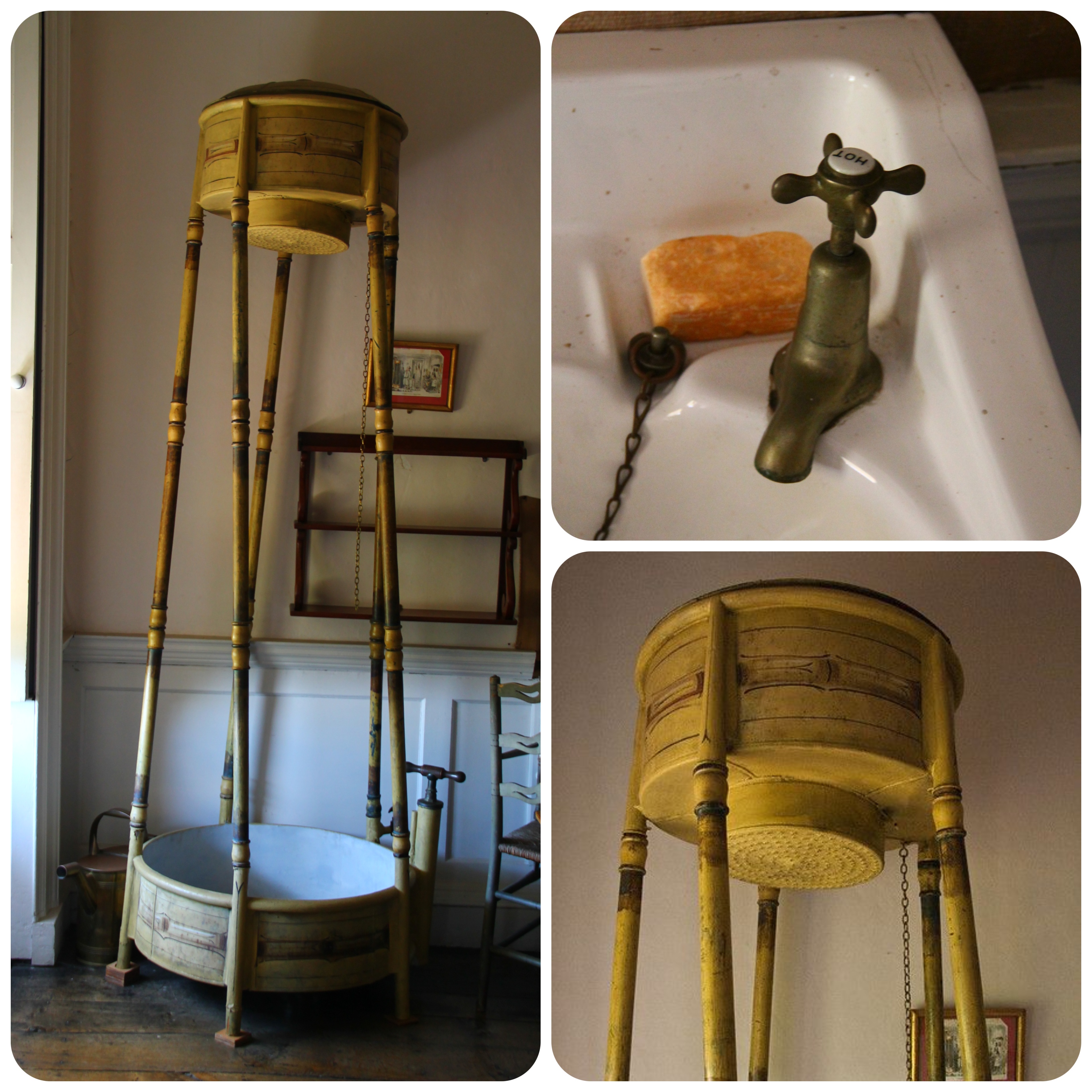
By the time we reached the bathroom, I was quite ready to use the unusual contraption which turned out to be a Victorian shower. Made from iron and wood, the uprights are painted to resemble bamboo poles. The tank above and basin below are similarly decorated, with integral stirrup pump and brass chain.


Leaving the house through a door leading into the garden did not bring any relief, as it had become decidedly sticky and stifling by now, the humidity index indicative of an impending thunderstorm.

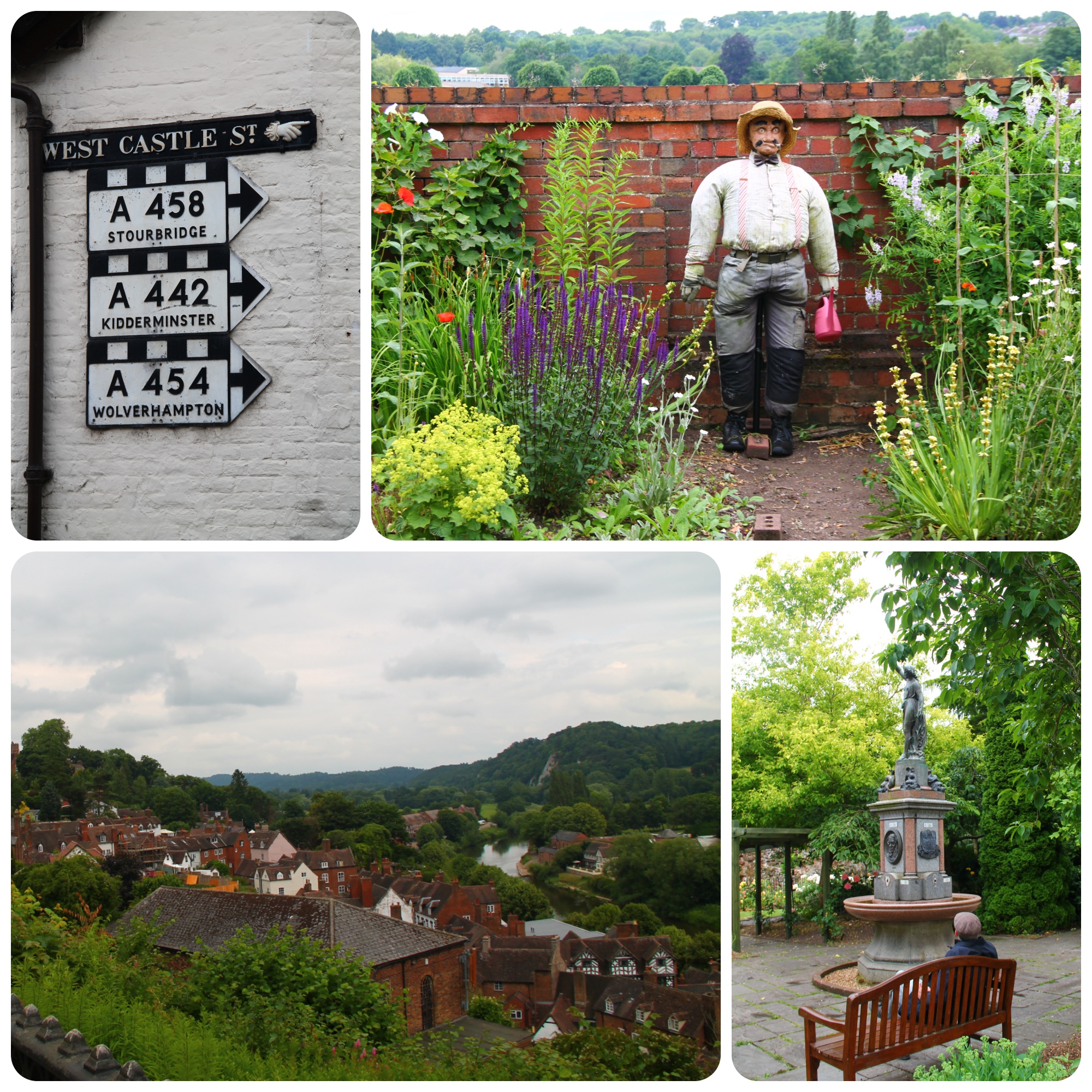
Even the briefest stroll through the garden, keeping mostly to the shade, was enough to make us break out in a sweat. Still, I persevered, leaving Jos sitting on a bench just outside the house (below, top left).


When I passed the entrance to the kitchen garden and its Victorian glasshouses - the bilingual sign reminding us we were well and truly in Wales - I walked back towards where Jos was sitting and persuaded him to accompany me for some final Lady of the Manor photos.

After refreshments at the café, we geared ourselves for the return journey. Obviously, our car had become reminiscent of a hot oven by now, so that we definitely needed its life-saving airco.

If only Jos hadn't insisted on putting it on at full blast ...


Clouds started gathering on our way home, and the weather gods even regaled us with a couple of scattered raindrops, but the expected thunderstorm refrained from happening.

The temperature, however, had already dropped several degrees when we arrived at the supermarket where we stocked up for a couple of days. We'd only just made it inside the cowshed when the heavens finally opened.


Thursday's cloying temperatures, followed by the blast of the airco, had triggered one of my migraines, which came on during the evening. A good night's sleep usually brings some solace, but unfortunately I kept waking up at all hours, so that I felt tired with a lingering headache in the morning. Consequently, it took me a while to get going.

Adamant not to let a minor detail like that spoil all the fun, we decided on a trip to the historic market town of Bridgnorth. The town, which we have visited quite a few times before,  is split into Low Town, on the edge of the River Severn and High Town, the two connected by the Bridgnorth Cliff Railway

Meanwhile, the temperature had dropped to a mere 18°C, and with rain still very much on the horizon, I was wearing the first of the pairs of wide-legged trousers I'd packed (charity shopped back in May) and the famous green raincoat which has accompanied me on many a UK holiday.


The usual journey of just under one hour had taken quite a bit longer due to a road diversion, and as we'd had a late start, it was almost midday before we arrived at our destination. What's more, the minute we started walking towards the town centre, it started drizzling, which it would do on and off throughout the day.

We made a quick dash around the town's charity shops, which are plentiful, but I only ended up buying the Zara blouse (above, bottom right) and the yellow pleated scarf I started wearing immediately, as in our haste I'd left without one.

Then it was time for lunch, which we had at the local Wetherspoons. While I opted for fish and chips, Jos stuck to his usual jacket potato! 


Still not feeling energetic, we refrained from walking from High to Low Town by descending one of the seven sets of ancient donkey steps, and taking the Cliff Railway up again, which was our original plan. 

Instead, we strolled along Castle Walk enjoying the incomparable view over the Severn Valley, with the plaintive whistling of the steam locomotives of the Severn Valley Railway as a soundtrack.


Before returning to the town centre, and ultimately to our car, we sat down for a while in Castle Gardens, reigned over by the remains of Bridgnorth Castle. As a result of a botched attempt to blow up the building by the Parliamentarians during the Civil War, the latter now leans at a 15-degree angle. 

My previous attempt to prop it up dates from our visit visit in 2018.

Would the weather and my migraine improve in the next couple of days? Please do stay tuned if you want to find out!