Tuesday, 15 May 2018

Let there be light ... and chocolate!

On Monday, the last full day of our extended weekend break in Bruges, we lingered over breakfast, loading up our plates with different kinds of bread and other delicacies, while enjoying glasses of home made apple juice and strong cups of coffee.

Rain kept plinking into the puddles which had formed overnight, drenching what we could see of the garden through the rivulets of raindrops which had gathered on the breakfast room's windows.


When the rain finally eased off, we made a beeline to our car and drove down to Bruges, where we once again left our car at the station car park and made use of public transport to reach the city centre.

The rain might have stopped but it was still gloomy, with nasty clouds promising more rain overhead. This, however, did not deter our fellow tourists, who had once again gathered in their masses, intent on taking over every square centimeter of the city's cobbled streets.


From the bus stop, we meandered in the opposite direction of the day before, making our way via the Vismarkt (Fish Market) and a narrow passageway going under the quirky name of Blinde Ezelstraat (Blind Donkey Street) to the Burg, which might very well be Bruges' most architecturally interesting square.

At the end of the alley, a gateway passes under a building which seems to come straight out of a fairy tale. This is the Civiele Griffie (Old Civil Registry), which was built in the Renaissance style in 1537.

Before walking underneath the archway, we looked up to see Solomon standing tall with Prosperity to the left and Peace to the right.


On the Burg itself, the full splendour of the building is revealed, its recently restored facade opulently decorated with columns and gilded friezes and statues, with Lady Justice balancing the scales in a prominent position on top.

The crowned shield flanked by the gilded lion and brown bear represents Bruges' intriguing coat of arms.


And look, only one tourist in front of the building. Quick, let's grab this unique photo opportunity!


Next door is arguably the most impressive building on the Burg, the Town Hall. This magnificent  Gothic building dates from 1376, making it one of the oldest in the Low Countries. Its facade is richly decorated with gothic windows, turrets, statues of the Counts of Flanders and biblical figures and the coats of arms of subordinate towns.


In a corner of the square is one its smallest buildings, the Basilica of the Holy Blood. The flamboyant facade, with its gilded statues and medallions representing the Counts of Flanders and their partners, is actually a 16th century staircase that connects two chapels: the lower Romanesque Saint-Basilius-chapel and the upper neo-gothic Holy Blood-chapel.


The church houses a relic of the Holy Blood allegedly collected by Joseph of Arimathea and brought from the Holy Land by Thierry of Alsace, Count of Flanders. Originally built between 1134 and 1157, the church was promoted to minor basilica in 1923.


After admiring the square's lavish architecture, we were getting hungry, so we made our way to the nearby Markt, where we had a meal on the terrace of the same restaurant we went to on our first day.

It was cold and the first drops of rain were starting to fall, so we were glad the terrace was covered and that we were sitting quite close to a heater.

We both had a craving for witloof in de oven, a classic of Belgian cuisine, which we'd seen on the menu. The dish consists of endives (or chicory) heads, which are rolled in ham, covered in a cheesy bechamel sauce and cooked in the oven, usually served with mashed potato. Yummy!


It was clear by now that we weren't going to see the sun again that day, so we had to make do with this sun-shaped cracker which came with our drinks!

We'd planned to walk to the Hansa Quarter after lunch, which we did, but the weather gods were well and truly against us, as it had started raining heavily.

There was nothing for it but to bring out the unwieldy umbrellas, which made taking photographs quite an ordeal. Along the way, we'd bought some cheap see-through plastic rain ponchos, looking a bit like oversized rain bonnets. At one point Mr. S. decided to wear his, which ended in fits of laughter. No way was I going to wear this!


From the 13th to the 15th century, Bruges was the most important trading centre in North-West Europe. In the old Hansa Quarter you can admire the mansions of the wealthy merchants of the era, and the whole quarter is drenched in a timeless atmosphere which is particularly charming, even on a rain drenched day!

And look, there's that bear again! This one is taking pride of place in a niche of the Poortersloge (Burgher's Lodge), which was built towards the end of the 14th century, and which was the place where wealthy citizens and foreign merchants met socially.

There's a legend attached to the bear, of course, involving a knight in shining armour called Baldwin Iron Arm, who heroically freed the city from a particularly aggressive bear. You can read the full story here.


Pelting down ever more more relentlessly, the rain drove us to a nearby museum. Or rather: two museums housed in one building, for which we bought a combined ticket.

The most popular one, Choco Story, tells the history of cocoa and chocolate, from its Mayan and Aztec origins to chocolate as we know it today.

Our ticket came with a free bar of chocolate (displayed on the museum guide on the top left) and it all started very promisingly with a huge chocolate egg, marking the museum's opening in 2004.


The museum is laid out over three floors and the average visit is supposed to take about one hour.

First we were taken through the customs, beliefs and everyday lives of the Mayas and the Aztecs, how they used cocoa as an offering to the gods, later using cocoa as a drink (equivalent to today's champagne - top right) and as a currency. On the bottom left is a piggy bank containing cocoa beans.

Later, the Spaniards adopted the drink, but added sugar to it, after which the sweet drink became the favourite beverage at Europe's royal courts.

All very interesting, if the crowds of tourists hadn't all decided to come as well, blocking the displays and making the going quite tough. As if this wasn't bad enough, there were bottlenecks at the three spots which had chocolate dispensers and where you could eat as much chocolate as you want. Needless to say, these were very popular!


Anyway, let's proceed with the history of the chocolate bar, which started much later that that of the drink. I was surprised to find out that in 1847 the first tablet of chocolate was moulded in England! 

Initially, chocolate was made by craftsmen only, but then industrialization gradually took over chocolate production and the rest, as they say, is history!

In the last part of the exhibition, we admired the many chocolate moulds, and learned about the history of Belgian producers, like Côte d'Or and Jacques (below). In these displays we recognized some things from our own little museum at Dove Cottage!


By then, we'd had quite enough of chocolate, not to mention the crowds, so we made our way to the turnstile entrance of the second museum, Lumina Domestica.

The museum contains the world’s largest collection of lamps and lights. More than six thousand objects tell the story of interior lighting, from the earliest prehistoric clay lamps and oil lamps that look like they’re holding a genie, to the light bulb and even LED.


We'd left the crowds behind stuffing their faces with free chocolate as, apart from one other couple, we were all alone, so that we could admire this amazing collection in peace!


We were quite dazzled by the time we left the building, finding that mercifully, if only temporarily, it had stopped raining.


Before heading back to our B&B, there was time for one more photo of me posing on one of the bridges crossing the Spiegelrei, a particularly picturesque corner of Bruges.

Friday, 11 May 2018

All around my hat

With still one day of our weekend in Bruges to go, I wanted to give you a break by reporting you about last Saturday's flea market.

The rain clouds which had dominated our little sojourn had evaporated by the time I had to go back to work on Wednesday. Typical, isn't it? But we were in luck as when the weekend rolled along we were back to Summer weather and it was as if nothing had happened.

Saturday was a glorious day and perfect for our first outdoor flea market of the year.


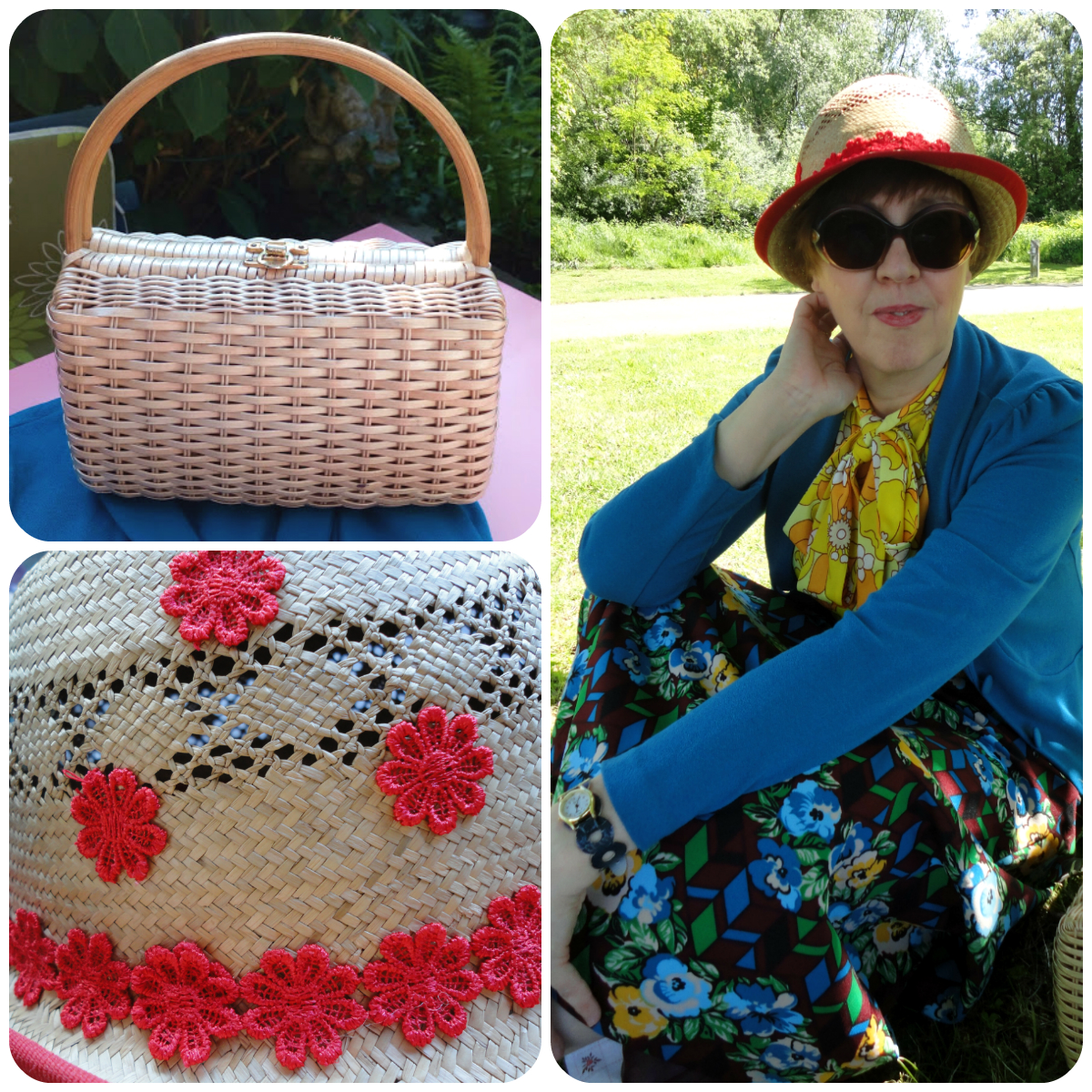
In our haste to get going, we forgot all about outfit photos, and I had to recreate Saturday's outfit on Sunday, with photos taken in our garden. Yes, that's the assault of greenery you can see behind me!


But let's get back to the flea market first. I'd taken my compact camera with me but even if it was dangling from my wrist for most of the time, hardly any photos were taken, as I was far too busy browsing.


I started out wearing a lightweight turquoise jacket but after lunch (I'm sure you won't be surprised if I tell you we'd brought a picnic) it was stashed away as it was getting quite warm, but with a welcome breeze preventing it from becoming too hot!

My white wicker handbag was charity shopped for next to nothing, and it was with some glee that during one of my lunch breaks this week I happened to see a similar one in Mango retailing for just under € 50.

If you look carefully, you might notice the change of hats! Initially I grabbed the hat I wore all through last Summer, a plain one which I'd customized by adding a hair band. You can see a close-up of it here.


But then I fell in love with this little hat which was on display behind one of the market's stalls. As luck would have it, it was my size, so not only did I buy it, I spent the rest of the day wearing it too!


I was wearing a maxi skirt with blue and yellow flowers interspersed with blue, green and black diamonds and stripes on a burgundy background. I bought it back in Autumn and this was actually its first wear. The blouse with its floppy pussy bow and psychedelic floral print in yellow, orange and white, has been in my wardrobe for at least two Summers. Both came from Think Twice.

The straw belt was a high street find and very comfortable to wear as it's got some stretch in it.


I was complimented quite a few times on my outfit and at one point I overheard one of the stall holders, who must have been English, exclaiming to his neighbour: look at how well turned out she is - and her husband's the same! I liked that last part the best, and obviously Jos was very chuffed when I told him.


Only minutes into the flea market my eye was caught by a cup painted with the most exquisite flowers on an otherwise quite uneventful stall at the end of a row. I picked it up to have a better look but then thought the better of it as we do have quite enough solitary cups already. Rounding the corner, I saw a bag full of assorted tableware, with not only a second cup but two saucers and two dessert plates as well, both in a quirky octagonal shape.  For € 5, there was no way we were going to leave these behind. The porcelain is quite thick and sturdy and made in Italy.


Shortly afterwards, I zoomed in on this pair of suede and patent leather Hotter shoes, still in good nick, and in a lovely burgundy, almost plummy colour. They were a size 5 (I usually take a size 4 to 4 ½) but they were a perfect fit. Even better, they were only € 2! 

Some Googling revealed that the model is called Valetta and when I Googled that I came across a blog post from 2012 from Mim! It's a small world, isn't it?


Continuing on our rounds, we happened upon a stall we immediately recognized as Ilona's. She's one of our favourite sellers, with a stall full of the most wondrous stuff, from which we never come away empty handed.

This time, a green ceramic deer and two tiny Scottie dogs caught our eye.


The Scotties are mounted on magnets which, as magnets are wont to do, pulls them together, while at the same time they start chasing one another when one of them turns tail.

Aren't they the cutest pair ever?


Doesn't the green deer look familiar? Well, it did to us, putting us in mind of the green deer lamp we bought at the castle back in April.

We thought that they could be friends, and here they are, living happily ever after on our mantelpiece.

Then there was a stall selling vintage and retro clothes, where I picked up two deadstock vintage frocks in pristine condition. Quite a rarity these days, especially at flea markets!


The first one, in blue Trevira with a diamond pattern featuring dainty rose buds, came with a self fabric belt with a slide buckle. 


There's no label in this pretty frock, which has a print of tiny squares in different blues, green, orange and white, with a solid white collar and cuffs and a tie belt. I'm sure it would look equally good or even better with a belt in one of the print's colours.


Sunday was spent at home and in the garden, doing nothing much. I'd taken a tumble down the stairs on Saturday night, leaving me with a bruised left arm and painful muscles in both upper arms, so I was sort of licking my wounds!

Anyway, it looks like we will have a bumper crop of gooseberries this year. I don't think we ever had so many. I do hope they will have ripened to a rich red and be ready to eat before we're off to Shropshire mid June.


Before I sign off, I wanted to show you two of my garden favourites, which are currently in full bloom, Allium (I think they are  Allium aflatunense, which is the most common type) and Aquilegia 'Nora Barlow' with its double pink blooms with white tips, resembling pom poms!

Watch out for my next post, in which I will regale you with our adventures on our last day in Bruges!

Meanwhile, I'm taking my outfit to Patti's Visible Monday at Not Dead Yet Style!

Monday, 7 May 2018

Right as rain

Are you sitting comfortably? Then I'll proceed to tell you about our first full day in Bruges!

Having woken up to an utterly grey and ominously clouded morning, the first drops of rain starting falling while we were having breakfast.

Not to be deterred, we dressed warmly (I'd switched to my Winter coat at that point), grabbed our umbrellas and drove down to Bruges, where we managed to find a spot at the car park near the station. You're getting a really good deal here: not only are you paying a maximum of € 3,50 for 24 hours, your ticket entitles you to free public transport to the town centre for up to four people.

Still raining ... look, there's our bus!


Soon we climbed aboard a crowded bus, which dropped us off at the Dijver, one of Bruges' most popular canals, by which time the rain seemed to be petering out.


Much photographed, the romantic Rozenhoedkaai, where the Dijver meets another of Bruges' canals, the Groenerei, was a mooring place for ships back in the late Middle Ages.

Needless to say, the crowds were thick here, with groups of people waiting outside the museums, accompanied by guides speaking every language under the sun, or queuing on the landing stages for a boat trip on Bruges' picturesque canals.


But we had our own agenda, which involved dodging the crowds (in as far as possible) and doing our own thing, wandering the city streets wherever our feet would take us.

From the Dijver, we entered an archway leading into the compact Arents Courtyard, surrounded by the Arentshuis after which it was named and which has temporary exhibitions of fine art, the Onze Lieve Vrouwekerk (Church of Our Lady), and the Gruuthuse Museum, known for its superb collection of 16th and 17th century tapestries, next door.


In the far corner of the courtyard is the tiniest of humpbacked bridges, St. Bonifaciusbrug, which is one of Bruges' most picturesque and certainly most photographed bridges. No photograph was taken, alas, as the bridge was full of people brandishing selfie sticks. I wonder if any of them realized that the bridge, which is looking decidedly medieval, was only built in 1910?

Looking upwards, we could see Bruges' smallest Gothic window (top left in the collage below), from which the Gruuthuse family used to keep watch on their landing stage below.


Immediately after crossing the bridge (which was't easy because, you know, selfie stick people), we passed through a gate leading to a quiet back street, where we admired two pink stuccoed Art Nouveau inspired houses dating from 1904.


The relative quietness was quite short lived as the end of the narrow cobbled street was blocked by people queuing at the entrance of Sint-Janshospitaal (St. John’s Hospital) immediately opposite. This is one of the oldest preserved hospital buildings in Europe, where you can learn about hospital life in the past. The museum also owns six masterpieces by the Flemish primitive artist Hans Memling, as well as many religious paintings and sculptures.

All very interesting, but on a quiet(er) weekday perhaps?

The hospital backs onto the canal, another one of Bruges' much photographed corners, which you can admire on the bottom right.


Meanwhile, we had reached the inner sanctum of touristland, where shops selling tacky souvenirs, lace items and chocolate lined the streets cheek by jowl. Or perhaps you would care for a waffle on a stick?


Ambling towards the Begijnhof (Beguinage) we came across a couple of bronze horse sculptures adorning a horse trough. Some real life horses eating their lunch from a nosebag made us realize we were hungry so we went in search for a half-decent restaurant to have lunch in.

While we were there, we noticed that passers-by were carrying umbrellas, but having been to Wales, we weren't put off by a little bit of rain, so we continued our walk without opening the cumbersome things. Jos did have his cap, but I'd forgotten the beret I'd brought at our B&B.


After crossing a bridge and entering through a lavishly decorated gate (above, bottom right), the Beguinage enfolds as a rough circle of delightful whitewashed houses surrounding a central green.


The best time to visit is in Spring, when the green is carpeted by daffodils. The bulbs, a total of 8000, were presented to the Beguinage by a Mrs. Sander in 1936, and at their peek this obviously is another much photographed scene.

Most of them were faded and dying by now, but it was still a magical experience to be walking among them, which we later found out was strictly forbidden.

The sun was trying her best to break through the thick layer of grey, enhancing the ethereal atmosphere under the canopy of the slightly crooked elms dotting the green.


Although the sun was beating a rapid retreat, the rain had temporarily eased off, allowing us to circle the Beguinage, which was founded in 1245, and admire the individual houses at peace, helped by the fact that the place was relatively devoid of tourists.


One of the houses, Begijnhuisje, can be visited, providing a peek into Beguinage life. Look at me, being all devout and trying my hand at being a beguine! But the bed behind me was too short, even for "petite" me!


By then, it had started raining again, in earnest this time. The tranquil lake known as the Minnewater (freely translated as Lake of Love), with its resident colony of swans, was looking rather forlorn, with a hazy fog fading out the spire of the Church of Our Lady in the background.


Legend has it that if you walk across the Minnewater bridge and kiss your loved one, it will become eternal love. But oops, we forgot to kiss!  A good thing then that we don't believe in that nonsense, although admittedly, it is a rather romantic thought!

The tower at one end of the bridge is called Poertoren (toren is the Flemish word for tower), which rises more than 18 metres above the water line. It was constructed in 1401 and is a remnant of the late-medieval city walls. At that time, the city used the tower to store its supply of gunpowder.


Back at the Markt, we dashed into Grand Café Craenenburg, one of the cafés lining the square, for a restorative if rather overpriced cup of Cappuccino. 

Our umbrellas finally came out for our walk back to the bus stop. Even though it was a Sunday, quite a lot of the shops seemed to be trading. And look, isn't that a Think Twice shop over there? 

There was no way I could pass the shop without having a browse, especially as it was near the end of the shop's sales and everything was € 3.


I might have gone a bit mad and splashed out on this flouncy frock!

See you soon for the final episode of my weekend in Bruges.

Linking to Patti's Visible Monday at Not Dead Yet Style as usual.


Thursday, 3 May 2018

Having a nosey in Bruges

On the occasion of Jos's last birthday back in September, he was given a delightful present by his children in the form of vouchers to be spent on hotel or B&B accommodation in Flanders.

With a huge selection of places to choose from, we finally settled on a weekend away to what is probably Belgium's most well-known city, Bruges. With millions of tourists flocking to the city to see its picture postcard perfectness (its historic centre is a UNESCO World Heritage Site), it has got its fair share of places to stay, but we opted for a quiet B&B about 15 kilometers away.


We wanted this to be a Spring break, so the last weekend of April seemed perfect. Wasn't it just our luck though that, after the summery weather of the week before, the temperature was about to drop dramatically, to a measly 10°C and less!

I'd fretted about what to pack for weeks, but in the end, choosing three outfits based on what remained of my long-sleeved frocks proved to be easy. Maybe there is something to be said for a capsule wardrobe after all ... Just kidding! I added three options of cardigans and opaques, some things to be layered underneath, and that was it: I don't think I ever travelled this light.

As the weather forecast was so dire, I did have to dig out one of my Winter coats again. And here I was hoping I'd said goodbye to them for at least six months!


Taking just over an hour's drive from Dove Cottage, we arrived at our B&B, Het Soetewater, around 2 pm on Saturday, and were greeted by our host, Veronique, with coffee and cakes, which we had in the breakfast room.

At one end of the room, a sofa and chairs were arranged in front of a fireplace which was lit in the evenings to take the chill away.


Our room was reached through the door behind the stairs, where a strip of light at ground level in the corridor turned on automatically upon entering. 

The door you can see on the left led to our room, which was called Cuberdon. I can see quite a few raised eyebrows there, as I'm sure that most of my non-Belgian readers haven't got a clue what a Cuberdon is.


Well, I'm no longer keeping you in suspense: it's a traditional Belgian sweet. This cone-shaped, purplish candy has the texture of soft licorice, with a darker purple, gooey centre. I have seen the taste described as raspberry, but to me it has a rather indistinct sweet taste. The Flemish colloquial name for the sweets is "neuzekes", meaning small noses.

By now, I guess you are wondering what all this has got to do with our room, but read on, and all will be revealed.


The rooms are situated in the former outbuildings of the farm which used to belong to Veronique's parents, and here and there you can still see some of the original features, such as the traditional tiled floor and the wooden beams in the breakfast room, and the brick wall behind the bed in our room.


The bathroom, with a bath and a shower, and much bigger than Dove Cottage's, was painted in Cuberdon colour, or at least a colour reminiscent of the gooey centre of the sweets. So, there you have your explanation!


The afternoon was getting on by then, so we decided to make a first trip into Bruges. We'd planned to park near the city centre, but the underground car park where we'd parked on a previous visit was full. When then made our way to the station, where there's a huge and reasonably cheap car park, passing several others, also full, along the way. Well, what did we expect? It was a Saturday afternoon after all, and this was Bruges, where it always seems to be teeming with tourists and day-trippers.

We finally found a parking space at the far side of the station from where it was a ten minute walk to the city centre.


Once we reached the city's main shopping streets, the throngs of people were becoming  nearly impassible and the only thing to be done was to let us be swept along in their tide until the main square, the Markt, was reached. 

Pointing my camera upwards, I tried to ignore the crowds. Looking at the artwork on one of the buildings, I'm quite sure it was a mirror image of my face at that point!


It wasn't less crowded on the Markt, but here people dispersed in all directions, some of them making for the horse-drawn carriages, a traditional way to see the splendour of the city. 

Others were admiring the biscuit tin worthy buildings lining the Markt, with the Provincial Palace built in Gothic revival style (bottom left) on one side, or straining their necks to see the the medieval Belfry, which stands 83 metres tall and dominates the square.


In front of the Belfry are two green wooden "frietkoten". "Frietkot" is Flemish colloquial for "frituur", that Belgian institution selling "frites" or Belgian (not French!) fries, as ubiquitous as the British chip shop. These two date from 1897 and the rumours that one is always busier than the other seem to be quite true! 

We were getting quite peckish by then but, rather than trying one of the above, we made our way to one of the restaurants housed in a row of gabled buildings across the square. After a quick look at the menu, we decided on St. Joris, where we had a proper sit-down meal on the - admittedly covered and heated - terrace.


Afterwards, we recrossed the square to investigate the Belfry and the market building, or Hallen, at its base, using the underpass to enter the rectangular courtyard, overlooked by a long line of galleries, which originally served as the town's market.

On the north side of the courtyard, up a flight of stone steps, is the belfry's entrance, where you can climb a narrow staircase of 366 steps to the top of the tower, your efforts rewarded with a undoubtedly breath-taking view. Mercifully, at the time of visiting, it was after closing time, so that I wasn't tempted to put my long-suffering knee through this ordeal.


I did make my way up the curving stone steps to the first floor gallery and, making my way down again, Jos caught this photo of me, showing a glimpse of my petticoat. Naughty!


We returned to the station by way of some quieter back streets, taking the opportunity to pose for outfit photos with the brilliant red doors of Sint-Salvatorskathedraal (Saint Saviour's Cathedral), Bruges’oldest parish church (12th–15th century) as a background.

Unfortunately you can only see part of my blue long-sleeved frock with its multicoloured spots (you can see a full picture here) and my green cardi peeping out from the three-quarter length sleeves of my swing coat. 

The frilly turquoise scarf was a godsend and so were the comfortable boot, which I can definitely say were made for walking. I chose my burgundy cross-body handbag, which wasn't too bulky and allowed me to keep my hands free for taking photographs. Far too many photographs, I might add.


Then it was back to our cosy B&B to rest and make plans for the next day. Note the wearing of the fashionable travelling Phoebe pants!

I hope you'll join me again for our first full day in Bruges in my next post.