Showing posts with label travelogue. Show all posts

Sunday, 10 November 2024

Goodbye to the West Country

Once again, thank you so much for all your lovely comments on my last post. Jos is doing well and getting better day by day, although I guess it will be some time until everything is back to normal. But although the latter might have received a bit of a battering and changes are still ongoing - which, as an HSP person I'm not finding particularly easy to deal with - our resilience has rather caught me by surprise. 

As I was writing my last post, I was reminded of the fact that in the past blogging has more than once saved my sanity, and in fact my heartbeat instantly slowed down as I sat in front of my PC and shared my thoughts and feelings with you.

For obvious reasons, no outfit photos were taken, nor did we embark on any adventures during the past few weeks, so I think I'll just continue where I left off, and take a couple of trips in the time machine back to before our lives went pear-shaped.


As I still owed you the final episode of my travelogue, why don't I start with that?

Admittedly, I had to rewind and reread my previous travel posts to get back into the moment. What with everything that has happened since, it's a bit like looking through a pair of inverted binoculars, shrinking and slightly distorting my memories of our week away. 

Anyway, here goes ...

We've arrived on Friday the 6th of September and, after treating us to a blustery and granite grey day at the seaside on Thursday, the weather gods had now dropped all pretense at good behaviour. 


According to our weather app, there wouldn't be any let-up in the rain any time soon, which meant that we would have to get our thinking caps on. After all, having spent the first week of September in the area since 2012 we had exhausted most of its wet weather options. 

But fear not, we did find exactly what we were looking for at the Bakery Museum on the outskirts of the town of Veurne, about 30 minutes from our cottage.

The rain clouds were taking a breather as we arrived, so that we managed to make it from our car to the museum's entrance without getting wet. Once inside, I donned apron and baker's hat and briefly joined the line-up of Confiserie Vanbelle's personnel.


The museum is located in the former buildings of the 17th Century Zuidgasthuishoeve, one of the guest houses in Veurne which used to care for the poor, the sick and the elderly.

The museum, which is recognized as a regional museum by the Flemish Community, opened its doors in July1985 and has undergone a major renovation and expansion in 2001. 


The museum's collection comprises a mind-boggling 24,000 pieces relating to the baking trade and baking culture in Flanders from the 19th Century to the present.

The collection was started in the 1970s by Walter Plaetinck (1931-2018), a travelling salesman who collected the materials from the hundreds of bakers who were his customers.


As well as everything to do with making bread, the museum displays ice-cream, speculaas and chocolate moulds, waffle irons and other baking equipment. 


There's a replica of a 1960s bakery shop, where you can listen to the latest gossip, or you can take a look behind the scenes in the baker's pantry, where you can marvel at the array of ingredients and try your hand at a scent guessing game. 


Afterwards we sampled some strawberry tarts accompanied by the ubiquitous cappuccinos in the museum café.

Having finally run out of steam, the rain clouds had decided to call it a day after we arrived back at the cottage, offering the perfect opportunity to show you my outfit.


My favourite denim maxi skirt was joined by a Finnish peasant-style blouse - both picked up from Think Twice - and a charity shopped orange Zoë Loveborn cardigan. My necklace was charity shop find too, while the green stretchy belt with its faux-bamboo buckle was last Summer's sales bargain.


We were happy to see that hop-picking had commenced in the hop field across the road, the proceedings of which we watched from the comfort of our first floor perch for a while. 

Later that evening the sun, who had been conspicuous by her absence for days, finally managed to get a look-in, painting a golden glow on the horizon just before going down.


All that moisture had left a misty morning in its wake, which the sun soon made short shrift of, promising a perfect Summer's day. 


The temperature was on the up from Friday's mediocre 18°C and would climb to a balmy 23°C by the afternoon.

We had plans for that afternoon - the only ones which were set in stone that week - but as we had oodles of time to spare in the morning, we decided to go for a walk in the woods.


I've lost count of the number of times we've been for a walk in the local Helleketelbos, which is about 10 minutes drive from the cottage. However, one way or another, and in spite of the numbered markers and handy map, we always manage to get lost here.

Knowing this, we threw caution to the wind this time and started our walk on a path we'd never taken before. One which wasn't indicated by a marker ...


Although this should have been a recipe for disaster I'm happy to report that we didn't get more lost than usual. We might not have ended up where we thought we would, but we soon came across some of the landmarks we remembered from our previous visits, such as the tiny half-timbered cottage (two collages above, bottom right). And no, I didn't add a photo from one of our UK holidays by mistake (above, top left). 


While walking on one of the main paths, I noticed a flash of bright orange in the undergrowth of the woodland to our right. Thinking it must be some kind of fungus, we decided to investigate and clambered through the thicket of unruly shrubs and thorny bramble stems. Might this be Orange Peel Fungus (Aleuria aurantia), I wonder? 

Later on, we spotted this peach-lookalike specimen on a tree trunk. My search for its name remains fruitless, so I'm hoping one of my knowledgeable readers might be able to help me out. Kezzie, I am looking at you! 


Having arrived home without any further hiccups, we had lunch and then took a little siësta before proceeding to our afternoon destination, which involved a mere couple of minutes's drive from the cottage: the house of local sculptor and ceramist Lucien De Gheus (1927-2013).

The artist was successful in the post-war fifties and sixties, his main oeuvre consisting of sculpture,  ceramic objects and bas-reliefs. The peak of his success was reached at Expo 58, the 1958 Brussels World's Fair, where he won a gold medal for ceramics.


Right from the start the house, which was built by the artist himself, was meant to be a sculptor’s home, with a large and high hall/exposition area, a heatable winter studio and a summer studio with high windows to the north to let in neutral light.  


Lucien and his wife Suzanne moved into the house in August 1962 and stayed there until their deaths. The “Gheuzenhol” (transl. Gheuze's hole), as the artist called his home, exudes his soul in every corner and keeps fascinating visitors to this day. The house is a  sample of all the artistic disciplines he excelled in: stained glass, paintings, glazed floor tiles, ceramic windowsills, furniture and chandeliers.


By will Lucien De Gheus left his house and possessions to the foundation Private Stichting Lucien De Gheus – Druant, in order to open up his artistic legacy to the public. 

He also stipulated that the foundation promoted contemporary art by organizing Summer exhibitions in the Museum House. This year's exhibition was called Fuga's en Pimpelmezen (transl. Fugues and Blue Tits) and I even recognized the work of one of the artists. It's the sculpture two collages above, bottom right, and it's by Sharon Van Overmeiren (b. 1985), whose work I'd admired at Middelheim.


We absolutely loved the juxtaposition of the various works of art with the paraphernalia of daily life as lived by Lucien and Suzanne, who was his muse.

Also, I could have moved lock, stock and barrel into this wonderfully spacious 1960s house.


It's simply mind-boggling that, in spite of having holidayed in the area for so many years, this was our very first visit to this fascinating museum. But it definitely won't be our last!

So, that was it, our September getaway all wrapped up. Finally!

Before returning to the here and now, I'll be taking another couple of trips in the time machine. I hope you'll join me for the ride.

See you soon!


Friday, 15 April 2022

Postcards from Bruges - Part 3

Hello, and welcome to the third and final part of my Bruges travelogue!

Following Wednesday's exertions, we'd slept the sleep of the dead, waking up bleary-eyed when our 8 am alarm went off.  Drawing aside the curtains, we were met by a sky full of rain-heavy granite grey clouds. Add to this the chilly 7°C which had accompanied us on our way to breakfast and our first thought was to stay put. Snuggling under a blanket and finishing my book sounded very tempting, especially after Veronique sent us on our way with a tray full of scrumptious homemade mini apple turnovers!


But surely that would have been a complete waste of time. After all, Bruges, with its plethora of museums, has plenty of wet weather options on offer.

With the forecasted return to Winter temperatures, I'd had the foresight to pack one of my warmest dresses, in a heavy-weight knit polyester, its pattern a mix of red and greyish white stripes and chevrons. If last time I wore it green was its accompanying colour, this time I opted for turquoise and cream. True to form, I was wearing turquoise opaques - with an additional pair of nude tights underneath - although you can only just catch the merest of glimpses of them.


On our last visit to Bruges, in that fateful February 2020, we'd traipsed around the Onze-Lieve-Vrouwekerk (Church of Our Lady) after we'd visited its neighbour, the Gruuthuse Museum, as it was included in the ticket price. However, with our heads already filled to the brim with history and art, we we'd only had the briefest look around.

The 13th to 15th century church, with its 115.5 metre-high brick church tower - the second tallest in the world - illustrates the craftsmanship of the Bruges builders. Together with the St. Saviour's Cathedral and the Belfry, it dominates the city's skyline. 


While entry to part of the church is free, you need to purchase a ticket to see its true treasures. So, that's what we did, after which we made our way through the ticket barrier, joining a handful of other tourists and one or two of the omnipresent groups of school children.


I loved the wealth of colour and detail in the De Baenst Chapel, named after a prominent Bruges family. Deceased family members are commemorated with colourful, painted memorials in half-relief, called memorial scenes. They show the deceased, together with their patron saint and children, kneeling around the enthroned.


On the top left, the magnificent oak confessionals dating from 1697, considered one of the most beautiful baroque sculptures in Bruges. 


On the bottom right is the prayer chapel of the wealthy Gruuthuse family, dating from 1472.
Lodewijk of Gruuthuse (1422-1492), a powerful advisor to the Dukes of Burgundy, lived in the city palace adjacent to the church, now the Gruuthuse Museum. In the late 15th century, he had both buildings connected by a two-storey prayer chapel. From the upper chapel, the Gruuthuse family could attend mass without having to leave their palace. The lower chapel was probably intended for friends or courtiers. The priest could access the upper chapel to administer communion via a staircase.

The upper chapel is now part of the Gruuthuse Museum. You can see its interior, as well as a look through its windows into the church here.

The painting on the bottom left is the Last Supper by Pieter Pourbus, dating from 1562.


The star exhibits are the magnificent 15th and 16th century tombs of Mary of Burgundy and her father, Charles the Bold, which are situated in the choir of the church.

Duchess Mary reigned over the Low Countries in the last part of the 15th century. At the age of 25 she met her death by a fall from her horse on 27 March 1482. She loved riding, and was falconing with her husband, Maximilian of Austria, when her horse tripped, threw her, and then landed on top of her, breaking her back. She died several days later. Her husband commissioned the Gothic style tomb monument in 1490. 

Charles the Bold died in 1477 in Nancy, France, during a battle. Brought back to Bruges in 1550, his remains lie next to those of his daughter. While the design of Charles the Bold’s tomb is very similar to that of his daughter, it was made seventy years later and parts of it are already in the Renaissance style


I was completely enamoured with the painting on the top left, Our Lady of the Seven Sorrows (1528-1535) by Adriaen Isenbrandt. Reflections thwarted my efforts to take a proper photo of it, so I downloaded it from the wonderful Art in Flanders website.

And then there's the famous Madonna and Child (bottom left), carved in Carrara marble in Italy by Michelangelo. It is the only one of his sculptures which left Italy during his lifetime. Alas, I wasn't able to make a proper photo of it either, so here's one I pinched from the Visit Bruges website.


A wonderful surprise awaited us when we stepped outside. All traces of imminent precipitation had miraculously disappeared - and we hadn't even burned a candle! - leaving a bright blue sky dotted with white cotton-wool clouds.

Too early yet for lunch, we strolled around the corner to the Gruuthuse Museum's courtyard, taking in its splendid architectural details and making the acquaintance of one of the museum cats.


After lunch, we retraced Tuesday's steps into the direction of the Beguinage, but rather than cavort among the daffodils, we booked tickets for a tour of  Brouwerij Halve Maan (Half Moon Brewery) at their Walplein premises later that afternoon.

With time to spare, we aimlessly wandered through the busy Katelijnestraat with its tourist shops selling the ubiquitous lace, waffles and chocolates. I loved the waffle bunting decorating the fanlight above the door in one of them. On the bottom right, an assortment of neuzekes (a.k.a. cuberdons) in an array of colours.  This traditional sweet was originally only available in the dusky purple version on the left.


Here, a refuge from tacky tourist-land can be found in two of the 46 small groups of godshuizen (almshouses) which are scattered all over Bruges, most of them clustered around a cosy courtyard.

These charitable dwellings were built from the 14th century onwards, set up by the guilds to lodge their elderly members, or by widows or well-to-do burghers who wanted to ensure their place in heaven.


With their picturesque gardens and white-painted façades, they are true oases of quiet, tucked away at the end of an alleyway often pranged between rows of houses and shops.

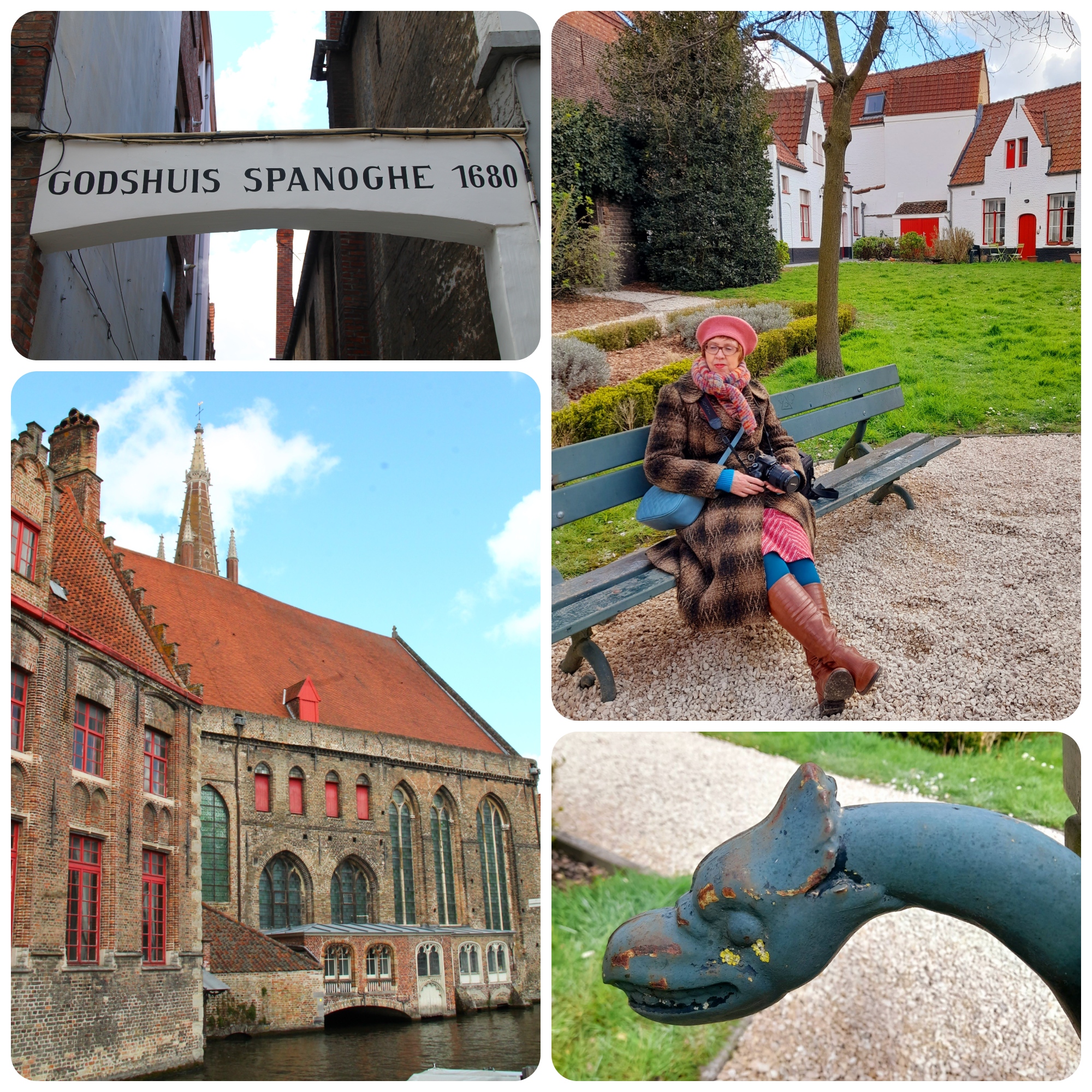
The one in the above collage, Godshuis Spanoghe, has a couple of conveniently placed benches (with the cast iron griffin head finials typical for Bruges) overlooking one of the canals and offering a closer look at the back of St. John's Hospital.


We'd managed to obtain tickets for the 3 pm brewery tour so, after having fortified ourselves with another round of cappuccinos in a café across the square, we made our way towards the brewery's shop.

As we were joining an English language tour, an international group of beer aficionados had gathered here, and we were soon joined by a passionate guide who definitely had the gift of the gab.


The authentic brewery, the last one remaining in the centre of Bruges, is a family business with a tradition stretching back through six generations to 1856. This is where the Bruges city beer - the Brugse Zot - is brewed: a strong-tasting, high-fermentation beer based on malt, hops and special yeast. 

In 2016 a unique underground beer pipeline, some 3 km long, was laid from the brewery to the bottling plant in the suburbs. The pipeline you can see on the bottom right is just a gimmick, and isn't part of the real one.


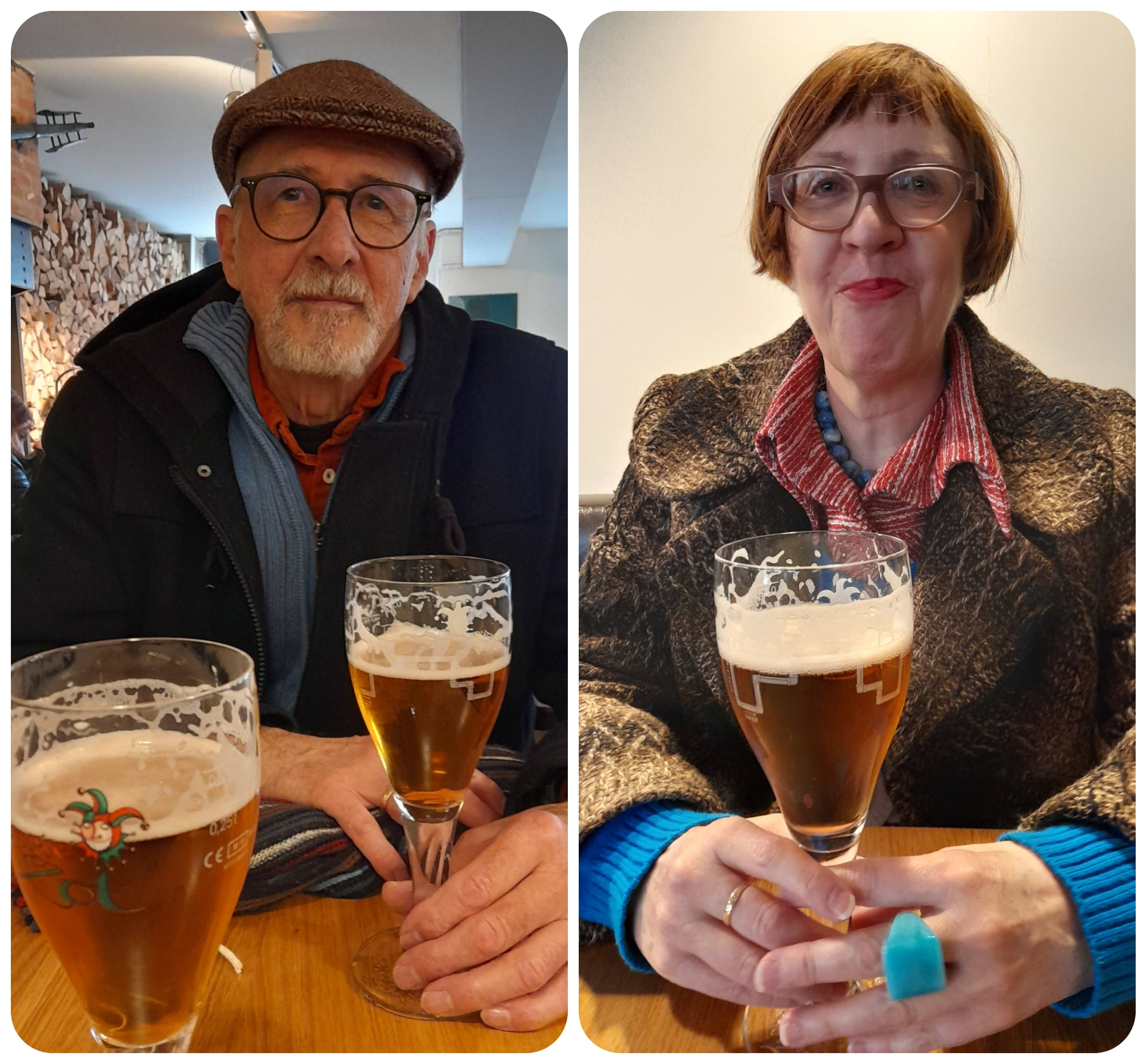
Those of you who have been following me for a while might frown at all this talk about beer, knowing that both Jos and I do not drink alcohol. There is, however, an alcohol-free version of the Brugse Zot - which by the way translates as Bruges Fool - going under the decidedly ugly name of Sportzot, and which happens to be Jos's favourite.

Back in September, we even witnessed part of the hop picking and processing at the hop farm near Poperinge where the hops used to produce Brugse Zot and Sportzot are grown. See here and here.


One of the highlights of our visit included a steep climb on a narrow staircase up to the brewery's roof terrace, which challenged both my claustrophobia and vertigo!

It was just our luck that clouds had gathered in the meantime and that our faces were being stung by the first of the forecasted sleet once we'd made it up there! The panorama was spectacular though, so I quickly snapped a few photos before following the rest of the gang who had already taken shelter inside. It was only later that I noticed the gate, church and part of the Beguinage courtyard in the photo on the top left.


The tour ended with a free drink at the large on-site café, ours obviously being a Sportzot! 

By the time we left and were walking back to the car park, the clouds had temporarily dried their eyes and, with a parting glance at the splendid St. John's Hospital picturesquely lining the canal, we once again bade Bruges goodbye.


Back at the B&B, with the rain beating against our windows, we had our evening meal, consisting of rolls we'd bought in Bruges and the rest of Tuesday's tapas board, which Veronique had kindly wrapped up and put in the fridge for us.


Imagine our surprise when, after our final night in the lap of luxury we woke up to a Winter Wonderland on Friday morning. The temperature had dropped to barely above freezing point and we were positively shivering when we quickly dashed across to the main building for breakfast.

By the time we'd packed our bags into the boot of our car, thaw had already set in and we made it home without any hiccups or delays.


Sadly, we have come to the end of our adventures, and it will be business as usual in my next post.

But not before leaving you with the scene awaiting us when we drew our curtains that morning. Surely it couldn't have been more magical. Or perhaps it could, if they'd been unicorns instead of horses!


Saturday, 9 April 2022

Postcards from Bruges - Part 2

Apart from the obvious reasons - surely writing travelogues is much more enjoyable than keeping you up to date about everyday life - there is another reason that I am thankful for having the subject matter of our Bruges getaway to blog about. Unfortunately Jos's cold has caught up with me in the meantime, although it did have the decency to wait until I was back. So, apart from a couple of haphazard outfit photos, I wouldn't have had much to show you and even less to tell you about otherwise!

Time having its usual tendency to fly when one is having fun, it is now well over a week ago that we woke up in Het Soetewater on the morning of our first full day, Wednesday the 30th of March.

We'd both slept like the proverbial logs and it was an utter joy to wake up at leisure and in a peaceful environment instead of being jolted awake around 6 am by building work going on across the road.


We took our time getting ready and dressed, gazing out across the field where the two horses had been joined by complacent sheep and gambolling lambs, then strolled over to the breakfast room in the B&B's main building. 

Impatient though he was to start sampling Veronique's breakfast delicacies, I nevertheless made Jos wait until I'd taken a photo! 


After breakfast, it was time for our second trip into Bruges, where we arrived shortly after the shops had opened, before it got too busy for our liking. Not that we wanted to do a spot of shopping, mind you. We just wanted to stroll along the Steenstraat, one of Bruges' main shopping streets, into the direction of the Markt (Market Square). 

Our chosen route took us past the Sint-Salvatorskathedraal (Saint Saviour's Cathedral). As we'd walked past it countless of times over the years but had never been inside, this was our first stop of the day.

We were a bit put off to see several groups of children apparently on school trips. In fact, they contributed largely to the amount of tourists milling around, the advantage being that they were only a temporary nuisance, leaving relative peace and quiet in their wake after they'd moved on.  In short, it was just a matter of waiting in the wings until they'd gone.


Visiting the cathedral had been a spur of a moment thing, so I hadn't done my homework.  I just photographed things that caught my eye, only finding out later that I'd managed to catch some of the cathedral's main treasures. 

Case in point is the marble and alabaster tomb of Bishop Jean II Carondelet (1469-1544), who became provost of the cathedral chapter of St Donatian in Bruges in 1520. He was the confidant of Margaret of Austria and a friend of Erasmus. The tomb dates from 1549 and is one of the finest Renaissance sculptures preserved in Bruges.


The cathedral is Bruges' oldest parish church (12th–15th century) and among its treasures are a rood loft with an organ (the latter currently being under restoration), medieval tombs, Brussels tapestries and a rich collection of Flemish paintings dating from 14th to the 18th century. 


The crucifix on the top left used to be in the former Eekhout Abbey, a medieval house of Augustinian Canons in Bruges. After the French Revolution, the cross and the associated "Brotherhood of the Miraculous Cross" found shelter in St Saviour’s in 1801. According to legend, a group of iconoclasts were intent on destroying it. However, before they could do so, Christ opened his eyes and moved his foot - which accounts for the peculiar position his right foot is in - scaring the living daylights out of them and making them flee the scene.

The crucifix, which dates from the late 13th century, would be the oldest one preserved in Bruges.


Other highlights include the silver reliquary of St. Eligius (top left) dating from 1612, who allegedly was the founder of St. Saviour's.

On the top right, the coffin-shaped copper reliquary of Charles the Good, in neo-Romanesque style and dating from 1883-85. It is decorated with 1588 gemstones, semi-precious stones and pearls. Charles the Good, Count of Flanders, was murdered on 2 March 1127 in the once important St. Donatian's church in Bruges, of which now only the foundations remain.

Finally, on the bottom right, the intricately carved Retable of St. Anna, in polychromed and gilded wood and dating from 1533.

There is, by the way, no entrance fee to the church, but collection boxes for the maintenance of the church can be found at regular intervals. I rather loved the ornate wooden one on the bottom left.


Right, that's more than enough religious architecture and art heritage for now. Let's proceed towards the Market Square, shall we? 

But not before making another stop at The Chocolate Line (top right), the chocolate shop selling artisan  chocolate with a cool and trendy side (their words, not mine), by the famous Belgian chocolatier Dominique Persoone, who describes himself as a "shock-o-latier". As a surprise for the joint birthday party of the Rolling Stones' Ron Wood and Charlie Watts in 2007,  and at the request of the musicians' wives, Persoone invented the "Chocolate Shooter", a device with which you can shoot chocolate powder into your nostrils. 

We decided not to join the queues and, spurred on by our rumbling stomachs, continued to the Market Square, where we had Croques Monsieurs (toasted sandwiches with ham and cheese) for lunch, sitting outside on a - thankfully heated - terrace.  


Afterwards, we strolled towards the Belfry on the opposite side of the square. There was an actual market taking place, and we browsed the stalls selling an array of foodstuffs as well as plants and flowers. Both me and Lulu seemed to have stalls here, mine selling all kinds of sweets and hers a choice of French sausages!

The narrow, waffle and souvenir shop lined Breidelstraat, leading to the Burg square, was chock-a-block with the aforementioned groups of school children, so we waited until they'd disappeared around the corner.


When we reached the square shortly afterwards, they seemed to have vanished into thin air. Perhaps they'd gone into once of the square's richly decorated buildings?

In my humble opinion, the Burg is Bruges' most architecturally interesting square. The impressive building right in front of us is the Gothic Town Hall dating from 1376, making it one of the oldest in the Low Countries. One could stare at its lavish facade for hours and still discover quirky stone carvings one hadn't noticed before.


The Town Hall is flanked by two other noteworthy buildings, starting with the Civiele Griffie (Old Civil Registry, top left) on its left. Opulently decorated with gilded friezes and statues, it was built in the Renaissance style in 1537.

More gilding was used on the facade of the building on its right, the Basilica of the Holy Blood (bottom right), built between 1134 and 1157, and promoted to minor basilica in 1923.


We left the Burg behind by walking underneath the arched gateway of the Civiele Griffie which gives access to a narrow lane hemmed in between houses and leading towards the Vismarkt (Fish Market).

There's a number of restaurants here which in spite of being in a popular spot didn't seem to attract too much business. The cheerful red booth selling tickets for boat trips always makes me reach for my camera.

The sun briefly showed her face again as we crossed the Vismarkt and starting walking along the picturesque stretch of canal called the Groenerei. 

The mercury would barely touch 10°C that day, so I'd dressed warmly in a black wool and polyester blend vintage dress dotted with flower baskets. I'd exchanged Tuesday's coat for my favourite brown Winter one, which I combined with a marled knit scarf of many colours and a sage green beret.  


There are photo opportunities with every step you take. Several old arched stone bridges cross the canal here and if you're lucky nobody's walking across them just when you click the shutter. Patience usually pays off, as in spite of its appealing character, it's usually not that crowded here.

Apart from the usual suspect, the Summer house, which I have yet to pass without making a photo, I was charmed by the hotel sign which seemed to be caught in the branches of the tree, and the gaggle of fluffy ducklings taking a rest on a stone slab.


A backward glance was rewarded by another classic Bruges scene, with the belfry unfortunately playing hide and seek behind the branches of a tree. Can you spot it?


We crossed the busy Langestraat and proceeded along the Verversdijk, on the left side of yet another canal.The street on the other side is called the Sint-Annarei, which can be reached by crossing the eponymous bridge. Away from the hustle and bustle, the quiet Sint Anna quarter is definitely one of the city's hidden secrets. 

The intriguing tower on the top left belongs to the Jerusalem Chapel, which is part of the Adornes domain, an authentic medieval estate. This is well worth a visit, which is what we did back in February 2020. You can read my post about it here.

A bit further along is the Museum of Folk Life, which we visited back in May 2019. Just like we did back then, we had a drink at the traditional on-site café called In De Zwarte Kat, although we were saddened to learn that the museum's black cat had dissapeared back in February.


Here are a some glimpses at the museum's collection of objects relating to daily life in Bruges in the 19th and early 20th centuries. I was intrigued by the contraption on the top right, which turned out to be mud shoes!


By the time we left the museum it was mid-afternoon, and having walked a long way we were getting tired. Moody clouds had obscured all traces of sunshine by now. In order to catch our breaths, we sat down on a bench at the head of the junction of the Sint-Annarei with yet another canal, the Spiegelrei.

Again, this is a typical Bruges scene, the wide canal lined by monumental merchants' houses dating from the 13th to the 15th century, when Bruges was the most important trading centre in North-West Europe.


Having finally dragged ourselves away from the bench, we returned to the town centre by walking  along the Spiegelrei. There's a small square at the canal's end, with some imaginatively planted up flower boxes which, apart from the ubiquitous tulips and forget-me-nots contained a couple of majestic orange Fritillaria imperialis. 


We ducked into a patisserie, where we had restorative cups of cappuccino and watched the world go by. 

We finished our day by wandering around and having a browse in a couple of shops until it was time for dinner, for which we returned to the Market Square. No photographs were taken of our meal as we were both more than ready for a lie-down by then. 

The weather forecast for Thursday was predicting another drop in temperature accompanied by rain and sleet. Would the blasted weathermen have it right? Please join me again in my next post in order to find out!