Showing posts with label Bruges. Show all posts

Friday, 12 December 2025

More Bruges wanderings and a fairy-tale castle

This is the view which greeted us upon waking up on our second morning at B&B Het Soetewater. The morning fog was about to make way for another unseasonably warm and sunny day. The sun was gently illuminating the trees standing guard in their Autumn finery at the back of the meadow, the resident sheep playing hide-and-seek with the lingering veil of opalescent mist.


All traces of fog had disappeared into thin air by the time we were ready for breakfast, leaving a bright blue, almost cloudless sky in its wake.

Before making our way to the breakfast room in the main part of the B&B, we briefly wandered around the garden to admire the dried papery flower heads of the hydrangeas and the Michaelmas daisies which were still in their prime.


So, breakfast! You'll be glad to hear that Jos's appetite had returned, so that he was finally able to sample some of Veronique's delicacies. As you can see, he could hardly wait until I'd taken a photo of our breakfast table!


We'd decided on a day of two halves, starting with a morning of wandering around Bruges.

After once again leaving our car at the 't Zand car park, we now proceeded to walk into the opposite direction, taking a left turn instead of a right like we did on Thursday.

We had no agenda for our wanderings, our only aim being to soak up the atmosphere of this picture perfect UNESCO World Heritage city, which on this gloriously sunny November day, with its dome of cerulean blue sky, was looking particularly dreamlike.


And so it was that we found ourselves at the Leeuwenbrug (or Lion's Bridge), which crosses the peaceful Speelmansrei canal, where two almost pussycat-like lions are gazing towards the Belfry. 

The current bridge dates from 1627 and was built by Bruges master mason Jan de Wachter. In 1629, the parapets were decorated with two lion statues crafted by sculptor Jeroom Stalpaert, their front paws proudly resting on a shield bearing the gothic B of Bruges.

At the end of the eighteenth century, the lion on the western parapet was pushed into the water and replaced by a new one. In 1955, the second lion was replaced due to the poor condition of the stone.


Recently, the shields have been restored to their original appearance. During annual maintenance, it was determined that they were in urgent need of restoration. While cleaning, two different shades of blue were discovered. After further investigation, supported by a historical photograph from the image bank, it became clear that the darker shade of blue was the correct finish, so that the decision was made to repaint them in their authentic colour.


Soon our wanderings were making us thirsty, so we found a nice little café, called Salé et Sucré, where Jos enjoyed a glass of his favourite alcohol-free beer, while I opted for a cappuccino. 

Jos's beer came accompanied with a bowl of crisps which he devoured in no time. If that isn't proof that he'd regained his appetite, I don't know what is.


No matter how many times we've been here, Bruges continues to wow us. 

We ambled into the direction of Jan van Eyck Square, named after the world-famous master painter.

From the 13th to the 15th century, this was a lively port area where traders assembled from all over Europe. Bruges was the trading hub between the Hanseatic cities of the far North, England and Germany, and the main trading centres in France, Spain and Italy. 

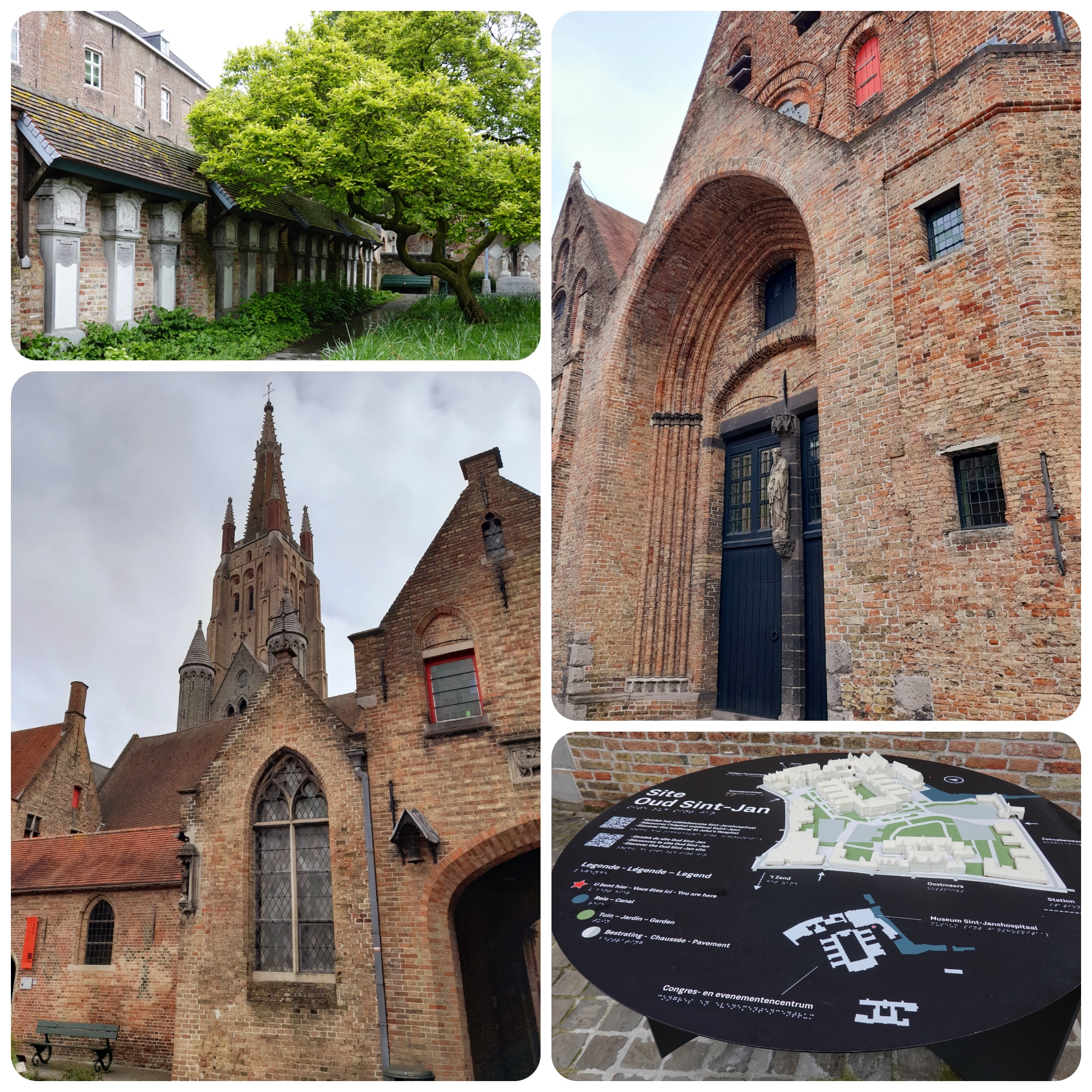
In the Middle Ages a toll was levied here.  Pieter van Luxemburg, a knight of the Order of the Golden Fleece, used this money to rebuild the Old Tollhouse in 1477 (above, bottom right) and the late Gothic porch is therefore decorated with his polychrome coat of arms. The narrow building jutting out to the left of the porch is the Rijkepijndershuis, the guild house of the dockworkers.


Jan van Eyck square ends rather abruptly at the stone parapet of the Koningsbrug (King’s Bridge) which backs the majestic Spiegelrei canal, looking particularly splendid with the blue sky reflected in its gently rippling waters. 

Wandering through Bruges means revisiting old favourites, like the quirky Papageno sculpture (1980) in front of the Royal City Theatre (1869) with its neo-Renaissance façade.  The sculpture, which is by the Belgian sculptor Jef Claerhout (1937–2022), pictures the Papageno character from Mozart’s opera ‘Die Zauberflöte’ (The Magic Flute). See here for some close-ups.

There are some sculptures at the back of the theatre as well, by Jozef De Looze (1925-2011), one of which you can see in this collage), but we had yet to spot this tiny bronze frog, which sits almost unobtrusively on the railing around one of the flower beds at the front of the theatre. I squealed in delight when I finally found the little fellow.


Midday had come and gone? but instead of finding a place to have lunch, we grabbed some cheese and ham rolls and a drink, which we planned to have at our afternoon destination.

A mere 10-minute drive took us from the 't Zand car park to Loppem Castle in the village of Loppem, which lies to the south-west of Bruges. Those of you who have been here for a while might recall our previous visits, in August 2021 and April 2024. 

We parked our car in the leafy car park which lies at the end of a long and narrow cobbled drive, where we had a makeshift picnic amid a flurry of drifting Autumn leaves. 


Boasting the turrets, nooks and crannies you would expect to find in a neo-Gothic building, Loppem Castle seems to have been lifted straight from the pages of a book of fairy tales.

The castle has been in the van Caloen family since the 18th century, but has seen a number of changes over the generations. The current castle, which replaced an older, original manor house, was completed in 1863 and is considered an excellent example of Flemish neo-Gothic style. 


In 1856, the English architect Edward Welby Pugin (1834-1875) was commissioned by the future inhabitants, Baron Charles van Caloen and his wife, Countess Savina de Gourcy Serainchamps, to draw up plans for the castle. Later on, supervision of the building work was entrusted to the Belgian architect Jean-Baptiste Bethune (1821-1894), who gave a slightly more Flemish character to the building. 


Unlike many castles which evolved over the centuries, Loppem Castle was constructed in a single phase and, even though it was occupied by its owners for generations until 1940, the interior has remained almost completely untouched, with the original neo-Gothic architectural features and furnishings still present and correct, and thus maintaining much of its original design and charm.


The castle's entrance hall or vestibule was definitely built to impress. With its grand staircase and its vaulted ceiling, it is where guests were received and where van Caloen and his guests played billiards.

The stunning encaustic floor tiles were produced by Minton Hollis from Stoke-on-Trent, Staffordshire.


Reaching up 17 metres from the floor, in polychromed wood with six bosses decorated with family coats of arms, the ceiling is a faithful copy of the 14th century vault of the gothic hall in Bruges' city hall.

The grand staircase's banister is composed of a hundred exquisitely crafted panels featuring native plants, animals and hunting scenes.


On the first floor, the two-storey, single-nave family chapel, with Jean-Baptiste Bethune's stained-glass windows depicting the family's patron saints, can be admired.

The chapel is housed in the prominent, corbelled sandstone bay crowned with octagonal spire at the front of the castle.


During World War I, the castle played a crucial role in Belgian military history. In October 1918, King Albert I of Belgium and his government used the castle as their temporary headquarters while planning the final offensive against German forces. It was here that key decisions were made about Belgium’s post-war future, adding an extra layer of significance to the castle’s legacy.

The castle and the park became the property of the Jean van Caloen Foundation in 1952 in order to protect the future of this exceptional heritage site. The park was opened to the public in 1974. One year later the castle was made accessible as well. Visitors cannot only enjoy the unique interior but also discover an important painting and sculpture collection.


The floor above the main Entrance Hall is where much of the art collections are on display;

Collecting started at the time of Charles van Caloen and Savina de Gourcy Serainchamps. They bought all kinds of art and antiques with which they decorated their castle: paintings, Chinese porcelain, glassware, hunting paraphernalia, Etc. 

The greatest collector, however, was their grandson Jean van Caloen. The collection he amassed is impressive. In addition to paintings and sculptures, he bought medieval manuscripts, master drawings, prints, ivory, alabaster, pottery and even baking moulds. His son Roland van Caloen was also a passionate collector, especially of Asian and African art.


There's so much to see that repeated visits are required to take it all in, so that it definitely won't be the last time we were here. If only it was to see my favourite object, the Waffle Angel! 

I was most disappointed upon learning that this wood, polychrome and gilt kneeling angel has nothing whatsoever to do with waffles or waffle-making. Made in Italy between 1425 and 1450, he or she was used to store relics.


While Jos was taking a breather and resting his feet on a bench, I strolled through the English-style park with its winding paths, ancient trees and intriguing red painted octagonal pavilion.


In 1866, a neo-Gothic building was constructed in the garden for Joseph, Charles' and Savina's eldest son. Named "Le Petit Musée” (the little museum), its was where the young Joseph could indulge his interest in art and house his collection of objects.


The castle and garden are actually on an island which can be reached by two separate bridges and, with the weather still holding, but the first of the clouds on the horizon, I crossed the one at the west side of the garden. Viewed from the lane at the back of the garden, the castle was looking particularly picturesque framed by the lake and the Autumn clad trees.

At the east side of the castle, another surprise awaited in the form of a German bunker (hidden behind the topiary hedges in the photo on the bottom left), built during the First World War as a shelter for the German officers who occupied the castle from the end of 1917.


The remainder of the day's blue sky had now been completely obscured by a layer of grey and, although rain didn't seem to be imminent, we decided to call it a day and return to the B&B.

As this was our last day, and we'd be going home on Saturday morning this, alas, is the end of my tiny Bruges travelogue. 

It'll be business as usual as from my next post onwards.

Thank you for reading and for your all of your lovely comments!


Friday, 5 December 2025

In Bruges

We woke up to a sky of deepest blue, its colour appearing even more vivid against the amber and gold Autumn foliage. The weather forecast couldn’t have been better, speaking of highs of 18°C and promising a day which, if one disregards the fact that signs of advanced Autumn were all around us, could almost have been considered summery. After weeks of grey and rainy days, we couldn’t have planned our holiday at a better time if we’d tried. The world – or at least Bruges – was our oyster that day and Veronique’s breakfast was awaiting us. 

So, what could possibly go wrong? Well, quite a lot, it seems as, after a fitful night’s sleep, Jos had woken up feeling tired and queasy.


We were the only guests for the first two nights, so breakfast was set out exclusively for us. Apart from a selection of cereals, homemade granola, fruit and yoghurt, homemade bread, rolls and croissants, Veronique had produced a fingerlickingly good chocolate cake. Set out on our table was a selection of charcuterie, cheeses and smoked salmon, all of which were making my mouth water. Not Jos’s though, although he did do his best to at least eat something in spite of his appetite having gone AWOL.


After breakfast, we took our time getting ready for the 20-minute or so drive into Bruges, parking at the inner-city car park at the ‘t Zand square. There’s a cheaper alternative at the railway station from where there’s free public transport to the city centre. However, we are prepared to pay somewhat over the odds for the luxury of being within a short walk of the majority of Bruges’ tourist attractions.

We hadn’t made any definite plans on what to do apart from earmarking a couple of museums in case it should rain. As the weather gods clearly didn’t have any intention in that direction, we were just going to wander and see where our feet would take us. 


There’s no avoiding the hordes of tourists who flock to Bruges any given day of the week or time of year, but we still wanted to give a wide birth to the main shopping thoroughfares leading to the tourist honey pots around the Market Square. Instead, we walked along some quiet back streets into the general direction of the Beguinage.

Still not feeling up to much, Jos was lagging behind while I tried to keep my own spirits up by taking photographs of anything which grabbed my attention, starting with an armada of paper boats floating upon the water of 't Putje, a tiny square in the shadow of the Concert Hall.


Our feet ultimately took us to the Minnewater (a.k.a. the Lake of Love), where we found Jos a sun-trap of a bench on which to sit and watch the world go by. 

People once believed that water nymphs (minnen in old Flemish) lived here, and thus the lake acquired its name. Add to that a tragic love story, mysterious trees and an abundance of greenery and you get a place steeped in romance. 

The tragic legend recounts the tale of Minna, a young woman who was in love with a warrior of a neighbouring tribe. Minna ran away from her father to avoid being forced to marry someone else. She ran into the forest and found her lover, only to die in his arms of exhaustion from her journey.


The Minnewater is also home to the famous Bruges swans. 

After the death of Mary of Burgundy in 1482, Bruges went through some troubled times. The townspeople, enraged by the new taxes imposed by Mary's successor, Emperor Maximilian of Austria, rose in revolt against their new ruler. As Maximilian was locked up in House Craenenburg on the Market Square, he helplessly witnessed the torture and eventual beheading of his bailiff, Pieter Lanchals, whose surname translates as long neck. Legend has it that the Emperor eventually escaped and later took his revenge on the local people by forcing them to keep long necks, or swans, on the canals for eternity. 

In reality, however, swans have been swimming on the canals since the beginning of the 15th Century, when they were seen as a status symbol of the city’s power and wealth.


The picturesque building which meets its reflection in the lake (above, bottom left) is the Sashuis (or Lock-Keeper's House)  used to regulate the city's water supply The current Sashuis was built in the 16th Century to replace a 13th Century lock complex. It has been out of use since the 1970s but the three sluice gates are still clearly visible. 

Leaving Jos topping up his Vitamin D levels on that lakeside bench, I decided to walk into the direction of the bridge the eagle-eyed of you might be able to spot between the trees on the bottom right in the above collage, and which lies at the opposite end of the Minnewater.


There were picture postcard views everywhere I looked, and I couldn't resist taking snapshots of the reflections in the mirror-like surface of the lake. Quite a few trees seemed to be reluctant to let go of their leaves and, if one half-closed one's eyes, one could even imagine it being at the tail-end of Summer rather than the year's penultimate month. But then the quality of light - so typical of a sunny Autumn day - and the seasonal show of reds, yellows and golds were giving the game away. 


The picturesque building on the east bank of the lake is Minnewater Castle, previously known as Castle de la Faille and built in neo-Gothic style in 1893. Opened in 2015 as a brasserie with a lake-side terrace, we had the pleasure of enjoying cups of cappuccino here on a bitterly cold day back in March 2022. 


Upon reaching the bridge which marks the end of the lake, one comes face to face with the imposing Poertoren (Gunpowder Tower). The defensive tower, which was built in 1397 and stands 18 metres tall, was originally part of one of the city gates and was later converted into a gunpowder store. 


The bridge leads into the leafy Minnewater Park, where I took one of the winding paths to take me back to the start. I stopped to take a photo or two whenever a view of the lake opened up, and ultimately passed the rather forlorn looking Minnewater Castle (above, top right). The latter didn't seem to be open so that we would have to look elsewhere when in need of sustenance.


After touching base with Jos on his bench and making sure he was ok, I decided to join the hordes of tourists who were taking a guided tour of the Beguinage. As they all seemed to walking into the direction of the main gate, I took the one opposite the Lock-Keeper's House, and walked along a dead-end street with a couple of houses called de steert (transl. the tail).

Years of practice makes it look as if I was on my own here, but trust me, I wasn't. The place was inundated with groups of tourists who were being entertained by knowledgeable guides speaking every language under the sun.


The  'Princely Beguinage Ten Wijngaerde' was founded in 1245. This little piece of world heritage was once the home of the beguines, emancipated lay-women who nevertheless led a pious and celibate life. Their life in the beguinage was lived in silence as much as possible. 

Today it is still inhabited by a few nuns and by single women who choose to live a serene lifestyle. 


Leaving de steert, the Beguinage enfolds as a rough circle of delightful whitewashed houses surrounding a central green. In Spring, this is a mass of daffodils, which is quite a magical sight


Before leaving the beguinage, I paid a brief visit to its church (top and bottom left and bottom centre).

The 13th-Century St. Elisabeth church was originally Gothic, but almost completely burned down in the 16th Century due to a fallen candle. Some baroque interior elements were added during its reconstruction in the 17th Century.

The shrine to Our Lady of Banneux, virgin of the poor (above, top right), is hidden away in a little chapel in the front garden of one of the beguinage's cottages. 


It was almost 1.30 pm when I finally rejoined Jos, and my stomach was audibly rumbling. Walking away from the Minnewater on the picturesque Wijngaardplein we spotted an empty table on the terrace of a restaurant called La Dentelliere and decided to look no further. 

Jos still wasn't hungry and the pasta dish I'd ordered turned out to be fairly basic, so that it wasn't the most enjoyable experience ever, apart from the fact that we were able to eat outside in bright Autumnal sunshine on the 6th of November!


Wijngaardplein is the place where the horse carriage rides stop for a breather. The horses can be seen enjoying a short break from their work here and being given buckets of feed which the poor creatures need to share with the eternally famished flocks of pigeons. 

The afternoon was well advanced by the time we (or rather, I) finished lunch, so we decided to walk back to 't Zand.  I'd devised a little route which would take us past some Godshuisjes (Alms Houses), but unfortunately these turned out to be closed off as they were in the process of being restored.


Eventually we arrived in the peaceful Arents Courtyard, which is surrounded by the Arentshuis after which it was named and which has temporary exhibitions of fine art, the Onze Lieve Vrouwekerk (Church of Our Lady), and the the city palace of the lords of Gruuthuse, now an award-winning museum.

The chap on the top left in the above collage is one of the The Four Horsemen of the Apocalypse by Belgian sculptor Rik Poot (1924-2006).


From here, we wanted to cross into the courtyard in front of the Gruuthuse museum, but once again we found our plans thwarted by the omnipresent roadworks. Sigh! 

I still managed to take a couple of snapshots of the former palace's magnificent façade.

Then we took a deep breath and entered tourist land, crossing the Dijver canal and making our way towards the Market Square and along Bruges' main shopping street until we reached the car park. 


Back at the B&B, we rested our feet until it was time to devour the rest of Veronique's tapas board. I'm sure you'll be glad to know that Jos managed to eat some of it and that in the course of the evening he suddenly declared he was feeling much better!

I'll be back with a more cheerful report of our second day, but in the meantime here's a peek of what I was wearing underneath that checked coat ...


Tuesday, 7 May 2024

No Bruges deluge!

It was a grey and gloomy day we woke up to on Friday the 19th of April. Gone were Thursday's blue skies and glorious sunshine, and if the weather forecast was to be believed we were in for another Bruges deluge

A peek through our windows revealed that, although proof of some overnight rain was in the puddles, at least it was dry for now. What's more, there still wasn't any sign of imminent rain when we walked over to the breakfast room. The outside world didn't look - or feel - any inviting, though, so we lingered somewhat over breakfast while discussing our plans for the day ahead.


Without the previous day's sunshine, the temperature, which was once again barely into double digits, felt positively chilly, so that a bit of layering was of the essence. 

I picked up the long-sleeved Trevira fit and flare dress from Think Twice back in September. The chocolate brown cable-knit tank top I layered on top of it was a charity shop find at the end of 2022 and has proved to be a versatile workhorse in my wardrobe. As does my necklace, which was a retail buy from Accessorize many years ago. As we'd expected to be out and about all day, I added a cardigan for good measure. You'll be catching a glimpse of the latter at the end of this post.


Much to our delight, it was still dry when we were finally ready to drive down to Bruges. However, as the weathermen on the news and the app on our phones seemed to be in agreement that it would rain at some point during the day, we decided to dip into Bruges' ample wet weather options.


Our first port of call was St. John's Hospital, which is one of Europe's oldest preserved hospital buildings, dating from the 12th Century. 

Although we'd often walked on the adjacent Old St. John's site, which also contains the hospital's 19th century successor (now a congress centre), we never had the opportunity to visit the museum itself as for some reason it always seemed to be closed when we were in Bruges.

This time, finally, we were in luck: after an extensive refurbishment, the museum had reopened its doors in December 2023.


Hospitality and care have been intertwined with the hospital's DNA since it was originally founded back in the 12th century.  Ill and needy people were taken care of here. In fact, anyone who needed care or a place to sleep was welcomed, regardless of origin or class. 

The mediaeval wards, with accompanying chapel and impressive attic, are now set up as a contemporary museum, in which visitors are being immersed in the history of care and healing.


There's an impressive collection of medical instruments and hospital artifacts which make you thank your lucky stars you were born in the 20th Century and that medicine has come along as far as it has.

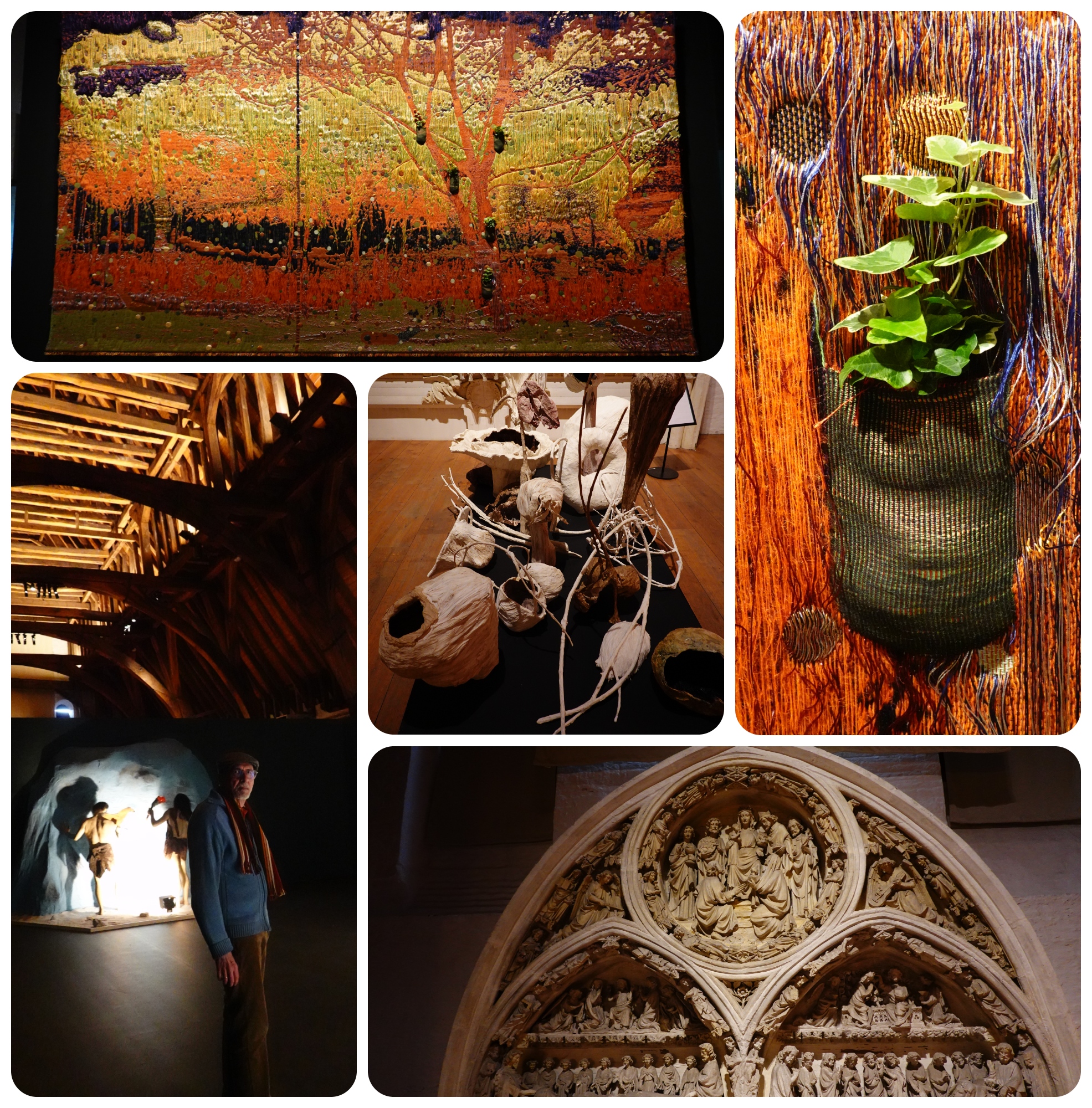
One of the items on display is an old ambulance (above, top right), which is little more than a metal box with long wooden handles, in which the patient had to stand as he was carried by porters to the hospital. 

Not surprisingly, heavenly intervention was much relied on back in the day. There was an interactive display (above, top right) which shed some light on the available celestial remedies.


The museum contains a unique collection of works by Hans Memling,Hans Memling (1430-1494), the 15th century Flemish Primitive painter. This master of hyper-realistic scenes and landscapes lived and worked in Bruges and created his most important works there. In fact, four of the seven masterpieces in the museum were created specifically for St. John's Hospital, and they have been housed here since the late 15th Century. 


In the adjacent hospital church, you come face to face with the St. Ursula Shrine, one of Memling's absolute masterpieces. Completed in 1480, this work is considered the highlight of the artist’s later years. Taking pride of place in the hospital chapel, the shrine is a carved reliquary cased in gold and shaped like a miniature wooden Gothic church. 

Here, you are offered the opportunity to fold a paper model of the shrine and - like people did at the St Ursula Shrine in mediaeval times - make a wish and entrust it to the shrine.  And yes, we did fold one of our own - or rather, Jos did - and took it home with us.


In dialogue with Memling's work are some works by contemporary artists. 

These include the large sculpture (above) called 'Reclining Arcangelo II'. Representing a reclining angel with folded wings on a kind of tomb, its creator is the Flemish artist Berlinde De Bruyckere (°1964), who made it especially for the museum.


The textile installation 'De Fluisterzetel' (Whisper Chair, above, top left) by Barbara Raes and Klaas Rommelaere incorporates stories and clothes from deceased loved ones. 

Another contemporary artwork is the sculpture called 'The Bridge' by Australian artist Patricia Piccinini (°1965). It’s a hyper-realistic sculpture of a woman gently placing her hand on the hand of a strange creature, which is half woman, half pig. 


It is definitely worth climbing to the the attic floor, which is being used for temporary exhibitions. The spectacular roof structure made from oak beams is among the oldest and most monumental in Europe.

Here, Unearthed - Sunlight (2021) by Nigerian artist Otobong Nkanga (°1974) is taking pride of place. In this work, she combined woven images of a heat-scorched forest with tendrils of living ivy.

This work is part of an exhibition called Rebel Garden, which takes place simultaneously in three Bruges museums. The exhibition broaches highly topical themes such as the effects of global warming, climate activism, man's symbiosis with nature and the relationship between artist and garden.


I took up the invitation to become part of the exhibition by sticking my head into one of the hanging greenhouse structures!

A combined ticket encompassing all three museums was € 25 so even if we were only planning on visiting two of them, it would be saving us money, since the general entrance price for each of them separately was € 15. 


It was midday by now and time for lunch, for which we returned to our favourite place at the Market Square, passing some of Bruges' iconic landmarks along the way.

The rain held off until we were safely ensconced on the restaurant's heated and covered terrace, and had thankfully come and gone by the time we'd finished eating. In fact, we didn't even have to open our umbrellas all day. 


Still, the forecasted rain must have put off most of the tourists as, contrary to Thursday's queues for canal boat tours, the majority of the boats now lay empty and idle at the landing stages due to lack of punters.

We were on our way to our second museum of the day, the Groeninge Museum. 

With works by Flemish primitives such as Jan van Eyck, Hans Memling and Gerard David, neo-classicism by Joseph Odevaere and Joseph Ducq, Flemish expressionism, and 20th Century modern art by René Magritte, Roger Raveel and Raoul De Keyser, the museum offers six centuries of Belgian visual arts in one location.


It's impossible to thoroughly take in everything in one go, so we'll definitely need to schedule another visit at a later date.

Here are some the highlights, or rather, some of the paintings which caught my attentions.


I didn't need to read the inscription to identify the triptych on the bottom left as the work of Hieronymus Bosch (c. 1450-1516). With his imaginative visual language awash with devils and monsters, he developed a movement that was highly dominant throughout north-western Europe in the 16th Century. The Last Judgement, part of which was completed by Bosch alone, depicts a hellish landscape populated with imaginary creatures.

The Triptych of Job on the top right dates from the first quarter of the 16th Century is by an anonymous follower of  Hieronymus Bosch.

It goes without saying that the works on the top left and bottom right are part of the Rebel Garden exhibition.


As are the fungi-like things between the paintings on the top left.

The other paintings are, clockwise from top right: Portrait of the Archduchess Isabella (c. 1601-1620, anonymous follower of Frans (II) Pourbus, Rest on the Flight into Egypt (c. 1560, anonymous) and Portrait of Margareta van Eyck (1432, Jan Van Eyck).


Clockwise from top left: Portrait of a Woman with her two Children (c. 1804, Franciscus Josephus Kinsoen), the atmospheric 'La Mare aux Fées' at Fontainebleau (c. 1876, Alphonse Asselbergs), Portrait of Marie-Joséphine Lafont-Porcher (c. 1835, Franciscus Josephus Kinsoen) and the haunting Les Fumées (c. 1930, Pierre Paulus).


Stunned by room after room of paintings, we were ready for another round of waffles, for which we made our way to the nearest tearoom along the Dijver canal.

Then, alas, it was time to say goodbye to Bruges once more. But no fear, we'll be back soon!