It was a grey and gloomy day we woke up to on Friday the 19th of April. Gone were Thursday's blue skies and glorious sunshine, and if the weather forecast was to be believed we were in for another Bruges deluge!
A peek through our windows revealed that, although proof of some overnight rain was in the puddles, at least it was dry for now. What's more, there still wasn't any sign of imminent rain when we walked over to the breakfast room. The outside world didn't look - or feel - any inviting, though, so we lingered somewhat over breakfast while discussing our plans for the day ahead.

Without the previous day's sunshine, the temperature, which was once again barely into double digits, felt positively chilly, so that a bit of layering was of the essence.
I picked up the long-sleeved Trevira fit and flare dress from Think Twice back in September. The chocolate brown cable-knit tank top I layered on top of it was a charity shop find at the end of 2022 and has proved to be a versatile workhorse in my wardrobe. As does my necklace, which was a retail buy from Accessorize many years ago. As we'd expected to be out and about all day, I added a cardigan for good measure. You'll be catching a glimpse of the latter at the end of this post.

Much to our delight, it was still dry when we were finally ready to drive down to Bruges. However, as the weathermen on the news and the app on our phones seemed to be in agreement that it would rain at some point during the day, we decided to dip into Bruges' ample wet weather options.
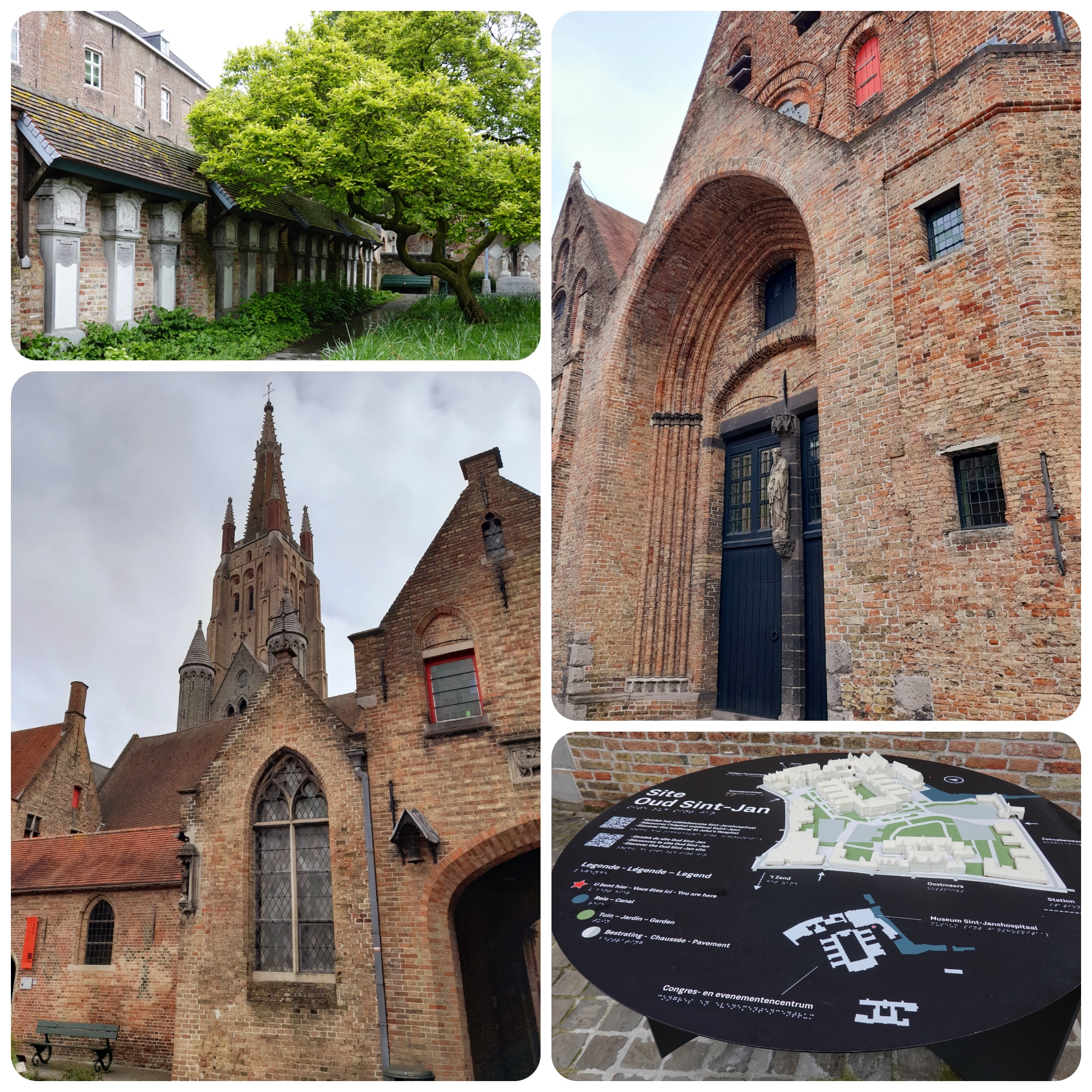
Our first port of call was St. John's Hospital, which is one of Europe's oldest preserved hospital buildings, dating from the 12th Century.
Although we'd often walked on the adjacent Old St. John's site, which also contains the hospital's 19th century successor (now a congress centre), we never had the opportunity to visit the museum itself as for some reason it always seemed to be closed when we were in Bruges.
This time, finally, we were in luck: after an extensive refurbishment, the museum had reopened its doors in December 2023.

Hospitality and care have been intertwined with the hospital's DNA since it was originally founded back in the 12th century. Ill and needy people were taken care of here. In fact, anyone who needed care or a place to sleep was welcomed, regardless of origin or class.
The mediaeval wards, with accompanying chapel and impressive attic, are now set up as a contemporary museum, in which visitors are being immersed in the history of care and healing.

There's an impressive collection of medical instruments and hospital artifacts which make you thank your lucky stars you were born in the 20th Century and that medicine has come along as far as it has.
One of the items on display is an old ambulance (above, top right), which is little more than a metal box with long wooden handles, in which the patient had to stand as he was carried by porters to the hospital.
Not surprisingly, heavenly intervention was much relied on back in the day. There was an interactive display (above, top right) which shed some light on the available celestial remedies.

The museum contains a unique collection of works by Hans Memling,Hans Memling (1430-1494), the 15th century Flemish Primitive painter. This master of hyper-realistic scenes and landscapes lived and worked in Bruges and created his most important works there. In fact, four of the seven masterpieces in the museum were created specifically for St. John's Hospital, and they have been housed here since the late 15th Century.

In the adjacent hospital church, you come face to face with the St. Ursula Shrine, one of Memling's absolute masterpieces. Completed in 1480, this work is considered the highlight of the artist’s later years. Taking pride of place in the hospital chapel, the shrine is a carved reliquary cased in gold and shaped like a miniature wooden Gothic church.
Here, you are offered the opportunity to fold a paper model of the shrine and - like people did at the St Ursula Shrine in mediaeval times - make a wish and entrust it to the shrine. And yes, we did fold one of our own - or rather, Jos did - and took it home with us.

In dialogue with Memling's work are some works by contemporary artists.
These include the large sculpture (above) called 'Reclining Arcangelo II'. Representing a reclining angel with folded wings on a kind of tomb, its creator is the Flemish artist Berlinde De Bruyckere (°1964), who made it especially for the museum.

The textile installation 'De Fluisterzetel' (Whisper Chair, above, top left) by Barbara Raes and Klaas Rommelaere incorporates stories and clothes from deceased loved ones.
Another contemporary artwork is the sculpture called 'The Bridge' by Australian artist Patricia Piccinini (°1965). It’s a hyper-realistic sculpture of a woman gently placing her hand on the hand of a strange creature, which is half woman, half pig.
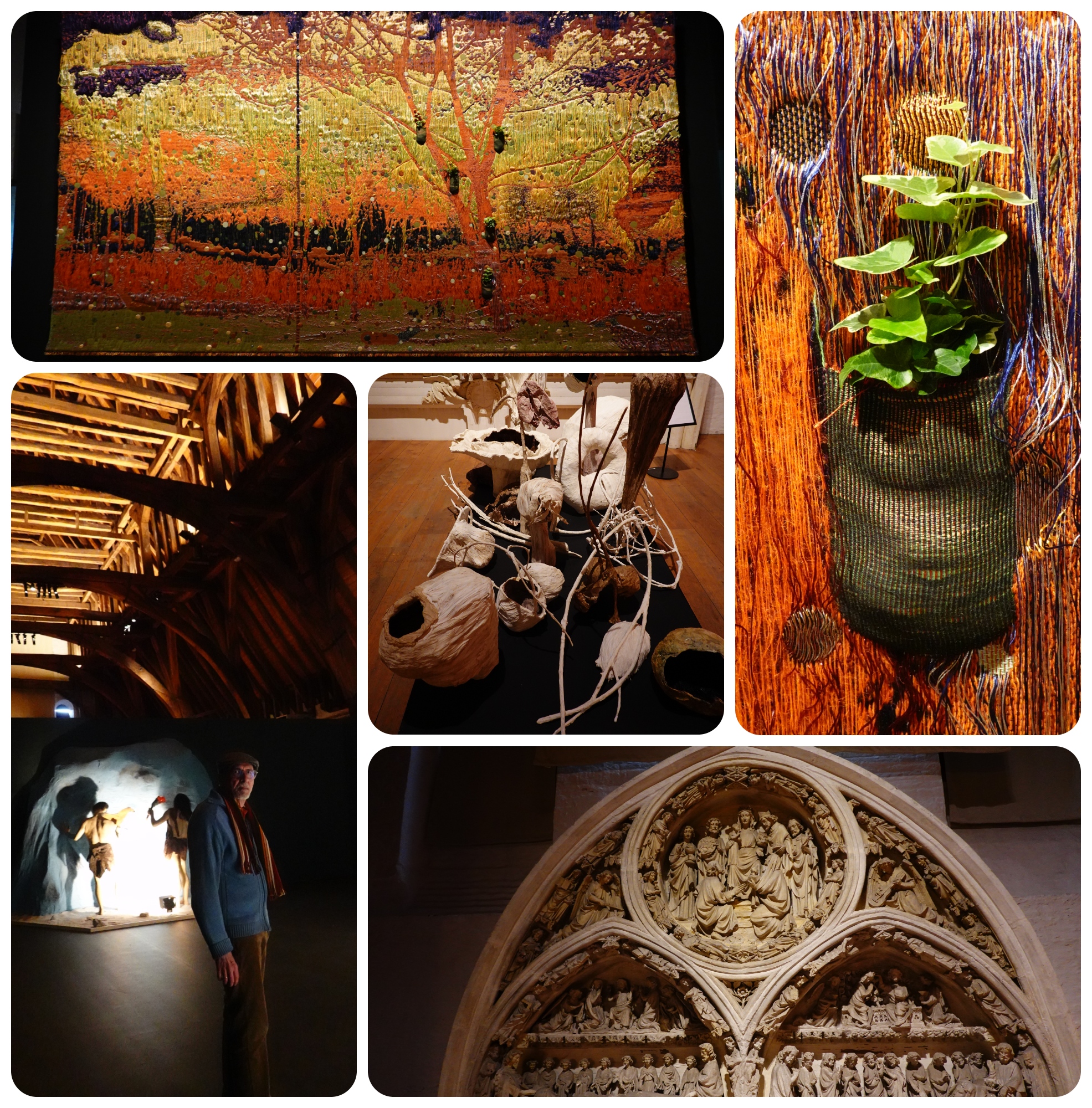
It is definitely worth climbing to the the attic floor, which is being used for temporary exhibitions. The spectacular roof structure made from oak beams is among the oldest and most monumental in Europe.
Here, Unearthed - Sunlight (2021) by Nigerian artist Otobong Nkanga (°1974) is taking pride of place. In this work, she combined woven images of a heat-scorched forest with tendrils of living ivy.
This work is part of an exhibition called Rebel Garden, which takes place simultaneously in three Bruges museums. The exhibition broaches highly topical themes such as the effects of global warming, climate activism, man's symbiosis with nature and the relationship between artist and garden.

I took up the invitation to become part of the exhibition by sticking my head into one of the hanging greenhouse structures!
A combined ticket encompassing all three museums was € 25 so even if we were only planning on visiting two of them, it would be saving us money, since the general entrance price for each of them separately was € 15.

It was midday by now and time for lunch, for which we returned to our favourite place at the Market Square, passing some of Bruges' iconic landmarks along the way.
The rain held off until we were safely ensconced on the restaurant's heated and covered terrace, and had thankfully come and gone by the time we'd finished eating. In fact, we didn't even have to open our umbrellas all day.

Still, the forecasted rain must have put off most of the tourists as, contrary to Thursday's queues for canal boat tours, the majority of the boats now lay empty and idle at the landing stages due to lack of punters.
We were on our way to our second museum of the day, the Groeninge Museum.
With works by Flemish primitives such as Jan van Eyck, Hans Memling and Gerard David, neo-classicism by Joseph Odevaere and Joseph Ducq, Flemish expressionism, and 20th Century modern art by René Magritte, Roger Raveel and Raoul De Keyser, the museum offers six centuries of Belgian visual arts in one location.

It's impossible to thoroughly take in everything in one go, so we'll definitely need to schedule another visit at a later date.
Here are some the highlights, or rather, some of the paintings which caught my attentions.

I didn't need to read the inscription to identify the triptych on the bottom left as the work of Hieronymus Bosch (c. 1450-1516). With his imaginative visual language awash with devils and monsters, he developed a movement that was highly dominant throughout north-western Europe in the 16th Century. The Last Judgement, part of which was completed by Bosch alone, depicts a hellish landscape populated with imaginary creatures.
The Triptych of Job on the top right dates from the first quarter of the 16th Century is by an anonymous follower of Hieronymus Bosch.
It goes without saying that the works on the top left and bottom right are part of the Rebel Garden exhibition.

As are the fungi-like things between the paintings on the top left.
The other paintings are, clockwise from top right: Portrait of the Archduchess Isabella (c. 1601-1620, anonymous follower of Frans (II) Pourbus, Rest on the Flight into Egypt (c. 1560, anonymous) and Portrait of Margareta van Eyck (1432, Jan Van Eyck).

Clockwise from top left: Portrait of a Woman with her two Children (c. 1804, Franciscus Josephus Kinsoen), the atmospheric 'La Mare aux Fées' at Fontainebleau (c. 1876, Alphonse Asselbergs), Portrait of Marie-Joséphine Lafont-Porcher (c. 1835, Franciscus Josephus Kinsoen) and the haunting Les Fumées (c. 1930, Pierre Paulus).

Stunned by room after room of paintings, we were ready for another round of waffles, for which we made our way to the nearest tearoom along the Dijver canal.
Then, alas, it was time to say goodbye to Bruges once more. But no fear, we'll be back soon!