Showing posts with label art. Show all posts

Saturday, 27 July 2024

Sunday pursuits and a Monday meet-up

Welcome back to the Shropshire travelogue, which has now reached episode # 5. As the adventures I'm chronicling here today are now well over a month old, a bit of time-travelling was required to relive them all. So, once again I'm thankful for the effort I made to at least jot down a couple of lines in my diary each day, and there's definitely more than just a modicum of truth in the time-worn adage that a picture is worth a thousand words!


Take this one for instance, for which we stopped at the top of our lane on the morning of Sunday the 16th of June. For once the weather gods appeared to be with us that day, treating us to a blue sky floating with fluffy cotton wool clouds and bathing the rolling green sheep-dotted fields in glorious sunshine. It instantly takes me back to that morning when, breathing in the scents of Summer in the countryside and listening to the soothing soundtrack of bleating sheep, I felt on top of the world.


After our outing to the Ironbridge gorge on Saturday, we wanted to stay a little bit closer to home on Sunday. Just as we'd done on the in-between Sundays in both 2022 and 2023, we'd planned to drive over to Ludlow, about half an hour up the road from the cowshed. However, as our journey would take us through Craven Arms, we couldn't pass up the opportunity to visit the English Heritage owned Stokesay Castle, tantalizing glimpses of which can be caught from the A49.

It wouldn't be our first visit to this picturesque fortified medieval manor house. In fact, we first came here on a rainy day in July 2008 when we were holidaying across the county border in Herefordshire, while our second and penultimate visit was on a glorious Summer's day in June 2019.


What we hadn't reckoned with on on this sunny Sunday, on which highs of 18°C had been forecasted, was that we had to share the property with a coach party, who were just making their way towards the entrance when we were parking our car.

Stokesay Castle was constructed at the end of the 13th century by Laurence of Ludlow, who at the time was one of the richest men in England. It remains a treasure by-passed by time and one of the best places to visit in England to experience what medieval life was like.

With so many people milling about the property, it was virtually impossible to take a proper photograph of the17th-century timber-framed gatehouse leading into Stokesay or the beautifully ornate carvings in its frame. The photograph on the top right was taken at the back of the gatehouse in a rare moment when nobody was passing through it.


The same problem awaited us in Stokesay's great hall which has remained virtually unchanged for more than 700 years. The fine timber roof and staircase (the latter not pictured, as I gave up trying), with treads cut from whole tree trunks, all show the same carpenters' mark from 1291. 

Too swift to determine whether they were swallows or house martins, we were nevertheless captivated by the birds who were clearly treating the castle as their domain, freely flying in and out of the windows in order to feed their hungry offspring in their intricately built clay nests.


Inside the solar - or private apartment block - one is bowled over by the overmantel, intricately carved with fruit, flowers and figures. Once brightly coloured it still has some traces of the original red, green and gold paint. The two-storey solar has one of the few post-medieval alterations to the castle, having been refashioned in the 17th century into a fine panelled chamber.


We ended our visit with a stroll around the castle by way of the moat walk, taking in views towards the North Tower and Great Hall, with the occasional glimpse of the surrounding Shropshire Hills.

For further reading, I urge you to have a look at Aril's blog (here), as she serendipitously posted about her visit to Stokesay Castle earlier this week.


Before continuing to Ludlow as planned, we enjoyed a car picnic, and made some quick outfit photos. I was wearing a cotton skirt I'd bought in an Outlet shop back in February, combined with a green and blue Breton top from H&M by way of the charity shops. My fuchsia belt and wooden discs necklace were bought on the high street, while the pink, flower-patterned sneakers were a lucky find in a Shrewsbury charity shop in June 2019.

It's only a 10-minute or so drive from Stokesay to Ludlow, where we managed to grab one of the last parking spots going. We were just about to put our money into the Pay and Display machine, when we were reminded by a couple passing by that parking was free on a Sunday. Duh, of course! We ended up talking to the lovely couple, who'd just travelled up from their home in Somerset the previous day and, like us, were staying in a holiday cottage called The Byre!


We went for a stroll around this gem of a town, found treasure in the handful of charity shops which were open on a Sunday and browsed the Antiques and Collectors fair on Castle Square, where most of the brooches were found.

I'd been on the lookout for Emma Donoghue's Slammerkin for ages and couldn't believe my luck when I happened upon a pair of pristine Clarks Wave Walks, which might be in the running to replace my beloved but slightly battered Cloudsteppers. The Big Biba book was picked up from Castle Bookshop.

Having done our rounds, we were in need of a sit-down and some sustenance, which we found in the café of the newly refurbished Assembly Rooms turned arts and community centre on Castle Square. Which comes highly recommended, by the way.


Before rejoining our car, we couldn't resist popping into St. Laurence's Church, Shropshire's largest parish church and often described as the "cathedral of the marches". 

I'm not surprised it was among the 18 churches given a five-star rating in England's Thousand Best Churches by Simon Jenkins (1999).


My main reason for popping in was to swoon once more over the church's magnificent collection of misericords or mercy seats. Misericords are medieval choir stall seats designed to be raised during services, so that the occupants had to stand. If they became tired, they could rest their bottoms against the small ledges protruding from the bottom of the seats: a small mercy of the heart (or misericordia).

St Laurence's has a total of 28 of these, one of the largest collections in a parish church. They date from two periods: the construction of the original choir stalls in about 1425, and the remodelling of the stalls in 1447 when the Choir was extended.


We had an early night on Sunday, as we needed to be up early-ish on Monday. 

We were relieved that it looked set to be a mostly dry day with some sunny spells thrown into the mix as another blogger meet-up was on the menu that day. I had suggested the National Trust managed Dudmaston Hall due to its manageable distance for all of us. This time, apart from Vix and Jon, we would be joined by my blogging friend Claire and her husband Gareth, whom we'd met for the first time last year. 


We were the first to arrive but had only just stepped out of our car when Vix and Jon's red Citroën C5, Patrice, trundled up the drive, closely followed by Claire and Gareth in their red Beetle.

Lots of hugging ensued, after which we proceeded towards the entrance, where we arranged to join a tour of the property's art collection at 11.30. Finding our plans for a stroll around the garden thwarted as it only opens at 11, Claire and Gareth suggested going for a walk, which turned out to be the delightful Dingle Walk we did back in 2019 and 2023. It was here that the ominous looking sky decided to rain down on us. Thankfully, it was only a mere and very short-lived drizzle! 


We made it back to the house with only minutes to spare for the Cocktail of Art tour during which Alison, our lovely volunteer and guide, walked us around Dudmaston Hall's art collection, pointing out favourites and giving some background information on the artists. 

Dudmaston Hall houses one of the most important collections of modern art in Britain, started by Sir George and Lady Labouchere - who inherited Dudmaston Hall in 1952 -  in the 1950s while Sir George was working for the British Embassy in Brussels. 

The collection includes works by Barbare Hepworth (top right) and Henry Moore (bottom left) amongst many others. I'm not sure the boys were quite as impressed by the works of art as us girls!


Photos on top left and right courtesy of Vix


With the tour finished, it was time for a spot of lunch, which at around 19°C we were lucky enough to be able to have outside in the orchard.

Afterwards, we headed back to the house for a visit to the rooms proper.

The girls were drawn to the fabulous collection of antique fans. No fear, we didn't raid the display cases for the ones we are holding. They were laid out alongside some leaflets explaining the language of the fan. According to Vix, I'm wishing to get rid of you here. Sorry about that!

Dudmaston’s story spans almost a millennium, lived in by the same family through inheritance and marriage for over 875 years and never sold. 


After years of diplomatic service, Sir George and Lady Labouchere moved into the property in 1966. 

By this time it had been decided that the estate would be given to the National Trust, which was completed in 1978 with the provision that Lady Labouchere’s descendants could carry on living at the estate. Lady Labouchere died in 1996, followed by her husband George in 1999, but members of the Hamilton-Russell family (descendants of Lady Labouchere’s cousin), remain occupants of the house to this day.


Vix, Claire and I kept snapping away, often captivated by and photographing the same things. We all swooned over the yellow Nina Campbell wallpaper in one of the bedrooms.


By then, gaps of blue had appeared in the sky, and we were raring to go and explore the gardens. The usually fabulous view towards the house was marred by a giant marquee, which thankfully disappeared once we'd descended the steps into the rockery to arrive at the edge of the Big Pool.


There are several sculptures by the artist  Anthony Twentyman (1906-1988) dotted around the garden. One of them, called Space Frame (1985) was featured in the BBC 2 series Hidden Treasures of the National Trust last year. As it was fenced off, I refrained from taking a photograph this time around, but the link will take you to the one I made on our previous visit.

The sculpture Jon and I are posing next to is another one by him, called The Watcher. The photo is courtesy of Vix.


Photos courtesy of Vix, Jon and Claire


We ended the day by going for another, longer walk around the estate, skirting Big Pond, with us girls chatting all the time and only marginally taking in the views. After all, it might very well be another year until we meet again!

After a final drink, which we once again had in the orchard, it was time to say our goodbyes, and to exchange presents with Claire and Gareth.


They absolutely spoiled us with local delicacies, a Bridgnorth tankard, a gorgeous patchwork washbag, lots of lovely jewellery, including a woolly sheep brooch from Ireland, a vintage Berkertex blouse and St. Michael skirt.


I'm ending this post with a view from the cowshed's window that evening. That moody sky really didn't bode well. 

What would the weather gods have in store for us for the final days of our holiday? I'll tell you all about it in my next and final travel post!


Tuesday, 7 May 2024

No Bruges deluge!

It was a grey and gloomy day we woke up to on Friday the 19th of April. Gone were Thursday's blue skies and glorious sunshine, and if the weather forecast was to be believed we were in for another Bruges deluge

A peek through our windows revealed that, although proof of some overnight rain was in the puddles, at least it was dry for now. What's more, there still wasn't any sign of imminent rain when we walked over to the breakfast room. The outside world didn't look - or feel - any inviting, though, so we lingered somewhat over breakfast while discussing our plans for the day ahead.


Without the previous day's sunshine, the temperature, which was once again barely into double digits, felt positively chilly, so that a bit of layering was of the essence. 

I picked up the long-sleeved Trevira fit and flare dress from Think Twice back in September. The chocolate brown cable-knit tank top I layered on top of it was a charity shop find at the end of 2022 and has proved to be a versatile workhorse in my wardrobe. As does my necklace, which was a retail buy from Accessorize many years ago. As we'd expected to be out and about all day, I added a cardigan for good measure. You'll be catching a glimpse of the latter at the end of this post.


Much to our delight, it was still dry when we were finally ready to drive down to Bruges. However, as the weathermen on the news and the app on our phones seemed to be in agreement that it would rain at some point during the day, we decided to dip into Bruges' ample wet weather options.


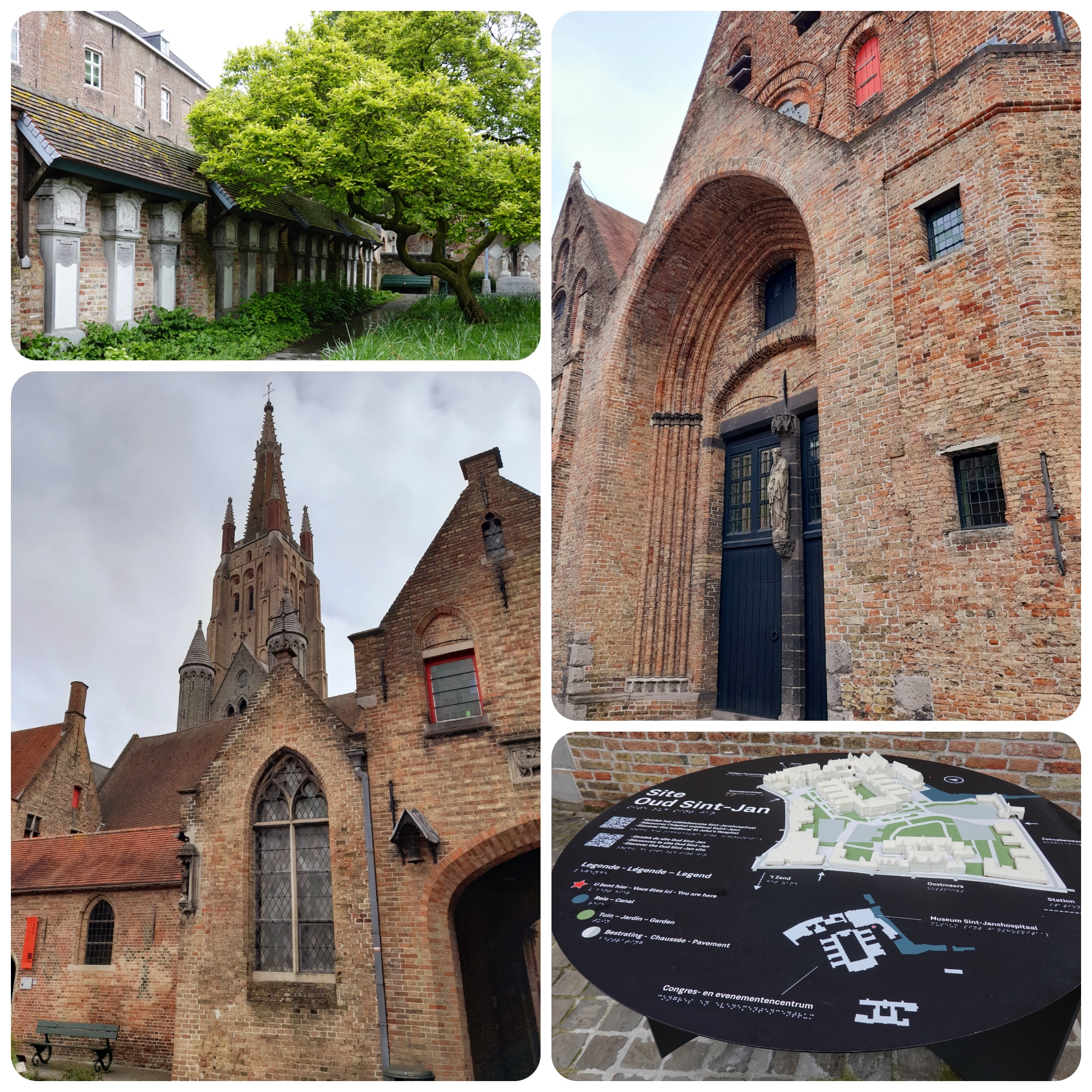
Our first port of call was St. John's Hospital, which is one of Europe's oldest preserved hospital buildings, dating from the 12th Century. 

Although we'd often walked on the adjacent Old St. John's site, which also contains the hospital's 19th century successor (now a congress centre), we never had the opportunity to visit the museum itself as for some reason it always seemed to be closed when we were in Bruges.

This time, finally, we were in luck: after an extensive refurbishment, the museum had reopened its doors in December 2023.


Hospitality and care have been intertwined with the hospital's DNA since it was originally founded back in the 12th century.  Ill and needy people were taken care of here. In fact, anyone who needed care or a place to sleep was welcomed, regardless of origin or class. 

The mediaeval wards, with accompanying chapel and impressive attic, are now set up as a contemporary museum, in which visitors are being immersed in the history of care and healing.


There's an impressive collection of medical instruments and hospital artifacts which make you thank your lucky stars you were born in the 20th Century and that medicine has come along as far as it has.

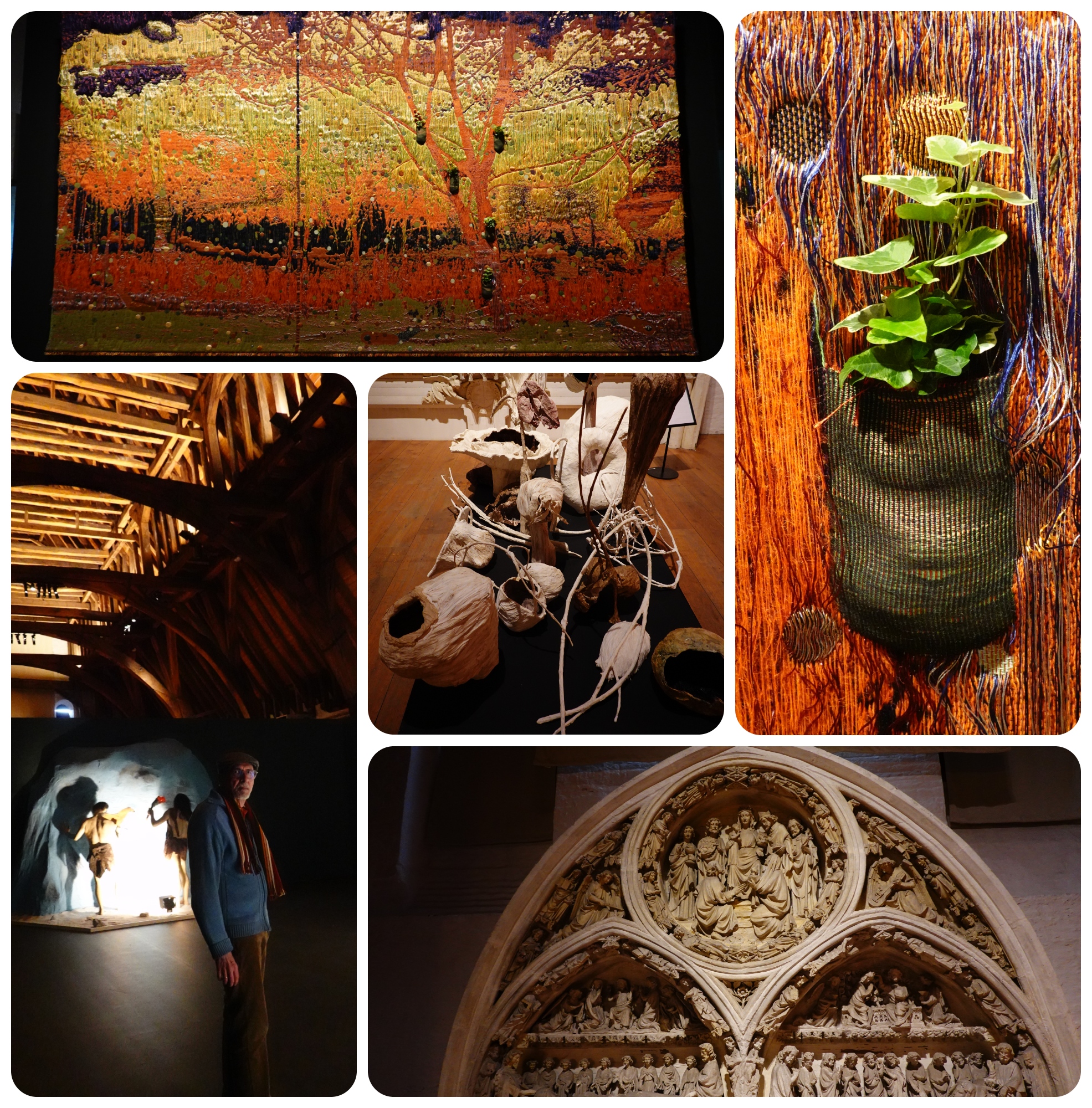
One of the items on display is an old ambulance (above, top right), which is little more than a metal box with long wooden handles, in which the patient had to stand as he was carried by porters to the hospital. 

Not surprisingly, heavenly intervention was much relied on back in the day. There was an interactive display (above, top right) which shed some light on the available celestial remedies.


The museum contains a unique collection of works by Hans Memling,Hans Memling (1430-1494), the 15th century Flemish Primitive painter. This master of hyper-realistic scenes and landscapes lived and worked in Bruges and created his most important works there. In fact, four of the seven masterpieces in the museum were created specifically for St. John's Hospital, and they have been housed here since the late 15th Century. 


In the adjacent hospital church, you come face to face with the St. Ursula Shrine, one of Memling's absolute masterpieces. Completed in 1480, this work is considered the highlight of the artist’s later years. Taking pride of place in the hospital chapel, the shrine is a carved reliquary cased in gold and shaped like a miniature wooden Gothic church. 

Here, you are offered the opportunity to fold a paper model of the shrine and - like people did at the St Ursula Shrine in mediaeval times - make a wish and entrust it to the shrine.  And yes, we did fold one of our own - or rather, Jos did - and took it home with us.


In dialogue with Memling's work are some works by contemporary artists. 

These include the large sculpture (above) called 'Reclining Arcangelo II'. Representing a reclining angel with folded wings on a kind of tomb, its creator is the Flemish artist Berlinde De Bruyckere (°1964), who made it especially for the museum.


The textile installation 'De Fluisterzetel' (Whisper Chair, above, top left) by Barbara Raes and Klaas Rommelaere incorporates stories and clothes from deceased loved ones. 

Another contemporary artwork is the sculpture called 'The Bridge' by Australian artist Patricia Piccinini (°1965). It’s a hyper-realistic sculpture of a woman gently placing her hand on the hand of a strange creature, which is half woman, half pig. 


It is definitely worth climbing to the the attic floor, which is being used for temporary exhibitions. The spectacular roof structure made from oak beams is among the oldest and most monumental in Europe.

Here, Unearthed - Sunlight (2021) by Nigerian artist Otobong Nkanga (°1974) is taking pride of place. In this work, she combined woven images of a heat-scorched forest with tendrils of living ivy.

This work is part of an exhibition called Rebel Garden, which takes place simultaneously in three Bruges museums. The exhibition broaches highly topical themes such as the effects of global warming, climate activism, man's symbiosis with nature and the relationship between artist and garden.


I took up the invitation to become part of the exhibition by sticking my head into one of the hanging greenhouse structures!

A combined ticket encompassing all three museums was € 25 so even if we were only planning on visiting two of them, it would be saving us money, since the general entrance price for each of them separately was € 15. 


It was midday by now and time for lunch, for which we returned to our favourite place at the Market Square, passing some of Bruges' iconic landmarks along the way.

The rain held off until we were safely ensconced on the restaurant's heated and covered terrace, and had thankfully come and gone by the time we'd finished eating. In fact, we didn't even have to open our umbrellas all day. 


Still, the forecasted rain must have put off most of the tourists as, contrary to Thursday's queues for canal boat tours, the majority of the boats now lay empty and idle at the landing stages due to lack of punters.

We were on our way to our second museum of the day, the Groeninge Museum. 

With works by Flemish primitives such as Jan van Eyck, Hans Memling and Gerard David, neo-classicism by Joseph Odevaere and Joseph Ducq, Flemish expressionism, and 20th Century modern art by René Magritte, Roger Raveel and Raoul De Keyser, the museum offers six centuries of Belgian visual arts in one location.


It's impossible to thoroughly take in everything in one go, so we'll definitely need to schedule another visit at a later date.

Here are some the highlights, or rather, some of the paintings which caught my attentions.


I didn't need to read the inscription to identify the triptych on the bottom left as the work of Hieronymus Bosch (c. 1450-1516). With his imaginative visual language awash with devils and monsters, he developed a movement that was highly dominant throughout north-western Europe in the 16th Century. The Last Judgement, part of which was completed by Bosch alone, depicts a hellish landscape populated with imaginary creatures.

The Triptych of Job on the top right dates from the first quarter of the 16th Century is by an anonymous follower of  Hieronymus Bosch.

It goes without saying that the works on the top left and bottom right are part of the Rebel Garden exhibition.


As are the fungi-like things between the paintings on the top left.

The other paintings are, clockwise from top right: Portrait of the Archduchess Isabella (c. 1601-1620, anonymous follower of Frans (II) Pourbus, Rest on the Flight into Egypt (c. 1560, anonymous) and Portrait of Margareta van Eyck (1432, Jan Van Eyck).


Clockwise from top left: Portrait of a Woman with her two Children (c. 1804, Franciscus Josephus Kinsoen), the atmospheric 'La Mare aux Fées' at Fontainebleau (c. 1876, Alphonse Asselbergs), Portrait of Marie-Joséphine Lafont-Porcher (c. 1835, Franciscus Josephus Kinsoen) and the haunting Les Fumées (c. 1930, Pierre Paulus).


Stunned by room after room of paintings, we were ready for another round of waffles, for which we made our way to the nearest tearoom along the Dijver canal.

Then, alas, it was time to say goodbye to Bruges once more. But no fear, we'll be back soon!


Friday, 12 January 2024

Twixmas tales - Part 2

I woke up with a head full of cotton wool on Boxing Day.  As congested sinuses had made me toss and turn all night, I could only thank my lucky stars that I didn't have to get up when it was still pitch dark outside and that I could spend the day doing whatever tickled my fancy. In fact, nobody would have batted an eyelid if I'd wanted to spend it lying on the sofa if so inclined.  

Wasn't it just my luck though that I had to be plagued by a head cold during my week off? Admittedly, it was miles better than being struck down by a serious case of the flu like I was last year, but I could still have done without it.


I started feeling a bit better after a healthy dose of fruit and yoghurt for breakfast, after which I had a good old rummage in my wardrobes (note the plural!) in search of the perfect outfit to suit my mood as well as the day. 

No athleisure wear for me, thank you, and God forbid I'd stay in my pyjamas all day!

So, out came this navy blue Diolen dress, its pattern a seemingly incongruous mix of yellow and tan flowers and seashells. 


Blues and yellows were the colours of choice for my dress's companion, a zig-zag patterned Zoë Loveborn cardigan charity shopped back in November. The blue flower corsage I pinned to the latter was echoed by my moulded plastic flower ring. 

My necklace featuring multicoloured wooden disks was bought brand new from Accessorize and has been in my collection for many years. 

The day was miraculously dry and sunny for once and with the temperature still a more than reasonable 12°C, it was clear that the sofa would have to wait another day.


It has long been a tradition of ours to go for a walk in Middelheim Sculpture Park on Boxing Day, even if the weather was determined to put a spanner in the works a couple of times. This year, however, wild horses couldn't have kept us away!

Art has been on the move here all through 2023 and will continue to do so in 2024, as a mind-boggling total of 224 works are in the process of being given a new home. I'm pretty sure that Odyssey (above, bottom right) wasn't in this particular place before. Dating from 1968, it is a work by the American sculptor Bernard (Tony) Rosenthal (1914-2009). 


The hesitant Midwinter sunshine was spotlighting Antony Gormley's Firmament III, which I suspect is among the 50 or so works of art in the park which are inseparable from their location and will therefore remain in situ.

The same will definitely be the case for the make-believe street called Surroundings (1972-1973), an art installation by the Italian artist Alik Cavaliere (1926-1998).


Moving a sculpture that has been anchored in the ground for decades is no easy task. Moreover, they are all unique works of art, each of them requiring its own preparation process, method and approach depending on its materials and vulnerabilities. The relocation of a total of 224 different works of art is, therefore, a hugely labour-intensive job. 

After the transformation, the sculptures will be on display in completely different clusters, inspired by the different types of landscape in the park.


Meanwhile, normal service is disrupted, with some parts of the park temporarily out of bounds, and a not inconsiderable amount of sculptures hanging out together in the adjacent open-air depot before being allocated their new location.

Believe it or not, but the massive tire which has suddenly materialized at the back of the Braem Pavillion is a work of art too: dating from 2012, it is part of  Pièces à conviction (Pieces of evidence) by the Belgian artist Michel François (b.1956). It used to be in the part of the museum called Middelheim-Laag on the opposite side of the road.


Vierkantrohre Serie D (above, top left) by German artist Charlotte Posenenske (1930-1985) has been attached to the side wall of the Braem Pavilion since 2017. It consists of a set of six hollow forms made of galvanized metal that appear to be parts of an industrial ventilation shaft. Very convincingly, it seems, as I only found out this was actually a work of art when I was browsing the museum's online catalogue a couple of years ago.

Bosque Metalica (above, bottom left) has found its new location near the Braem Pavillion as well. Dating from 1971, and thus a contemporary of the Brutalist pavillion, the sculpture which consists of eight separate elements in black, green, orange and yellow, is by the artist Jorge Dubon (Mexico, 1938-2004).


Making a shortcut through a carpet of leaves to avoid a particularly muddy stretch, we came across Artisticus Confusa (2020), a whimsically shaped aluminium flower of nearly one metre tall, created by Tom Volkaert, who was born in Antwerp in 1989.

The gold painted chair is part of the park's furniture. These, and their silver painted sisters can be found all over the park and are perfect if one wants to take a breather or just, sit and stare at a particular work of art, or perhaps even temporarily become part of it.


This sculpture, which I believe is new to the museum, was caged to protect it from the elements. Although I hadn't seen it before, it instantly rang a bell, as it reminded me of the sculpture on display in the courtyard of the 800-year old castle known as Het Steen standing on Antwerp's quayside.

Sure enough, when I looked it up, it turned out to be by the same artist, Sharon Van Overmeiren (b. 1985). It is called The Voyage of the Mascot and dates from 2021.


We ended our afternoon walk in the Museum Café, where we shared a hefty piece of cheesecake, and enjoyed cups of cappuccino (Jos) and hot chocolate (me).

Although more rain had been forecasted for Wednesday the 27th of December, it never materialized. I know, stranger things have happened but still ...

I was rewearing the as yet unphotographed outfit I wore on my last office day of the year, featuring a happy mix of charity shop and retail buys.


The forest green faux suede skirt is an old sales bargain from Mango and an absolute joy to wear. Here, it is joined by a rose-patterned jumper from King Louie, by way of the charity shops. Both the label-less sparkly pink cardigan and the green Les Cordes necklace were charity shop finds as well.

My one and only Christmas themed brooch deserves a special mention, as it was a gift from the lovely Gisela, who blogs under Miss Magpie's Musings.


Apart from the odd sniffle, I was feeling so much better and, what's more, I was craving a rummage at the charity shop. 

We drove down to the three-floored one in Duffel where it was quite busy as it seemed a lot of people had had the same idea. Or perhaps they'd come to donate their unwanted Christmas presents?


Anyway, here's a quick look at what I found. 

Above, from left to right: brown marled knit hat, groovily patterned blouse by Belgian label Claude Arielle, tan mock croc belt by CKS, which is yet another Belgian label, and chunky yellow, white and dusty pink knit scarf with pom-poms!

In spite of my self-imposed coat ban, I couldn't possibly resist this purple and lime patterned one, although the photo doesn't do its colours much justice. To make up for this, I'll be wearing it in one of my next posts!


And now, it's time to divulge which one of my lady brooches turned out to be the bargain of the century.

Ta-dah! I'm sure this isn't the one you expected it to be! Bought for less than € 10 at the indoor flea market a couple of years ago, I only found out its true nature and value by accident in the Summer of 2022 when I was looking up a Léa Stein brooch I'd picked up in a vintage shop in Middelburg.

It turns out that, although not marked, this was a Léa Stein too, and one of her earliest and most valuable at that, estimated between $ 200 and $ 300. It's one of her serigraphy (screen printed) brooches dating from the late1960s and the early 1970s. The most collectable among these are the romantic or nostalgic female portraits, a plastic version of Victorian miniatures, so to speak.


For those of you who are unfamiliar with Léa Stein, who was born in1936, she is a French artist and accessories maker known for her compressed plastic buttons, brooches and bracelets. She is often hailed as the most notable and innovative designer of plastic jewellery of the 20th century. 

Stein entered the fashion industry in 1957 working in textiles, and by 1965 had developed an interest in plastic. She worked with her husband, the chemist Fernand Steinberger, to develop a process of layering very thin sheets of cellulose acetate (or rhodoid) and laminating them to form a multi-coloured sandwich of plastic, which was then baked, cooled and cut into shapes. The process could take as long as six months!

Her brooches are avidly collected and generally command high prices and it therefore won't come as a surprise that they are often imitated. 

There's a very interesting and useful Facebook group called Lea Stein Appreciation of which Mme. Steinberger herself is a member and to which she sometimes contributes whenever there is doubt if a certain piece is a Léa Stein original or not.

I will be back with more adventures soon!