Showing posts with label Lea Stein. Show all posts

Friday, 12 January 2024

Twixmas tales - Part 2

I woke up with a head full of cotton wool on Boxing Day.  As congested sinuses had made me toss and turn all night, I could only thank my lucky stars that I didn't have to get up when it was still pitch dark outside and that I could spend the day doing whatever tickled my fancy. In fact, nobody would have batted an eyelid if I'd wanted to spend it lying on the sofa if so inclined.  

Wasn't it just my luck though that I had to be plagued by a head cold during my week off? Admittedly, it was miles better than being struck down by a serious case of the flu like I was last year, but I could still have done without it.


I started feeling a bit better after a healthy dose of fruit and yoghurt for breakfast, after which I had a good old rummage in my wardrobes (note the plural!) in search of the perfect outfit to suit my mood as well as the day. 

No athleisure wear for me, thank you, and God forbid I'd stay in my pyjamas all day!

So, out came this navy blue Diolen dress, its pattern a seemingly incongruous mix of yellow and tan flowers and seashells. 


Blues and yellows were the colours of choice for my dress's companion, a zig-zag patterned Zoë Loveborn cardigan charity shopped back in November. The blue flower corsage I pinned to the latter was echoed by my moulded plastic flower ring. 

My necklace featuring multicoloured wooden disks was bought brand new from Accessorize and has been in my collection for many years. 

The day was miraculously dry and sunny for once and with the temperature still a more than reasonable 12°C, it was clear that the sofa would have to wait another day.


It has long been a tradition of ours to go for a walk in Middelheim Sculpture Park on Boxing Day, even if the weather was determined to put a spanner in the works a couple of times. This year, however, wild horses couldn't have kept us away!

Art has been on the move here all through 2023 and will continue to do so in 2024, as a mind-boggling total of 224 works are in the process of being given a new home. I'm pretty sure that Odyssey (above, bottom right) wasn't in this particular place before. Dating from 1968, it is a work by the American sculptor Bernard (Tony) Rosenthal (1914-2009). 


The hesitant Midwinter sunshine was spotlighting Antony Gormley's Firmament III, which I suspect is among the 50 or so works of art in the park which are inseparable from their location and will therefore remain in situ.

The same will definitely be the case for the make-believe street called Surroundings (1972-1973), an art installation by the Italian artist Alik Cavaliere (1926-1998).


Moving a sculpture that has been anchored in the ground for decades is no easy task. Moreover, they are all unique works of art, each of them requiring its own preparation process, method and approach depending on its materials and vulnerabilities. The relocation of a total of 224 different works of art is, therefore, a hugely labour-intensive job. 

After the transformation, the sculptures will be on display in completely different clusters, inspired by the different types of landscape in the park.


Meanwhile, normal service is disrupted, with some parts of the park temporarily out of bounds, and a not inconsiderable amount of sculptures hanging out together in the adjacent open-air depot before being allocated their new location.

Believe it or not, but the massive tire which has suddenly materialized at the back of the Braem Pavillion is a work of art too: dating from 2012, it is part of  Pièces à conviction (Pieces of evidence) by the Belgian artist Michel François (b.1956). It used to be in the part of the museum called Middelheim-Laag on the opposite side of the road.


Vierkantrohre Serie D (above, top left) by German artist Charlotte Posenenske (1930-1985) has been attached to the side wall of the Braem Pavilion since 2017. It consists of a set of six hollow forms made of galvanized metal that appear to be parts of an industrial ventilation shaft. Very convincingly, it seems, as I only found out this was actually a work of art when I was browsing the museum's online catalogue a couple of years ago.

Bosque Metalica (above, bottom left) has found its new location near the Braem Pavillion as well. Dating from 1971, and thus a contemporary of the Brutalist pavillion, the sculpture which consists of eight separate elements in black, green, orange and yellow, is by the artist Jorge Dubon (Mexico, 1938-2004).


Making a shortcut through a carpet of leaves to avoid a particularly muddy stretch, we came across Artisticus Confusa (2020), a whimsically shaped aluminium flower of nearly one metre tall, created by Tom Volkaert, who was born in Antwerp in 1989.

The gold painted chair is part of the park's furniture. These, and their silver painted sisters can be found all over the park and are perfect if one wants to take a breather or just, sit and stare at a particular work of art, or perhaps even temporarily become part of it.


This sculpture, which I believe is new to the museum, was caged to protect it from the elements. Although I hadn't seen it before, it instantly rang a bell, as it reminded me of the sculpture on display in the courtyard of the 800-year old castle known as Het Steen standing on Antwerp's quayside.

Sure enough, when I looked it up, it turned out to be by the same artist, Sharon Van Overmeiren (b. 1985). It is called The Voyage of the Mascot and dates from 2021.


We ended our afternoon walk in the Museum Café, where we shared a hefty piece of cheesecake, and enjoyed cups of cappuccino (Jos) and hot chocolate (me).

Although more rain had been forecasted for Wednesday the 27th of December, it never materialized. I know, stranger things have happened but still ...

I was rewearing the as yet unphotographed outfit I wore on my last office day of the year, featuring a happy mix of charity shop and retail buys.


The forest green faux suede skirt is an old sales bargain from Mango and an absolute joy to wear. Here, it is joined by a rose-patterned jumper from King Louie, by way of the charity shops. Both the label-less sparkly pink cardigan and the green Les Cordes necklace were charity shop finds as well.

My one and only Christmas themed brooch deserves a special mention, as it was a gift from the lovely Gisela, who blogs under Miss Magpie's Musings.


Apart from the odd sniffle, I was feeling so much better and, what's more, I was craving a rummage at the charity shop. 

We drove down to the three-floored one in Duffel where it was quite busy as it seemed a lot of people had had the same idea. Or perhaps they'd come to donate their unwanted Christmas presents?


Anyway, here's a quick look at what I found. 

Above, from left to right: brown marled knit hat, groovily patterned blouse by Belgian label Claude Arielle, tan mock croc belt by CKS, which is yet another Belgian label, and chunky yellow, white and dusty pink knit scarf with pom-poms!

In spite of my self-imposed coat ban, I couldn't possibly resist this purple and lime patterned one, although the photo doesn't do its colours much justice. To make up for this, I'll be wearing it in one of my next posts!


And now, it's time to divulge which one of my lady brooches turned out to be the bargain of the century.

Ta-dah! I'm sure this isn't the one you expected it to be! Bought for less than € 10 at the indoor flea market a couple of years ago, I only found out its true nature and value by accident in the Summer of 2022 when I was looking up a Léa Stein brooch I'd picked up in a vintage shop in Middelburg.

It turns out that, although not marked, this was a Léa Stein too, and one of her earliest and most valuable at that, estimated between $ 200 and $ 300. It's one of her serigraphy (screen printed) brooches dating from the late1960s and the early 1970s. The most collectable among these are the romantic or nostalgic female portraits, a plastic version of Victorian miniatures, so to speak.


For those of you who are unfamiliar with Léa Stein, who was born in1936, she is a French artist and accessories maker known for her compressed plastic buttons, brooches and bracelets. She is often hailed as the most notable and innovative designer of plastic jewellery of the 20th century. 

Stein entered the fashion industry in 1957 working in textiles, and by 1965 had developed an interest in plastic. She worked with her husband, the chemist Fernand Steinberger, to develop a process of layering very thin sheets of cellulose acetate (or rhodoid) and laminating them to form a multi-coloured sandwich of plastic, which was then baked, cooled and cut into shapes. The process could take as long as six months!

Her brooches are avidly collected and generally command high prices and it therefore won't come as a surprise that they are often imitated. 

There's a very interesting and useful Facebook group called Lea Stein Appreciation of which Mme. Steinberger herself is a member and to which she sometimes contributes whenever there is doubt if a certain piece is a Léa Stein original or not.

I will be back with more adventures soon!


Wednesday, 31 August 2022

Escape across the border

With building work still going on next door on Saturday the 6th of August, we once again sought peace and quiet elsewhere. What's more, wanting to get as far away from the headache inducing racket as possible, we decided to go abroad for the day! 

If you're doing a double take and reading that last bit again to make sure you've got it right: we're not that far from the Dutch border, so going abroad for a day isn't as far-fetched as it might sound. Our destination of choice was Middelburg, the charming capital town of the Dutch province of Zeeland, a leisurely drive of just over an hour from Dove Cottage's front door.

Long-time readers have accompanied me here a couple of times before, as we spent two short holidays in Zeeland, in November 2018 and November 2019, staying in a lovely airbnb on the outskirts of  Middelburg.


We therefore know the town quite well, and what's more, we knew exactly where to find free parking, on a street parallel to the one our airbnb cottage used to be in. From there, it is just a 10 minute stroll into town. Before doing so, however, we had a sneaky peek at the cottage, which it seems has been sold on in the meantime, and sadly is no longer available on airbnb.

The walk into town is delightful, crossing a picturesque canal with a park laid out on the old town ramparts and then, after passing the Kloveniersdoelen, an imposing building dating from 1609 (above, top right), crossing a second one which takes you straight into one of the town's busiest shopping streets.

If it all looked familiar but strangely out of kilter to us, it must have been because we'd only ever seen Middelburg in November.  Admittedly, I thought that whitewashed windmill De Hoop (above, top left) didn't look quite as atmospheric as it did in Autumn. Have a peek herehere and here, so that you can judge for yourselves ...


Having yet again made a late start, it was soon time to look out for a place to eat. It didn't take long for us to be enticed inside a café called Reynaert, and back out again into its sheltered garden terrace where, as luck would have it, there was a free table for two.

Jos was wearing the short-sleeved shirt I found for him in the charity shop the other day. It's from C&A and although clearly a men's shirt, it was mixed up in a rail of women's blouses. I've added a close-up of its lovely sailing boats and palm trees pattern for you to admire.


We ordered toasted sandwiches with cheese and ham, which came on sourdough bread, with a salad and tomato ketchup, presented on a rustic wooden board covered with newspaper-print greaseproof paper.

Luckily for us, non-alcoholic Leffe - a Belgian beer - was on the drinks menu, so that we didn't have to assault our taste buds with non-alcoholic Heineken! 


After lunch, we continued along the Langeviele shopping street, passing up the various offers of the local delicacy, Zeeuwse Bolussen - a sticky sweet bun made from white bread dough rolled in dark brown sugar - or one of the many cheeses Holland is famous for.

We could hear a veritable cacophony of sounds reaching us from the direction of the Market Square. Apparently, Middelburg's yearly fun fair (or kermis in Dutch) was taking place and the square was filled with the most outrageous fairground attractions, their thumping sound systems vying for attention, with the ubiquitous chorus of screams emanating from the most spectacular ones. 

Needless to say, we couldn't get away fast enough ...


Once past the Market Square we strolled through Middelburg's main shopping street, Lange Delft, and went in and out of a couple of shops in search of a light jacket or cardigan for Jos to wear. He'd left his linen jacket in the car but as the day's highs of 22°C came accompanied by a brisk breeze - as it often does here in semi-sea locked Zeeland - he was starting to feel the chill. 

After purchasing an ochre denim shirt, which I'm sure will get plenty of wear in Autumn, we turned into one of the narrow side streets leading towards the town's most famous - and certainly most visible - landmark, the Lange Jan.


This 90,5 meter high wedding cake layered tower belongs to the town's large abbey complex which was established around 1100 by Flemish monks.

During our last visit, in November 2019, we had made an attempt to visit the three interconnected churches which are also part of the complex. Much to our dismay, however, we couldn't find a way in, even after a  helpful man directed us to a door behind which lay some atmospheric cloister passageways complete with intricately carved ceilings. Here too, any doors which could have given us access to the churches were firmly locked. Back at home, the mystery was solved when we found out that the churches are only open to visitors from Easter until end of October.

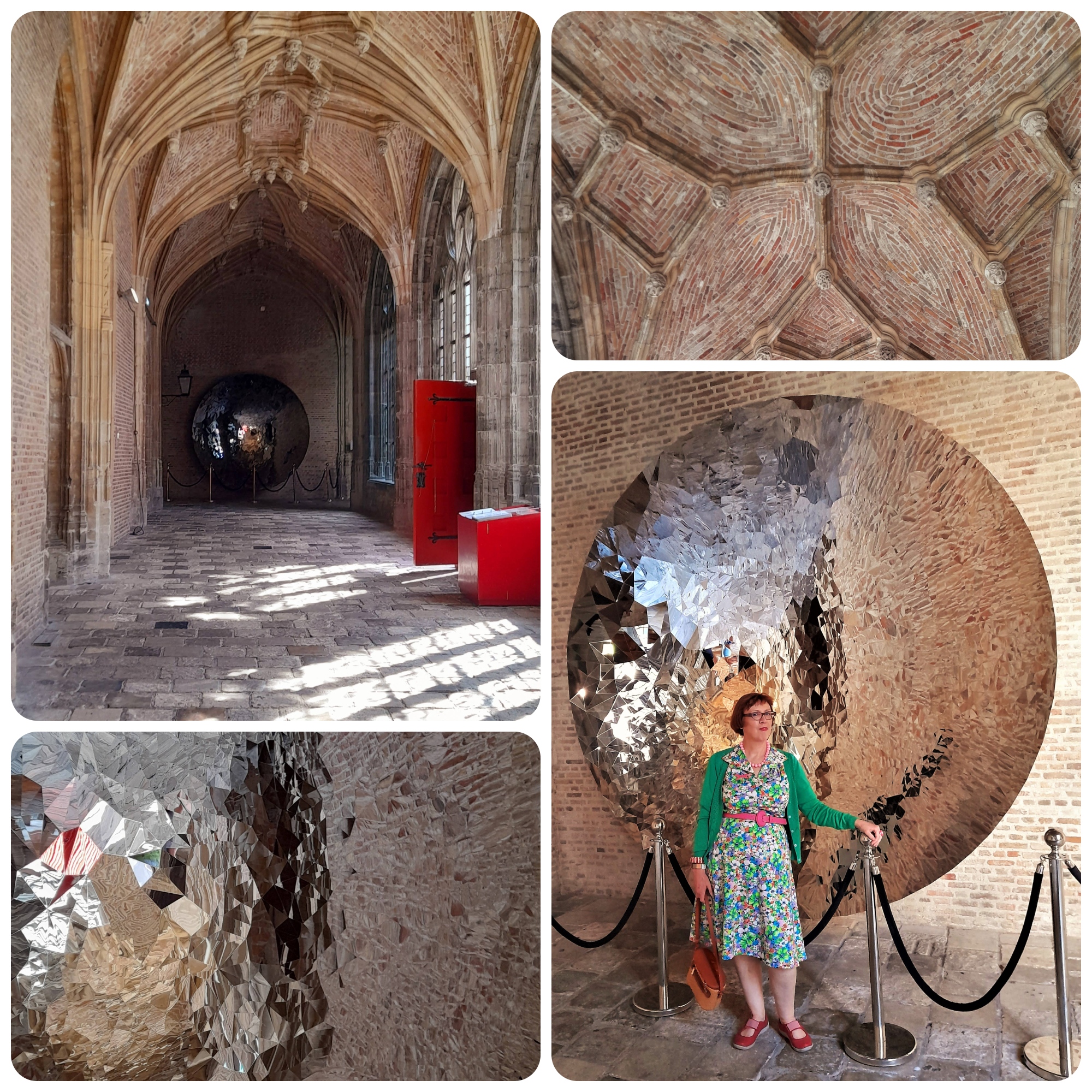
Now, we were finally able to have a peek inside the Nieuwe Kerk (above), which was built in the 16th century, and the Koorkerk (below), which dates from the 14th century. The churches are joined by a central choir called the Wandelkerk. 


Afterwards, we sauntered through the cloisters which, in stark contrast to our previous visit, we didn't have completely to ourselves. Not that you'd notice in the photos! I'm sure you know by now that - unlike in other areas of life - I've got the patience of a saint when it comes to taking photos.


At the time of our visit, Middelburg was hosting Façade, a contemporary art festival, which is still running until the 6th of November. 

At the end of the cloister, coming from the direction of the abbey courtyard, there was a shallow, bowl-shaped mirror consisting of hundreds, perhaps even thousands of triangular mirror fragments. This work of art is called Random Triangle Mirror and is the work of the British-Indian sculptor Anish Kapoor. Come close enough and you will see yourself in an infinite number of self portraits, in the artist's own words, the ultimate selfie moment!


The red door in the photo on the top right gives access to a small herb garden, a place for quiet contemplation, although not in high season with so many people milling about.

One of the benches is permanently taken by a sculpture of Hans Lipperhey (1570-1619), a German-Dutch spectacle-maker commonly associated with the invention of the telescope, as he was the first to try and obtain a patent for it. He settled in Middelburg in 1594 and remained there until his death in 1619.


You can catch a glimpse of my outfit here, built around the flower-infused 1970s does 1940s Diolen dress which is a firm favourite in my wardrobe. 

My Clarks Cloudsteppers, of course, were essential for a day of sightseeing. 


We emerged from the cloisters into the abbey courtyard, where we paused for a while and checked out a giant, blue dolly rope (plastic thread which is attached to fishing nets) covered hand by Kianoosh Gerami, who is based in the Zeeland town of Zierikzee. According to the Façade website there should have been three of these hands. I wonder what happened to the other two ...


We continued our wanderings, interrupted by cheesecake and cappuccino in a favourite café, coming across yet more works of art at regular intervals.

At one of the entrances of the tranquil  Kuiperspoort, three and a half metres above the unsuspecting spectator’s head, a garland of spiky grey spheres has been suspended (top centre). They are by Dutch artist Tanja Smeets. The Kuiperspoort itself is a picturesque 17th century cobbled courtyard. Jos is standing just inside one of its other entrances in the photo on the top right.

On the bottom left is part of an installation by Austrian artist Erwin Wurm (he of the melting sailing boat in Middelheim), who became world-famous for his sculptures about the absurd and the paradox in our society. Here, he has attached second-hand furniture - a complete interior, actually - to some walls.


By late afternoon our feet were getting tired, so we walked all the way back across the town to where our car was parked, picking up some food to eat at home along the way.

Our journey home was uneventful, except for a 10 minute wait at a drawbridge to give way to some sailing boats.


In the meantime, much to our relief, our neighbour had started work on the new wall. It would steadily grow higher in the next days. It still hasn't reached the required height as I write and it certainly won't be in the running for any beauty contests. However, once it has been insulated and finished, it is expected to look a whole lot better. I will keep you posted, obviously.


I'm now skipping two weeks, fast-forwarding to Saturday the 20th of August. I'll be posting about the weeks in between shortly, but as we made another trip to Middelburg that Saturday, I thought it only fitting to include it here as well.

Creatures of habit that we are, we immediately made our way to Reynaert upon arrival. While we were waiting for our lunch to arrive, I had a look at the map, plotting our itinerary for the afternoon.

First up was a rummage in a second hand clothing shop established on the premises of an old tobacco factory (top left). Disappointingly, there wasn't anything which caught our fancy, but while we were contemplating the impressive row of Lourdes holy water bottles displayed in the windows above the shop's door, we got talking to two nice German ladies, who'd just arrived back from Cornwall and were slowly making their way to the North of Germany. By bike! I was quite chuffed when they told me they were impressed with my command of the German language, which I'm sure reading Beate's posts in the original language has contributed to.


We were pleased to see that the fun fair had upped sticks, so that the Middelburg's magnificent town hall was once again in command of the Market Square.

It was voted the second most beautiful monument of the Netherlands and with its richly decorated façade, its profusion of statues and little turrets and its charming red, white and yellow shutters, it's easy to see why. 

Building began in 1452 and took over 80 years and several generations of an architect family from Mechelen (Belgium) to finish. 


I might have left that second hand clothing shop empty handed, but finding four brooches at Sebastian den Herder Vintage & Designers more than made up for this. It turns out that Sebastian is a collector of brooches himself, and it was nice chatting to someone so passionate and knowledgeable about them. 

The little bird brooch on the bottom left is Lea Stein, by the way.


After having made our purchases, we continued our meander through Middelburg's maze of cobbled streets. Once again, we strolled through 17th century Kuiperspoort (above, bottom left and right), exiting this inner-city oasis at the quayside, where we walked along a stretch of canal lined with monumental old merchant's houses and filled with quirky houseboats.

And just look at that brilliant blue sky!


Before I go, let's have a look at what I was wearing that day, for which I'm taking you to the peaceful abbey courtyard.

My midi-length circle skirt usually has many admirers. Charity shopped back in 2019, it is something of an oddity. Although there is a label, I suspect it is a personalized one and it is actually somebody's handiwork. Apart from its mid-century style print, it has a visible red side zipper and features random felt circles and visible stitching.


The green lacy short-sleeved jumper was an old Think Twice find, while the red cropped cardigan, as well as the belt, necklace and bangles were picked up in various charity shops. The enamelled butterfly brooch was a flea market find.

I'm currently counting down to our trip to Belgium's west country next week, but before I leave I promise to be back with a round-up of August's outfits and happenings.

See you soon!