Yesterday was my last day at work, which I managed to wrap up nicely, in spite of the hurdles thrown up in the last couple of weeks.
With our packing done and dusted this morning, we are now free to enjoy the rest of the day in peace and mentally prepare ourselves for our journey tomorrow.
While Jos has been known to throw a couple of thing into his suitcase at the very last moment (and would forget some crucial item if I weren't there to offer some guidance), I usually plan my holiday wardrobe well in advance.
In fact, the suitcase containing my clothes was packed almost two weeks ago, although I must admit I've taken out and added the odd item (or two) in the meantime.
Obviously, I am taking a couple of dresses. These two stretchy King Louie frocks, which I've had for many years, are super comfortable and I even rode a bike wearing one of them while on holiday in Belgium's west country last September. Their other advantage is that they can be stuffed in a suitcase without any fear of crumpling.
Our cottage does have an iron and ironing board, but I've never used them in all the years we've been going there.
The rest of my wardrobe will be dark denim jeans and a pair of red trousers to offer some variety, there's a selection of differently coloured lightweight cardigans and, apart from the peignoir (see previous post) to waft around in, I'll also be taking my Phoebe PJ bottoms.
I'm also taking a small case with accessories: scarves, necklaces and hair flowers to be used as brooches.
The vintage factor will be provided by a - large! - selection of tops, mainly vintage ones picked up at Think Twice, as well as a couple of new-to-me tops from flea markets and charity shops.
As we travel by car, and have oodles of space, there is no need to travel light, which is an absolute relief. How else would I be able to whittle down my wardrobe to just a few items for a holiday in Wales ... ?
The weather got progressively warmer and sunnier this week, and these are some of the outfits I wore to work.
New-to-me navy skirt combined with a cotton polka dot top from Think Twice. And the red shoes, which won't be going to Wales with me after all.
1950s style green printed rayon frock (Think Twice), combined with pink belt and beads and my most comfortable pair of Clark's wedge sandals.
Same sandals again, but this time I'm wearing a sailing boat printed Seasalt frock bought in Cardigan a couple of years ago. The orange piping called for orange accessories: belt, beads and bangle.
As we didn't have electricity at work for most of the day on Tuesday, I even had the time to squeeze in some last minute shopping and a short visit to MoMu, Antwerp's fashion museum.
In the gallery, and free of charge, there was a small exhibition of dresses by legendary Belgian fashion designer Ann Salens (1940-1994), who won acclaim for her colourful knitted and crocheted "bird of paradise" dresses, made from silk and artificial silk, which she sold at her shop in Antwerp's Wolstraat opened in the late 1960s.
Part of the Antwerp avant-garde scene in the 1960s, she was a natural talent, who refused to become commercial.
The dresses' former owner, who gifted them to the museum, was the female half of iconic Belgian showbizz duo, Nicole & Hugo, who started out in 1970. While not a fan of their music, their - often matching - stage outfits were something else altogether, and their 1973 passage at the Eurovision Song Contest did not go unnoticed, if only for their flamboyant purple Las Vegas style outfits.
The dresses on display all date from the 1970s and although there were only a few, they were presented as if in a red velvet lined black box, on black faceless models, which really made them stand out.
Afterwards, I sauntered back to the office, and passed the magnificent baroque St-Carolus Borromeus church, built between 1615 and 1621.
The square in front of it (which used to be the haunt of Antwerp's punks in the 1980s) was virtually empty for once, so I couldn't resist taking some photos with my smartphone's camera.
After having played the tourist in my own town, I am now ready to be a tourist in Wales. Although, after that many visits, I might be considered as a bit of a semi-local?
So, goodbye for now. Or as they say in Welsh: Hwyl!
See you in two weeks' time!
Showing posts with label Pembrokeshire. Show all posts
Friday, 16 June 2017
Friday, 19 May 2017
Wild about Wales
Once again, the weather has been playing yo-yo. After we were treated to two days of 27°C and more on Tuesday and Wednesday, a nosedive of at least 10°C followed on Thursday.
So far, Spring has been a disappointment, and it hasn't been easy to get into holiday mood. No time to dither, though, as in only four weeks time we will be making our way to Wales again.
Over the years, I must have made well over a thousand photographs, which I've been browsing through to get me in the right frame of mind, and I thought I'd show you some of my favourites places in the process.
Why not start with this one of me, masquerading as a Welsh lady in traditional costume, at Devil's Bridge in Ceredigion?
For those of you who have been watching Hinterland, Devil's Bridge is where the body of Helen Jenkins was found in the very first episode.
We have been going to the same area, always staying at the same delightful little cottage-for-two, since 2011.
We have twice tried to break the habit and go somewhere else, but here we are, on the brink of our seventh visit.
Our first visit was in May 2011, and the minute we stepped over the cottage's threshold, we felt right at home. With its thick walls, the old cottage keeps out the day to day sounds of the outside world, while keeping it warm and cosy on a cool day, yet deliciously cool on a hot one.
Waking up under the eaves, the plaintive calling of the gulls drifting up the estuary is the first sound you hear, and from the bedroom's skylight window the ever-changing view of the estuary, over the roofs of the cottages which tumble down the hill, always invites you to stand and stare. And then stare some more!
The village, St. Dogmaels, is a delight too, its houses climbing the hillside above the meandering River Teifi making its way to the sea. and boasting the ruins of a 12th century abbey.
We are in Pembrokeshire, if only just, with the neighbouring county, Ceredigion, almost literally on our doorstep, on the other side of the estuary (the meadows and fields we can see from our windows).
Nearby is the large expanse of Poppit Sands, perfect for blowing away the cobwebs on the first day, when we're not inclined to venture too far, or for a short evening walk, watching the sun disappear behind the horizon and lengthen the shadows.
One of our favourite places is Mwnt, just over the border with Ceredigion, waiting at the end of a narrow country lane. Down a steep flight of steps is the beach, overlooked by the green hump of Foel y Mwnt, while at the other end there's a lonely whitewashed little church.
It was at the end of a blustery June afternoon, and ours was the only car left in the grassy car park.
Vying with Mwnt for my favourite nearby beauty spot is Ceibwr Bay, along winding up-and-down lanes from St. Dogmaels. Surrounded by tall, spectacularly folded cliff formations, it feels wild and remote. Another place to stand (or rather, as I did here: sit) and stare, wondering at the forces of nature which must have been at work to create a place of such drama.
About a mile along the coast path is the Witches' Cauldron, a collapsed cave where in rough weather the sea comes surging into, creating a boiling mass of water and spray.
From here, the nearest town of any significance is the small seaside resort of Newport. About two years ago, I made this nostalgic collage of photographs taken in and around the town, which our cottage's rental office, which is based in the town, liked so much that they posted it on their Facebook page.
We are skipping along in a south-westerly direction, rounding a couple of headlands, until we arrive at Aberreidy, famous for its Blue Lagoon, a small slate quarry flooded by the sea. It is the slate which makes the water appear such an unfathomable shade of sapphire blue.
Onwards to Whitesands Bay near St. David's Head. The sky was looking ominously grey on our first visit, giving the wet sand an unearthly colour. St. David's Head itself can be seen beckoning in the distance.
The weather was glorious on our way up for our second visit one year later.
Nearing Whitesands, however, we could see mist drifting in from the sea. As it wasn't looking too bad, we decided to proceed with our planned walk up to St. David's Head, but visibility became worse the higher we got.
We were supposed to see Coetan Arthur, a 4000-year-old Neolithic burial chamber, silhouetted against the sky, but we didn't, and in the end roamed from one rocky outcrop to another, getting slightly panicky until a gap appeared through the cloud, through which we could see the path we had come up on.
A shortcut down a bracken covered slope put an end to our attempted walk. We have plans for a third attempt next month!
Inland to nearby St. Davids. Although only the size of an average village, St. Davids is in fact Wales' smallest city, a status it has been granted because of its cathedral, which they have cleverly hidden in a little valley of its own, so that it cannot be spotted from the sea.
Further south, there is a choice of castle ruins to visit.
Carew castle (top) is standing on a ridge at the head of a tidal inlet of the Carew river.
We often pushed the Welsh button, especially when there were other people around, so that they would think we were Welsh and actually understood what was being said.
Here I am in conversation with a brave Welsh archer: Bore da! Sut dach chi?
I'm definitely beginning to get into the mood for more Welsh adventures by now ...
However, the weather seems to be in a Welsh mood too, as it's started raining.
Oh, well, here's what I think of that ...
So far, Spring has been a disappointment, and it hasn't been easy to get into holiday mood. No time to dither, though, as in only four weeks time we will be making our way to Wales again.
Over the years, I must have made well over a thousand photographs, which I've been browsing through to get me in the right frame of mind, and I thought I'd show you some of my favourites places in the process.
Why not start with this one of me, masquerading as a Welsh lady in traditional costume, at Devil's Bridge in Ceredigion?
For those of you who have been watching Hinterland, Devil's Bridge is where the body of Helen Jenkins was found in the very first episode.
We have been going to the same area, always staying at the same delightful little cottage-for-two, since 2011.
We have twice tried to break the habit and go somewhere else, but here we are, on the brink of our seventh visit.
Our first visit was in May 2011, and the minute we stepped over the cottage's threshold, we felt right at home. With its thick walls, the old cottage keeps out the day to day sounds of the outside world, while keeping it warm and cosy on a cool day, yet deliciously cool on a hot one.
Waking up under the eaves, the plaintive calling of the gulls drifting up the estuary is the first sound you hear, and from the bedroom's skylight window the ever-changing view of the estuary, over the roofs of the cottages which tumble down the hill, always invites you to stand and stare. And then stare some more!
The village, St. Dogmaels, is a delight too, its houses climbing the hillside above the meandering River Teifi making its way to the sea. and boasting the ruins of a 12th century abbey.
We are in Pembrokeshire, if only just, with the neighbouring county, Ceredigion, almost literally on our doorstep, on the other side of the estuary (the meadows and fields we can see from our windows).
Nearby is the large expanse of Poppit Sands, perfect for blowing away the cobwebs on the first day, when we're not inclined to venture too far, or for a short evening walk, watching the sun disappear behind the horizon and lengthen the shadows.
One of our favourite places is Mwnt, just over the border with Ceredigion, waiting at the end of a narrow country lane. Down a steep flight of steps is the beach, overlooked by the green hump of Foel y Mwnt, while at the other end there's a lonely whitewashed little church.
It was at the end of a blustery June afternoon, and ours was the only car left in the grassy car park.
Vying with Mwnt for my favourite nearby beauty spot is Ceibwr Bay, along winding up-and-down lanes from St. Dogmaels. Surrounded by tall, spectacularly folded cliff formations, it feels wild and remote. Another place to stand (or rather, as I did here: sit) and stare, wondering at the forces of nature which must have been at work to create a place of such drama.
About a mile along the coast path is the Witches' Cauldron, a collapsed cave where in rough weather the sea comes surging into, creating a boiling mass of water and spray.
From here, the nearest town of any significance is the small seaside resort of Newport. About two years ago, I made this nostalgic collage of photographs taken in and around the town, which our cottage's rental office, which is based in the town, liked so much that they posted it on their Facebook page.
We are skipping along in a south-westerly direction, rounding a couple of headlands, until we arrive at Aberreidy, famous for its Blue Lagoon, a small slate quarry flooded by the sea. It is the slate which makes the water appear such an unfathomable shade of sapphire blue.
Onwards to Whitesands Bay near St. David's Head. The sky was looking ominously grey on our first visit, giving the wet sand an unearthly colour. St. David's Head itself can be seen beckoning in the distance.
Nearing Whitesands, however, we could see mist drifting in from the sea. As it wasn't looking too bad, we decided to proceed with our planned walk up to St. David's Head, but visibility became worse the higher we got.
We were supposed to see Coetan Arthur, a 4000-year-old Neolithic burial chamber, silhouetted against the sky, but we didn't, and in the end roamed from one rocky outcrop to another, getting slightly panicky until a gap appeared through the cloud, through which we could see the path we had come up on.
A shortcut down a bracken covered slope put an end to our attempted walk. We have plans for a third attempt next month!
Inland to nearby St. Davids. Although only the size of an average village, St. Davids is in fact Wales' smallest city, a status it has been granted because of its cathedral, which they have cleverly hidden in a little valley of its own, so that it cannot be spotted from the sea.
Further south, there is a choice of castle ruins to visit.
Carew castle (top) is standing on a ridge at the head of a tidal inlet of the Carew river.
Pembroke Castle (bottom), idyllically set on the banks of the river estuary, is a mighty fortress steeped in British history. Exploring the castle, you will meet figures of its former inhabitants, telling you their story, either in English or in Welsh.
We often pushed the Welsh button, especially when there were other people around, so that they would think we were Welsh and actually understood what was being said.
Here I am in conversation with a brave Welsh archer: Bore da! Sut dach chi?
I'm definitely beginning to get into the mood for more Welsh adventures by now ...
However, the weather seems to be in a Welsh mood too, as it's started raining.
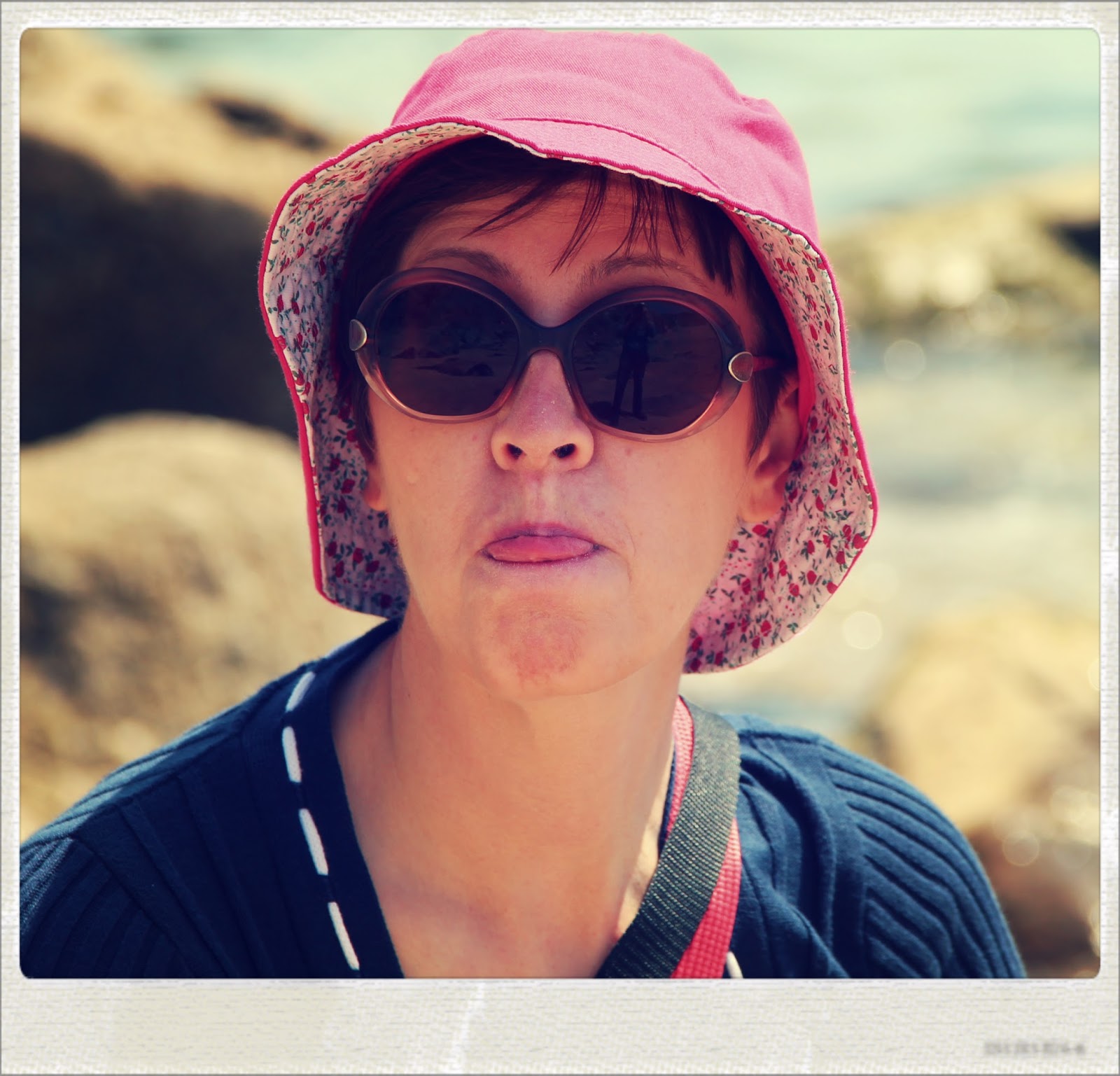
Oh, well, here's what I think of that ...
Subscribe to:
Posts (Atom)