Showing posts with label Bishop's Castle. Show all posts

Thursday, 27 June 2024

Everything but the cat

Bess has been demanding cuddles and claiming our laps ever since we walked through our front door on Saturday evening! Here she is, making air biscuits and purring loudly, stretched out on my legs a mere couple of minutes after arriving home. I didn't even have the time to take off my shoes!

Although she was well looked after during our absence and received her daily dose of cuddles from our cat sitters, Maurice and Inneke, she had clearly missed us and was over the moon to have us at her beck and call again.  


And we had missed her too, of course, even if our holiday did offer plenty of distractions. In fact, it had everything but the cat! Oh, and decent, June-worthy temperatures! In spite of my holiday wardrobe catering for all kinds of weather, I didn't pack nearly enough cold weather clothes ...

After a fitful night's sleep, the alarm went off at 4 am on Saturday the 8th of June and just under an hour and a half later we started the first leg of our travels, which would take us to the LeShuttle terminal in Calais, where we stocked up on free snacks and drinks in the posh Flexiplus lounge before embarking.


Once in the UK, our journey went relatively smoothly, apart from a one hour delay between two junctions on the M40. We breathed huge sighs of relief when we were finally able to leave the motorway behind us and trundle along on minor roads towards our final destination. 

So, imagine our dismay when we found the final stretch of road just before the turn-off to the single-track lane leading down to our cottage closed due to roadworks! It was a good thing this wasn't our first visit so that we were aware of the existence of an alternative approach along another lane we'd always made sure to avoid before. And with good reason, it seems, as it was long, winding and very narrow with a distinct lack of passing places. 


The sun, which had been playing peek-a-boo all day, was now out in full force. Don't be fooled by the blue sky and cotton wool clouds though: they came accompanied with a blustery wind, which made the day's highs of 16°C feel quite a bit chillier. 

Wanting to stretch our legs after our long journey, we walked back up the lane, taking in the glorious sight of our little valley nestling below the dramatic heath and moorland plateau of the Long Mynd.

Apart from the rustling of the wind, the only sound is provided by a chorus of sheep. In spite of our cottage being a converted cow shed, we were actually on a sheep farm, and they, and random bits of their fleece, were literally everywhere!


Beyond a gate, a public right of way along an inviting looking sunken lane beckoned. Too exhausted for any further exercise by now, we retreated to the cottage but vowed to return and investigate the next day!

All traces of sunshine and blue sky had gone by Sunday morning, when we woke up to an utterly grey and dismal day, on which the thermometer failed to climb higher than a measly 13°C. 


Still recovering from our day of travel on hardly any sleep, nothing too strenuous was on our agenda  apart from shopping for food in the nearest town of any significance, the delightfully quirky Bishop's Castle. 

Getting out of our car, I instantly regretted not having packed any warmer coats than my orange leather jacket, as I was feeling the cold in spite of wearing a t-shirt, long-sleeved Breton top and cardigan underneath. So much for Summer weather!

While we were shopping at the small local supermarket, I was complimented on my outfit by a lovely lady who wasn't looking too shabby herself. We later ran into her again at The Poetry Pharmacy, where she and her friends sat at the table next to us. 


Situated in a beautiful, original Victorian building, The Poetry Pharmacy (linking 'cause I love) combines a bookshop, a centre for poetry and creative writing and a café which serves its own blends of tea and coffee, as well as a selection of the most delicious cakes. 

After literally walking up the high street - it has a gradient of 1 in 6 - our limbs and spirits were restored with flasks of the house coffee and a shared slice of Earl Grey and rose petal cake, which was utterly moreish!


The harsh wind had died down somewhat when we left the café, and lo and behold, there was the odd break in the clouds revealing tiny bits of blue sky. So, instead of sticking to our original plan to return to the cottage, we ambled down the high street, taking in some of the unusually painted and decorated façades which hint at the quirkiness of the town's residents.


Images of elephants are everywhere! 

The elephant is rooted in the history of Bishop’s Castle. During the 18th Century it was home to Robert Clive, better known as the infamous Clive of India, his emblem being an Indian elephant. Then, in the Second World War, several circuses moved their animals to Bishop’s Castle to avoid the air raids. The elephants were housed in the stables at the back of The Castle Hotel, and when they finally left, one of the elephants was left behind. Apparently, the animal continued living n Bishop’s Castle for many years and was often seen being walked through the town and the local lanes, which must have been quite a sight!


We stopped to buy some Welshcakes at the local Spar and  a jar of locally produced honey directly from a beekeeper who was planting up some hanging baskets in front of his house.

Then we continued past The Six Bells pub at the bottom of Church Street, its façade painted a very bright eye-searing orange which my outfit had problems competing with. Across the road, in the retaining wall of the churchyard, we admired the traditional red post box dating from the era of King George V (1910-1936).


We entered the churchyard through the exquisitely carved lych gate and found ourselves in front of the Parish Church of St John the Baptist. The massive tower is all that remains of the original church built in 1291. The rest of the church was destroyed during the Civil War in the 17th Century and was completely rebuilt in 1869-60 by Thomas Nicholson. The present building in Victorian Gothic style is spacious and well-proportioned.


By then it was going on to 1.30 pm and, the shared slice of cake soon forgotten, we were getting a bit peckish. But then we remember the Welshcakes we'd bought, swiftly tore open the packet and ate a couple while sitting in the church porch. 

I made Jos pose next to the other grumpy-looking bearded individual who was guarding the main entrance to the church.


Among the church's many interesting features are some fine stained glass windows including two Pre-Raphaelite windows in the prayer chapel. 

The one on the left is depicting the Good Shepherd laying down his life for the sheep, while on the right is Purity, represented by a woman holding a lily, a symbol of purity usually associated with the Virgin Mary. The dove in the centre represents the Holy Spirit descending from heaven. 


After buying a replacement for the depleted packet of Welshcakes from the bemused shop assistant at the Spar, we returned to the cowshed for a couple of hours of rest.

But that sunken lane beckoned so we dressed up warmly - I added a jumper on top of all the layers I was already wearing - and ventured outside.


Originally the lane was a relatively level grassy track running between stunted, bent-out-of-shapes trees festooned with rags of sheep's fleece. 

Together with the sky, which had reverted to the morning's granite grey, they provided a suitable backdrop to the dramatic Long Mynd landscape.


When the track started going downhill, it became quite stony and harder to negotiate, so we thankfully made use of our walking poles to keep our balance. Further down, there was also quite a bit of mud to deal with.


Apparently, the public right of way is an old drovers' road connecting Adstone (the hamlet where we were staying) with the hamlet of Medlicott, and requires crossing a shallow ford. 

Courtesy of the excessive rainfall, it had turned into a bit of a stream so that, in spite of the alluring path on the other side, we decide to give it a miss and call it a day.


But what a magical walk it had been, and what a wonderful first day of the holidays!

There's more, of course, much more, so I'm hoping that you'll join me again for the next episode of the travelogue in a couple of days!


Tuesday, 9 August 2022

Cloudscapes

It has been a tough couple of weeks here at Dove Cottage, with disruptive and at times excessively loud building work going on next door, which has been playing havoc with anything involving the use of my brain.

Although taking a look in the rear-view mirror at our UK holiday in June has been a blessing, selecting photos and stringing sentences together for a blog post has been quite another kettle of fish. 

Therefore, this one has been cobbled together whenever I could snatch a rare moment of peace and quiet.


For my travelogue's penultimate installment, I am taking you back to Saturday the 25th of June.

While I was still feeling a bit tired and lightheaded, most of my migraine's symptoms seemed to have done a runner. Unfortunately, the same couldn't be said about the substandard weather. By the time we'd finished breakfast and were ready to go, we'd already seen grey skies, drizzle and the odd fleeting ray of sunshine. What's more, our weather app said there would be "highs" of only 14°C!

We had to do another food shop, so we drove down to nearby Bishop's Castle, the wonderful little town where we'd started our holiday just under a week ago. 


As the rain seemed to be holding off for now and the clouds had parted to show rare patches of blue, we started by walking up and down the high street, where I was struck by the wonderful variety of door knockers and noticed that the town seemed to have a penchant for elephants. Couldn't help snapping a couple more of those road signs of bygone times either!


We struck lucky at the town's one and only charity shop, where Jos fell in love with a butter dish and I found a label-less lightweight cotton maxi dress. 

I found the brooch on the bottom left in a small second hand shop I forgot the note the name of. 
The lovely owner kindly informed me that the flowers in the brooch were woven from silk and used to be given away with Kensitas cigarettes in 1933 and 1934, contained in a protective card. Intrigued, I proceeded to do some googling, and was amazed to find a whole website devoted to them. Here I discovered that mine belonged to the first series dating from 1933!


By the time we'd done our round of the shops and stocked up on food, ominous looking clouds had gathered and were in the process of obscuring the last of the patches of blue. 

It started raining while we were on our way back to the cottage and as there was still no let-up after lunch - indeed, by then, a gale force wind had joined forces with the rain - we decided to stay put and ditch any further plans for the day. 

The afternoon was spent reading and hemming a slightly too long maxi dress I'd charity shopped in the weeks before our holiday and which had gone straight into my suitcase. 


The weather forecast for Sunday was pretty dismal and as we didn't feel comfortable visiting any National Trust properties with inside possibilities on busy weekend days, we were at a bit of a loss.

Then, by pure chance, we discovered that the weather would be mainly dry and several degrees warmer if we ventured south, so that the gorgeous gem of a town called Ludlow would be the perfect destination.

For once, our weather app was right, as blue skies with innocent looking fluffy white clouds and a temperature of 19°C were on the menu. Admittedly, there were strong gusts of wind as well, which warranted the wearing of my raincoat and scarf.


If I remember correctly, this was our sixth visit to the town, travelling from Herefordshire in 2008, 2009 and 2010 for the first three, so that it is safe to say that we know our way around a bit. 

Looking back at my old albums made it clear that I'm always photographing the same things, such as the famous timber-framed Feathers Hotel (above). The oldest part of the building, including the stunning timber façade, was built in 1619, during the reign of King James I, by Rees Jones, a successful attorney in the town. The name springs from the motifs of ostrich feathers carved into the gables of the façade.

The Feathers has a well-known reputation for being haunted both inside and outside, and on a number of occasions, an apparition has been seen crossing the road from the direction of The Bull Hotel (also haunted) opposite.


The latter is not to be confused with Ye Olde Bull Ring tavern (above, top and bottom right), another magnificent timber-framed building. Built in the 14th century and with a history dating back as far as 1365, it is believed to be the oldest existing public house in Ludlow. 

The Smith & Co. ghost sign at the gable end of the house (top left) refers to the grocery business of Gaius Smith, who in the late 1800s had shops at both 42 Bull Ring and 6 King Street.

I also spotted the beautiful old mosaic at the Boots the Chemist shop. I couldn't find any reference to its age, but it must be quite rare as all the photos I found on the Internet were of this particular shop.


We never fail to visit the stunning St Laurence’s Church either! The church was established as a place of worship when the Normans founded Ludlow in the late 11th century. Often referred to as the "Cathedral of the Marshes", its 135 feet (41 metres) high tower commands excellent views of the town and surrounding countryside.

Notable features include fine stained glass - the lovely Nikki recently devoted an entire post to them - as well as an extensive set of misericords in the choir stalls (below).


Misericords are medieval choir stall seats designed to be raised during services, so that the occupants had to stand. If they became tired, they could rest their bottoms against the small ledges protruding from the bottom of the seats; a small mercy of the heart (or misericordia).

With its 28 mercy seats dating from the 14th and 15th century, St Laurence's has one of the largest collections in any parish church, and the carvings on each one are fantastic. There seems to be an misogynistic theme going on though. The mermaid, for instance, being symbolic of the woman luring men away from the path of salvation. She is holding a mirror in one hand and a now missing comb in the other, and is flanked by two snarling fish. 


We stopped for morning coffee and, after browsing some of the town's charity shops, the majority of which were open on a Sunday, we walked towards Castle Square. By then, the sun was making up for lost time. We sat down for a picnic on a bench overlooking the square, accompanied by live music courtesy of the Ludlow Fringe Festival.


From the Castle Gardens, we walked down to the river, following the lane downhill  - a steep 25% gradient - then crossing over over the River Teme via the picturesque Dinham Bridge, where the  wonderful and famous view of Ludlow Castle opens up.

We'd planned to do the Breadwalk, which leads up and over Whitcliffe Common, but by the time we'd found the start of the footpath, we'd already run out of steam, and decided to return to the town centre. After all, we still had to climb back up that 25% gradient!

Back at Castle Gardens, we took the path skirting the castle walls. Built by the Normans in the 11th Century to repel a Welsh invasion, Ludlow Castle is one of the town's finest attractions, which we last visited on a hot Summer's day in June 2019. Here, here and here are some impressions.


Back at the cowshed, we stepped onto our terrace for outfit photos. I was wearing a beloved vintage maxi skirt, which I paired with a green and navy striped Breton top. This too was picked up in a charity shop in the weeks before our holiday. Like the maxi dress, this went straight into my suitcase. 

The flower brooch, necklace and belt were all bought on the high street.


The outlook on Monday's weather still being uncertain, we hedged our bets and drove south again, where the mercury was supposed to climb to 18°C and a mixture of sunshine and clouds had been forecasted.

This time, however, we left Shropshire behind once more, driving over the border with Herefordshire which, having holidayed in the area for three years running, wasn't exactly new territory for us. 

With our NT Touring Pass still burning a hole in our pockets, we selected Croft Castle for our next property, which would be number 5. By now, we'd already more than recovered our costs!

The present, Grade I listed building dates from the 1660s, replacing an earlier house some thirty yards to the west. Owned by the Croft family since 1085, the castle and estate passed out of their hands in the 18th century, before being repurchased by the family in 1923. In 1957 it was bequeathed to the National Trust. 


Our first visit to Croft Castle dates from 2009 but, while I can still clearly remember the walled garden, the parkland and the adjacent church - now sadly covered in scaffolding - I couldn't recall whether we'd actually been inside the house.  

The interior features Jacobean panelling, 18th century Gothick plasterwork and woodwork, Rococo chimney pieces and fine neo-Georgian decoration. 

I loved the opulent wallpaper and gold embossed overmantel mirror by Thomas Chippendale in the Ambassador's Room. This room was named in honour of the Austrian Ambassador Albert Count von Mensdorff-Pouilly-Diestrichstein, who was was due to visit Croft Castle in the summer of 1914 and whom this room was painstakingly prepared for. However, when Archduke Franz Ferdinand and his wife Sophie were assassinated while on a visit to Sarajevo, triggering a chain of events that led to the start of World War One, the Ambassador and his would-be British hosts were now on opposing sides, so that the visit never happened.


Oh, and there's a rather splendid old water closet too!

After a visit to the loos, followed by lunch in the Carpenter's tea-room, we were ready to explore the three-acre walled garden.The garden, which even has its own small vineyard, is maintained by two full-time gardeners and a team of volunteers. 


The cloudscapes were truly dramatic that day, putting on a variety show of dark and menacing ones threatening rain at a moment's notice one minute, and marshmallow ones drifting in a bright blue Summer sky the next.

Having had our fill of horticulture, we thought we'd conclude our visit with a walk on the estate. 


From the way-marked trails on offer, we selected the Ancient Tree Walk, a gentle wander into the heart of Croft Castle's parkland. 

The walk offered stunning views across the Herefordshire countryside and took in the so-called Spanish Chestnut avenue, planted in the formation of the Spanish Armada around 350 years ago, and a 1000 year old Quarry Oak along the way.


Once we passed a cattle grid, there were sheep grazing everywhere, most of them not taking any notice of us at all, just the odd lamb bleating pitifully for its Mum on spying this weird-looking, red floral trousers wearing creature.


There was an impressive and somewhat eerie tree graveyard as well, contrasting starkly with the bright blue of the sky and the lush green of the grass.

The blissful quiet was only pierced by bird calls and the bleating of sheep, providing a soothing soundtrack I now desperately long for. 


Just as I do for rush hour on one of the country lanes leading back to the cowshed.


Thursday, 7 July 2022

Back to Shropshire - and back again!

Oh my, that went fast, didn't it! One minute we were packing our bags at a searing and brain-melting 35°C, and the next we're back home, spending the final two days of my leave in a whirlwind of unpacking, doing several loads of washing, catching up with blogland and making a start with writing this post. After all, being due back at the office on Tuesday, there was no time to lose!

Oh, and of course, whole chunks of those two days went to extensive cuddling sessions with Bess, who has hardly let us out of her sight since we walked through the front door on Saturday night.


Now, let's backtrack to the early morning of the 18th of June, when we set off just before 6 am - with the mercury still nudging the mid-twenties - to arrive at the Channel Tunnel terminal in Calais around two hours later. 

We had decided to splurge on the more expensive Flexiplus option, which gave us the freedom to turn up and board whenever we wanted, with guaranteed fast track check-in. Not to mention having the use of exclusive lounge facilities, rather than having to share the big terminal with what we half-jokingly called the plebs. So, having successfully passed border control - using our travel passports for the very first time - we enjoyed complimentary cups of coffee in an almost empty lounge, and filled a bag with fruit juice, pastries and other delicacies to be savoured during our journey.


Our train left at 8.50 on the dot, and arrived in Folkestone around 8.25. And no, that isn't a typing error. The train only takes 35 minutes to cross, and as we obviously have to set back our clocks one hour, our arrival was 25 minutes earlier than our departure. Surely, that's the closest thing to travelling back in time!

While we were travelling to Shropshire the temperature gradually dropped below 20°C and soon the first of the forecasted rain was tickling our windscreen. By the time we crunched our way down the lane leading into our valley below the Long Mynd, the thermometer indicated a measly 10°C.

Our cottage was actually freezing cold, so that we had to put the heating on. Something we couldn't even have imagined doing less than 24 hours earlier.


The cottage - called The Byre, as it's a converted former cow shed - was as charming as ever and, apart from a couple of minor details, nothing much had changed since we waved it goodbye in early July 2019. Little did we know back then that it would be three years before we'd be back!

If in the weeks before our holiday I fully expected to choke up at finally being in our beloved England again, strangely enough it didn't happen. In fact, it felt utterly normal to be back and, as I walked into the cottage with its ever-changing views towards the majestic Long Mynd, it was as if we'd only left yesterday.


With the rain lashing against the windows, we made ourselves at home, eating the ready meals we'd bought in the tiny Waitrose at Warwick services, then plonking ourselves down on the sofa, reading and listening to music until we dropped off. Then it was time to climb between the sheets of our bedroom's four poster!

We slept like the proverbial logs but woke up early as we were too excited and raring to start our holiday adventures. Drawing back the curtains revealed the Long Mynd bathing in some hesitant early morning sunshine.


We hadn't made any definite plans for the day, but needed to do some food shopping to tide us over for a couple of days so, after bacon and eggs for breakfast, we drove to  Bishops Castle, a delightful 15-minute drive along a succession of country lanes.

En route, we stopped at the top of our lane, looking back towards the valley with its huddle of farm buildings, our cow shed being one of them. In order to offer you a peek of what I was wearing, I even climbed the rickety stile giving access to Adstone hill.  As the temperature wasn't expected to climb much higher than 16°C, I wore a pair of floral slacks, a retail buy from H&M several years ago, and a black and white dotted Phase Eight raincoat picked up in a charity shop in nearby Church Stretton in June 2018.


Bishop's Castle is a small but perfectly formed ancient market town nestling amid the South Shropshire Hills, only a handful of miles from the Welsh Border.

After having parked our car, we emerged onto the town's high street and walked into the direction of St. John's Church, which is situated literally at its lower end.

The church was built towards the end of the 13th century, but only the tower remains of the original church, which was completely re-built in 1869-70. The tower has an unusual one-handed clock, apparently a leftover from the days before we needed to know the time down to the minute. Is it a wonder that time seems to go slower here?


The atmospheric churchyard, with its lichen encrusted, time-worn and tumbledown gravestones, strikes the right balance between maintained and semi-wilderness and is an absolute joy to stroll through.

It is part of Caring For God's Acre, which supports groups and individuals to care for and enjoy churchyards and burial grounds, aiming to protect and rejuvenate these beautiful havens of heritage and wildlife.

It was here that the tears finally came. Tears of happiness to be back where I feel I belong. My adopted country which often feels more like home than my actual home country. It was a good thing I was in a churchyard rather than anywhere else where people would give me the side-eye for crying in public.


After our ramble around the churchyard, we proceeded uphill: the gradient of the town's High Street is 1 in 6, a stiff climbed for our rusty limbs. At its upper end is the House on Crutches Museum (below, top right) which is situated in a quirky timber framed building dating back to Elizabethan times.

The town is at a junction of several old drover’s routes which led travellers, farmers and stock to the markets. In recent years, they have brought in artists, authors, musicians and free thinkers of every hue. As a result the town is famous for its welcome to visitors, its pubs, microbreweries, independent shops, and - last but not least - its slightly eccentric demeanour. Which meant that for once we didn't stick out like the proverbial sore thumbs :-)


Having climbed all the way up, we were gasping for a cup of coffee, so we ducked into one of the few establishments which were open on a Sunday. Yarborough House, its façade painted a cheerful orange, combines a tiny tea shop with a large second hand book and record shop.

Then we stocked up on provisions in the tiny local Co-op and whizzed back up those country lanes to enjoy a leisurely lunch at the cottage. 


The dark, rain-pregnant clouds which had been scudding across the sky all morning had decided to take their liquid load elsewhere and here and there a gap appeared through which a whisper of blue could be glimpsed. By then it had even warmed up a degree or two.

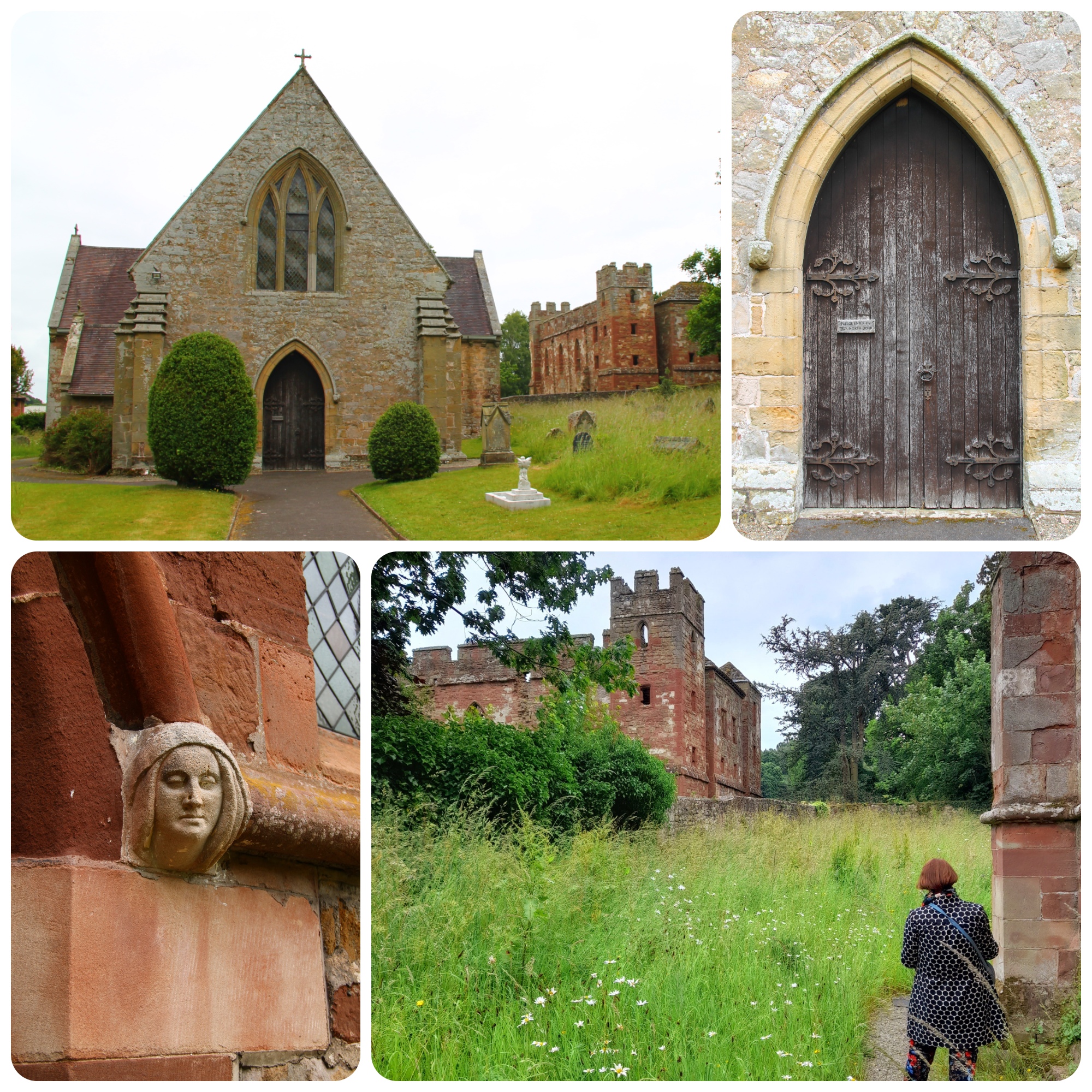
Consulting the map, we decided to pay the English Heritage managed Acton Burnell Castle a visit. The graceful red sandstone shell of the castle, which was built between 1284 and 1293 by Bishop Burnell, Edward I's Lord Chancellor, is tucked away in a quiet part of Shropshire, about half an hour's drive from the cow shed.

By 1420, the castle was abandoned, and it was allowed to decay while a new classical style mansion,  Acton Burnell Hall - now a private school - was built beside it in 1814.

Nonetheless, the castle remains an impressive example of a medieval fortified manor house.


When we arrived, a family was having a picnic inside the ruin, with both children and adults playing a boisterous game involving water guns. Not that you'd notice in the photos, as shooting around people and making it seem that we are the only visitors, is one of my fortes. This involves having lots of patience and a deadly stare! 


Leaving the castle grounds behind, we walked towards St. Mary's Church, the churchyard offering a fine view of the adjacent castle. Like the castle, we owe its existence to the aforementioned Bishop Burnell.

Unusually it remained unaltered from its completion in about 1282 until the addition of a new tower in the 1880s. 


The church's north transept has several fascinating and intricately carved alabaster effigies.

On the west wall is the memorial to Sir Humphrey Lee, who died in 1632 (above, bottom right). Sir Humphrey is shown at prayer facing his wife.  Their children too are shown kneeling, each of them being a miniature version of a parent.


On the right is the impressive monument to Sir Richard Lee, who died in 1591.  He is portrayed as a knight with his wife beside him, 3 sons at his head and feet, the eldest with his hand on the helmet, and his 9 daughters behind him. Interestingly, no two of the girls are identical!  


After leaving the church, we made our way to the enchanting little chapel at Langley, just 5 minutes up the road from Acton Burnell, and also owned by English Heritage.

The Burnells were lords of the manor of Langley and, in 1313, Richard Burnell obtained permission to build a chapel here.  The structure of the present building dates from this time. In 1377, the manor of Langley passed to the Lee family (they of the alabaster memorials), who fitted out the chapel in about 1546. In 1591, Sir Humphrey Lee moved to Langley. He was probably responsible for re-roofing the chapel in 1601 – a date given on the nave roof – and refurnishing it a few years later.


The atmospheric interior of the chapel, which is standing rather bleakly in remote countryside, contains a perfect set of 17th century timber furnishings.

Typical Tudor decorations of roses and fleurs-de-lis appear on the plaster frieze between the roof and south wall (below, bottom left).


By 1700 the chapel had largely fallen out of use, and thus escaped any attempt to re-order the interior according to the more elaborate ‘High Church’ model favoured in the 19th century. The last regular service was held here in 1871.

Having concluded our visit, we returned to our car parked in a lay-by, and attempted to drive back to The Byre. I won't mention the close encounter with a bus on a single track lane, which required us to reverse and half-burrow our car into a hedge, or the fact that our Satnav was trying to get us to take the infamous Burway, a steep and precipitous road crossing the Long Mynd. Having made that mistake once (see here) we weren't about to repeat the experience!