Showing posts with label Pre-Raphaelites. Show all posts

Monday, 8 July 2024

Halcyon Days

What with my return to the rat race and the preparations for next week's flea market, I'm the first to admit that my travelogue is proceeding at a snail's pace. My mind boggles at the fact that it is now well over two weeks since we've waved the cowshed goodbye! No fear of our holiday receding into the mists of time any time soon though. Courtesy of the just under a thousand photographs I've taken and the effort I made to scribble a couple of lines into my dairy in the evenings, I'm able to relive it all, one perfect day at a time.


But time marches on relentlessly, and it's almost beyond belief that in just a couple of days it will be one whole month ago since we drove through the gates of Stonecroft, Vix and Jon's wonderfully eclectic home in Walsall, on Wednesday the 12th of June.  And before I go any further, let me tell you that their home is every bit as gorgeous as it looks on her blog, and more!

Here Vix and I are posing in their garden, with the famous Kinky shed in the background, at the end of an absolutely fabulous day.  Even the weather gods were on their best behaviour, with lots of sunny spells and - gasp! - highs of 17°C.


I'd been keen to visit the upcoming Victorian Radicals exhibition in Birmingham ever since I read about it at the end of last year, and Vix's posts about her visits (here and here) had whetted my appetite even further.  However, as we weren't all too keen to drive into Birmingham, there were some logistics to sort out first. In the end, we proposed to drive over to Walsall - about an hour and a half from the cowshed - and take the X51 bus into Birmingham as mentioned by Vix on her blog.

So, that was exactly what we did and, after a catch-up over coffee and making the acquaintance of the handsome William, we walked over to the bus stop and hopped onto the fairly crowded bus for the 25 minutes or so drive into Brum.


Here, our guides swiftly walked us through the hubbub of Birmingham's city centre to Victoria Square, where they introduced us to Antony Gormley's Iron:Man and the Floozie in the Jacuzzi, whose official name is The River, by Dhruva Mistry, apparently one of the largest fountains in Europe.
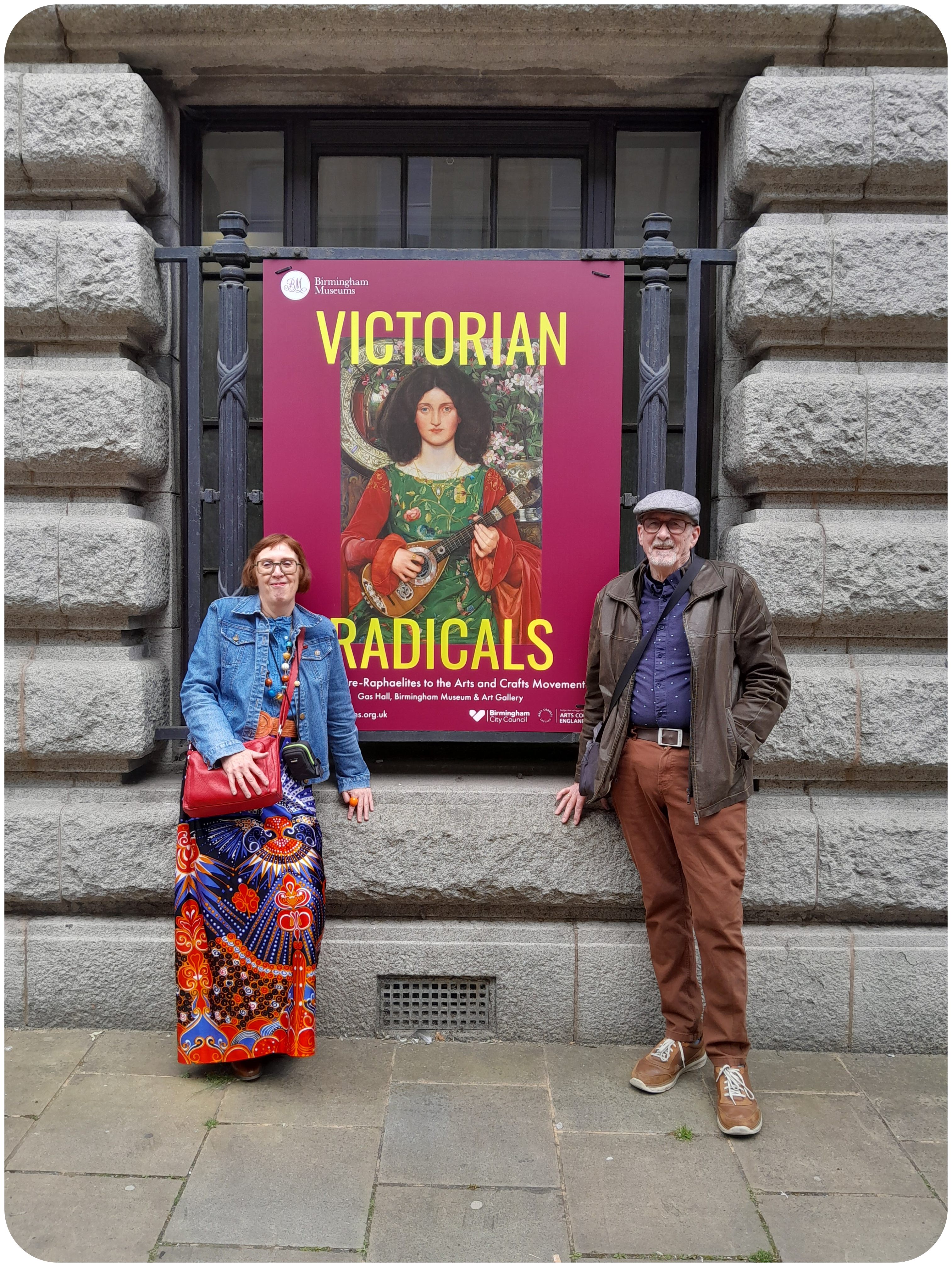

Walking around the corner to the Gas Hall's entrance, we obliged Vix by posing for the obligatory photo in front of the Victorian Radicals billboard.

I'm shamelessly quoting the museum's introduction to the exhibition on their website, to give you an idea of what the exhibition is about.

Three generations of British artists, designers and makers revolutionised the visual arts in the second half of the nineteenth century. The Pre-Raphaelites, William Morris and his circle and the men and women of the Arts and Crafts movement transformed art and design.

Selected from the city of Birmingham's outstanding collection, Victorian Radicals presents vibrant paintings and exquisite drawings alongside jewellery, glass, textiles and metalwork to explore their radical vision for art and society.


Suffice to say that it was far too much to take in during one single visit. In fact, I was so overwhelmed that I didn't take nearly enough photos. Here are just a handful of the things that caught my eye.

Above, clockwise from top left: portrait of Dante Gabriel Rossetti - doesn't he have the most mesmerizing eyes? - by William Holman Hunt (c.1882), a selection of tiles designed ca.1863 by Edward Burne-Jones and William Morris, La Donna della Finestra by Dante Gabriel Rossetti (1881), and Sigismonda Drinking the Poison by Joseph Edward Southall (1897).


I wouldn't have minded taking these embroidered purses and stunning jewellery home with me, although I think I might have had to share the latter with Vix.

Continuing with the favourites, below, from left: Beate Beatrix by Dante Gabriel Rossetti (completed by Ford Maddox Brown, 1877), Morgan le Fay by Frederick Sandys (1864) and A Young Woman Holding a Rose by Emma Sandys (1870-72).


Flanking Vix with her fabulous Pre-Raphaelite style hair are two stunning paintings by Kate Elizabeth Bunce ( (1858–1927), an English painter and poet, whose work falls somewhere between the Pre-Raphaelites and the Arts & Crafts movement. She was also a lecturer at Birmingham College of Art. 

On the left: Musica (1895), which you might recognize from the exhibition poster, and on the right: The Keepsake (1901). Apparently, the latter is based on a poem by Dante Gabriel Rossetti, called The Staff and Scrip:

'Then stepped a damsel to her side,
And spoke and needs must weep:
'For his sake, lady, if he died,
He prayed of thee to keep
This staff and scrip.'


Below, on the right is a Morris & Co. stained glass panel depicting St Mark the Evangelist, designed by Edward Burne-Jones for Merton Abbey, London (1883). On the left is a rare survival of a full-sized cartoon - using an oil painting rather than the more usual charcoal and wash drawing on paper - by Burne-Jones (1859) for a window depicting the Annunciation.


Below, clockwise from top left: lead glass flask (ca. 1870) by Thomas and Elijah Barnes, Choosing the Red and White Roses in the Temple Gardens by Henry Albert Payne (1908-10), Fiammetta (Georgie Gaskin) by Arthur Joseph Gaskin (1898), Hope comforting Love in Bondage (1901) by Sydney Harold Meteyard, Victorian gown made from William Morris fabric, originally intended for upholstery and, finally, Vix and yours truly admiring the stunning Beate Beatrix! 


Although the first edition had long been sold out, we were thrilled to see that the exhibition catalogue was available once more, so that we wasted no time in purchasing one of these hefty volumes, which Jos carried around in an appropriate Victorian Radicals canvas bag.

Meanwhile, a mirror selfie revealed that I'm shorter than Vix! And that's Jon photobombing Vix and Jos in the snapshot on the left!


It was well past midday and our stomachs were definitely rumbling by now. Guided by Vix, we made our way to the New Street branch of Medicine, a bakery, café and art gallery established on the first floor of the building which was previously home to the Royal Society of Birmingham Artists. 


Hunger pangs sated, we walked around the corner to the cathedral to admire the William Morris and Edward Burne-Jones stained glass windows. 

They were installed in 1885-87 and 1898 and depict the Ascension, the Nativity, the Crucifixion and the Last Judgement. 

Then it was back to the bus stop, where we had a bit of a wait until the X51 to Walsall rolled along. We finished the day with welcome cups of coffee, a tour of Stonecroft and, best of all, a peek inside the Kinky Melon tent. And exchanging gifts, obviously.


We were treated to handmade fabric tote bags full of goodies. 

Jos received a couple of naughty 1950s magazines, a Tala curry measure, a vintage Tala icing set, a fancy tea towel and two shirts, both of which he already wore during our holiday. 

My tote bag was filled with a gorgeous dress suit, two pairs of Snag tights - very welcome for these under par temperatures - two pots of Body Shop British Rose body butters and a handful of Ethiopian Honey face masks. When we met up a couple of days later, Vix also gave me a pot of Body Shop lip balm and Luckenbooth by Jenni Fagan, which is currently awaiting its turn in my TBR pile.

All too soon, it was time to say goodbye - although not for long! - and return to the cowshed. I wish I could say our return journey was uneventful but unfortunately road works and an unexpected road closure threw some spanners in the works. Needless to say that we were exhausted when we finally made it home.


We'd already made the decision to stay closer to home on Thursday, but it was the weather forecast for rain, wind and decidedly unsummery temperatures of 10°C which cinched the deal and saw us driving down to Attingham Park. Involving a drive of just over half an hour, this National Trust owned property has a Georgian mansion at its heart which is well worth a (re)visit.

As we'd slept in a bit longer and had taken our time over breakfast and getting ready, the morning was already quite advanced when we finally trundled up its long drive. I won't mention the fact that by then we'd taken a wrong turn twice and that our silly Satnav tried to take us to the exit rather than the entrance.

Upon arrival, we took refuge inside the extensive second-hand bookshop, where I serendipitously stumbled upon the Edward Burn-Jones tone. Four Hundred Years of Fashion, based on the V&A's world famous collection, also came home with me. Then it was up to the café for lunch, where I had a ham and smoked cheddar turnover, while Jos enjoyed his first jacket potato of the holiday.


Emerging from the café, we were dismayed to find that it had got even colder and, as the first drops of the forecasted rain were starting to fall, we ditched our plans to walk down to the walled garden.

Making our way towards the mansion, we were once again shivering in spite of wearing plenty of layers, in my case including a jumper and a cardigan. The volunteers inside the Entrance Hall (above, top right) had even closed the door to keep out the chill. 

There's a degree of trickery going on here, as the Entrance Hall is decorated with fake marble pillars and mock alcoves designed to look like three dimensional ones housing classical sculptures. The fireplace is topped with a bust of William Pitt the Younger, who was Prime Minister from 1783-1806, and who created the title Lord Berwick.


From here, we wandered from room to room, trying to keep one step ahead of a group who'd entered the mansion with us, some of whose members insisted on ruining the photos I was trying to make. Needless to say, much grumbling ensued, and there was nothing for it but to keep to details when my patience finally ran out.


Nevertheless, we spent an inordinate amount of time in the Picture Gallery until it was empty of the people who were milling about here. As apparently they were waiting for the guided tour of the private two-storey apartment in the East Wing, we could somewhat relate. The scene of last year's blogger meet-up, we'd done our fair bit of waiting around for our tardy tour guide back then.

When Thomas Hill, the second Lord Berwick, inherited Attingham Park in 1789, he also inherited a substantial fortune. As was the custom at the time, Thomas took part in the Grand Tour - a tour of Europe and Italy in particular - during which he purchased a great number of paintings and sculptures. As he needed a place to house his collection, he commissioned the architect John Nash to add the picture gallery in 1805. Nash's pièce de resistance was the sumptuous Grand Staircase (above, bottom right).


After touring the ground floor, it was time to descend to the servants' quarters "below stairs", where the kitchen, butler’s pantry, and servants’ hall can be visited.

Cook had just finished a batch of mince pies and surreptitiously dashed from the kitchen to get her mobile phone to take a photograph. Not surprisingly, she strictly forbade us to take a photo of her doing so ...


As there still wasn't any improvement in the weather when we left the mansion, we decided to have a cup of cappuccino and some shortbread and then call it a day.

By the time we'd stopped for a food shop at a supermarket in Church Stretton, it had begun to rain in earnest, and we'd barely made it inside the cowshed before all hell broke loose and we were treated to a veritable storm.


I'm happy to say that, although temperatures continued to be up and down, we didn't have a repeat of Thursday's atrocious weather. 

I'll be back with more later this week. Hope to see you again then!


Sunday, 17 July 2022

To the manor born

It was Day 3 of our holiday and the weather gods were still on their best behaviour. Wanting to make the most of both the glorious weather and our National Trust Touring Pass, we decided to leave Shropshire behind once more and visit a property which had been on our list for absolutely ages.

This time, our chosen destination was a bit further afield, involving a drive of about an hour and fifteen minutes in easterly direction, to the outskirts of Wolverhampton in the West Midlands.

The marshmallow clouds floating in a bright blue sky and the predicted highs of a balmy 24°C couldn't have been more perfect for what was officially the first day of Summer.


After driving through the varied landscape of South and South-East Shropshire, passing the wonderful high-and-low town of Bridgnorth along the way, we crossed the border into Staffordshire and were then welcomed to Wolverhampton, where our car's Satnav neatly deposited us at the approach to Wightwick Manor.

After some head scratching by the lady at the ticket office, who had clearly never seen a Touring Pass before, we were admitted to the property. We were told, however, that only the downstairs rooms were open and that sadly the Malthouse Gallery would also be closed that day due to a shortage of volunteers. 

She must have seen the disappointment on my face, so she took us aside and advised us to speak to one of the volunteers inside the house and explain that we'd come all the way from Belgium to see the De Morgan exhibition and then, perhaps, they'd find someone to open the gallery for us.


Instead of going straight to the house, however, we went for a walk around the woodland bordered lake lying to the west of the house to stretch our legs and get our bearings. 

Then we strolled towards the house, taking in its plethora of gorgeous architectural details, the front door leading to the porch and hall beyond standing invitingly open.


The superbly crafted rambling manor house was built in 1887 for Theodore Mander, a partner in the local varnish and paint-making firm of Mander Brothers. His architect was Edward Ould. The elaborate timber-framed exterior, with deliberate asymmetrical groupings, features barley twist brick chimneys, oriel windows and carved quatrefoils, which are four-leaved ornaments or apertures common in Gothic architecture.

In 1893 Ould added an east wing with the help from the Pre-Raphaelite glass-designer Charles Kempe, who produced some fine painted glass for the house as well as advising on its decoration.


Wightwick Manor - the name is pronounced as wittick - was built primarily as a family dwelling. Like many affluent Victorians, Theodore and his wife, Flora, wanted to move their growing family out of an industrial town to a healthier location. Although Wightwick was rural, it was only a mere three miles from the Mander Brothers factory in Wolverhampton!

The Manders wanted a comfortable home that reflected their aspirations and tastes, and the house combined exquisite period details - we lacked several pairs of eyes to take them all in - and traditional craftsmanship with modern technology. It had central heating, a modern kitchen and bathrooms and electric light throughout by 1893.


Having finally had our fill of the charming wood carvings - the bat and the owl being particular favourites - we took deep breaths and stepped inside, where we were greeted by a friendly and knowledgeable volunteer, who bade us welcome and proceeded to introduce us to the house and its extraordinary collection of Pre-Raphaelite art.

As soon as I could get a word in edgewise, I told her that we were from Belgium and were gutted that the gallery wasn't open, as a local friend (Vix!) had waxed lyrical about the De Morgans and had urged us to go and visit it.


At first, our ploy didn't seem to have worked (whereupon I shrugged, sighed "Oh well" and walked away), but a couple of minutes later she came running after us, telling us to hang around as she was trying to get someone to open the gallery for us. Result!

We continued our tour of the ground floor, making sure not to venture too far away, and trying but failing to take in room after room of period furnishings and decor, not to mention the volume of Pre-Raphaelite art. It immediately became clear to us that we wouldn't be able to cover everything in one single visit, and that we'd have to return one day.


When Theodore Mander commissioned the building of Wightwick Manor in Old English style in 1887,  he started the Mander family's love for Victorian art and design. However, following his untimely death in 1900, his eldest son Geoffrey inherited the property, entering both the family firm and local politics. After his first marriage in 1906, he and his wife, Florence, became notable advocates of women’s suffrage, holding meetings in the drawing room.

Wightwick as we now know it, however, developed only after Geoffrey’s second marriage - the first having ended in divorce - in 1930. His new wife, Rosalie Glynn Grylls, gave up her ambitions to be a Liberal MP and focused her attention on English literature and art. Starting with a biography of Mary Shelley, her surroundings at Wightwick soon inspired her to research the Pre-Raphaelites, especially Rossetti.


Sir Geoffrey and Lady Mander began to collect works associated with the movement, especially by those artists who had been friends of William Morris: Rossetti, Burne-Jones, their pupils and, interestingly, the Pre-Raphaelite women - principally Evelyn De Morgan and Lizzie Siddal. Their first acquisition was a portrait of Jane Morris by Rossetti. She is the striking red head above the piano in the previous collage. That's her husband William Morris's silhouette on the bottom right in the same collage, as well as one of his iconic wallpaper designs, Pimpernel.


Other works which caught our eye are the luscious portrait of Jane Hughes, Mrs. Nassau Senior (1858) by George F. Watts (top left), Fair Rosamond (1869) by Henry Treffry Dunn (bottom centre) and Music, Sweet Music (Saint Cecilia) by Evelyn De Morgan (1889) on the top right.


Lady Mander also had an eye for a bargain and made canny purchases, not just of art but of items from the Morris & Co range, such as the Trellis wallpaper in the previous collage, Acanthus (above, bottom left) and Daisy (above, top right).

I loved the fact that the chairs you were allowed to sit down on were indicated by cat cushions, a tribute to Rosalie, Lady Mander, who adored cats! 


In 1937, Geoffrey Mander gifted Wightwick Manor, its contents, and a financial endowment to the National Trust. It was the first house given under the recently introduced Country House Scheme. which meant that a family donating their property to the Trust did not have to pay death duties but could continue to live in the property rent free for two generations. In return, the property would be, at least partly, opened to the public.

Thus, Sir Geoffrey and Lady Mander continued to live in the house, opening it to the public on Thursday afternoons. As the property got more popular the National Trust provided helpers to welcome guests and offer guided tours.


We were gasping over the stunning Great Parlour, modelled on the medieval great hall - which you can catch a glimpse of in the photo above the collage - when our helpful volunteer came seeking us out, telling us that she'd found someone and that we were to follow her. She quickly whizzed us through the rest of the ground floor, opening a couple of secret doors to allow for shortcuts, and out through the servants' wing.

After waiting a couple of minutes in front of the gallery (below, top left) a young volunteer appeared, took us up the flight of stairs, produced the all-important key, and let us in. It was quite special having the place completely to ourselves and being able to admire the works of William and Evelyn De Morgan unhindered by other visitors.


William De Morgan (1839-1917) was a friend of William Morris, and the foremost ceramic artist of the Arts and Crafts Movement in the latter half of the 19th century.  That's his portrait dating from 1909 on the bottom right, holding one of his lustreware vases (c.1900) . The portrait was painted by his wife, Evelyn. 

He began his formal training as a fine artist, before being led by his scientific and mathematical investigations to the decorative arts, creating stained glass, designing his own kilns, undertaking investigations in chemistry to create innovative lustre glazes and, finally, enjoying a second career as an author of popular fiction.


Evelyn De Morgan (1855-1919) was a painter who defied the expectations of her class and gender to become one of the most impressive artists of her generation. Her richly coloured canvases featuring beautifully draped figures, deliver messages of feminism, spirituality and the rejection of war and material wealth, making them incredibly relevant today.


From top to bottom: The Cadence of Autumn (1905), Love's Passing (1883-84) and The Garden of Opportunity (1892).


A firm favourite was Demeter Mourning for Persephone, dating from 1906.

Demeter was the Greek goddess of the earth, and particularly of the fruits of the fields, and as usual she is represented here as the corn-goddess. Her hair is covered with ears of corn, from which poppies drop around her. Her daughter, Persephone was kidnapped by Hades and taken beneath the earth to his kingdom. Inconsolable at the loss of her daughter, Demeter refused to allow the earth to be fruitful.

You can see the painting in detail on the website of the De Morgan Collection here.


Our heads still reeling from all that splendour, we made our way to the tearooms for a late lunch. Contrary to the tearooms at Powis Castle, there weren't any queues, and we had the pick of the tables.
We both opted for jacket potatoes (Jos's favourite) with cheese, salad and coleslaw, which were absolutely delicious. 

Afterwards, we returned to the house to continue our explorations and to thank the lovely volunteer for her efforts. We were recognized by another volunteer, who asked us if we were back for round two. When we told her about the gallery, at first she misunderstood and was all set to call around to see if she could find someone to open it for us! 


It was mid afternoon when we finally made it outside but were lacking the stamina to properly explore the grounds and gardens. Yet another reason to come back another time ...

Instead we walked to the terraced garden, swooning over the black and white half-timbering and bay windows of Wightwick Manor's East Wing.


Then we strolled to the formal garden, where several peacock topiary are ruling the roost.

Apparently, new building development in the surrounding area has led to increased water run off through the gardens, which their Victorian drainage system is struggling to cope with. Therefore they are fundraising to develop a long term solution so that the beautiful gardens are not washed away. For this purpose, peacock topiary pins are sold for £ 3. We both bought one and as you can see, Jos started wearing his one straight away!


After another Lady of the Manor pose, it was time for a restorative cup of coffee before driving back to the cowshed.

I was wearing my beloved curtain couture maxi skirt, which I combined with an orange cap sleeved top patterned with tiny black and white dots. Both were ancient Think Twice finds and it was certainly not the first time they were worn together. My haori style cover-up was charity shopped and proved to be my best friend for a couple of days. Both the stretchy belt and my trusted Clarks Cloudsteppers were retail buys.

I'll be back with further adventures as soon as I've recovered from the extreme temperatures which have been predicted for the next days! If you're in the same boat, do stay cool!