Showing posts with label churchyard. Show all posts

Friday, 4 August 2023

The Shrewsbury loop

Are you sitting comfortably? Then please do fasten your seatbelts, as I'm taking you on a short trip in the time machine, back to the second week of our holiday in June.

For any new readers, or those joining me from outer space, we were in Shropshire, our holiday cottage being a former cowshed in a remote valley in the shadow of the Long Mynd, a heath and moorland plateau which is part of the Shropshire Hills.


It was Tuesday, the 20th of June, and the rain which had done its best to throw several spanners in the works when we were visiting Chirk Castle on Monday, had reached our little valley overnight and had been overstaying its welcome.

There was a brief lull in the downpour when Jos peaked through the curtains just before 5 am. The rain had left a veil of low-hanging cloud in its wake which effortlessly blotted out the landscape beyond the garden. The sun was doing its best to participate in the first light of day, adding to the otherworldly view in the process.


Soon we could hear the rain beating down on the cowshed's roof and lashing against our bedroom windows again and there seemed to have been no let-up by the time we dragged ourselves out of our bed a couple of hours later.

The landscape had been washed clean of any lingering snippets of mist but was otherwise looking quite dismal and bedraggled, the only sign of life two sad-faced rabbits sheltering beneath the hedge.


On the menu that day was a shopping trip to Shrewsbury, Shropshire's county town, and one of England’s finest medieval market towns.

Not all that far from the cottage as the crow flies, it still took us well over half an hour on a myriad of country lanes before we reached the main road leading into the town. As usual, we availed ourselves of its excellent Park and Ride service after tackling a rather tricky roundabout to get there.

The rain had eased off by the time we'd arrived, parked our car and made a run for the bus whose idling motor indicated that it was about to leave. In our haste, however, we forgot our umbrellas in the car, so that we could only hope for the best, the worst case scenario being that we would have to fork out for new ones.


It was drizzling slightly when the bus dropped us off at The Square, but it would soon stop altogether for the rest of the day, while the temperature would easily reach the forecasted 22°C.

We walked back into the direction we'd come, along the High Street and towards Wyle Cop, as I'd seen quite a few charity and other interesting shops while coming up on the bus. Our browsing, however, only yielded some books, by which time we'd started feeling peckish. After walking up again - and you can take that quite literally - to our starting point, we dived into Costa for a simple lunch of toasted cheese and ham sandwiches washed down with our usual cappuccinos.


Thus fortified, we continued our rummaging in the many charity shops lining Mardol, making a tiny detour to a delightful shop called Memory Lane Antiques and Vintage on Roushill which is literally crammed full of treasure. 

Here, I found two gorgeous brooches, while separately, Jos and I found vintage bottle: his an early 20th Century Coca Cola bottle and mine a Babycham one to keep my small collection of glasses company.


A rare as hen's teeth cotton petticoat, an orange, black and pink floral midi dress and several more brooches were our spoils from the Mardol charity shops. Let's have a closer look at the latter, shall we?


The two heavy silver-tone Brutalist style ones in the top photo unfortunately turned out to be scarf clips rather than brooches, but are definitely worthy of joining my collection. 

Like the faceted purple glass brooch in its pleated gold-tone frame and the early plastic cameo one, they were picked up for a mere snippet.


All shopped out and thirsty, our penultimate stop for the day was at the award-winning Shrewsbury Market Hall on Claremont Street, where we had a sit-down and a drink before exploring the eclectic mix of stalls.


This indoor market boasts over 60 stalls, which include cafés, artisan producers, vintage sellers, quality gift boutiques, as well as artists and craftspeople, all thriving alongside the traditional fresh fruit and veg stalls and family butchers.

We finished our day of shopping at Marks & Spencer and buying two more pairs of Clarks shoes for Jos, before hopping on the bus which would bring us back to the Park & Ride car park.


Shopping and sightseeing proved to be an impossible exercise so, fast forward two days to Thursday the 22nd of June, when we made a return visit which would just involve the latter.

With temperatures up to 25°C and sunshine from the word go, the weather gods definitely made up for their bad behaviour earlier that week.

Once again, we pointed our Satnav into the direction of the nearest Park & Ride, stopping for fuel along the way. The driver of the car in front of us at the petrol station, having clocked our car's Belgian licence plates, waited for Jos to return from the shop in order to strike up a conversation with him. Turned out that he'd lived in Brussels for 8 years and knew the country - and its flea market culture - quite well. What a nice guy he was!


This time, we had a wait at the Park & Ride as a bus was just seen driving off when we arrived. After the bus driver dropped us off at The Square, we strolled through narrow Grope Lane towards Bear Steps, which is home to many of Shrewsbury’s independent eateries and shops.

The 'polite' version of how Grope Lane got its name is that people had to grope their way along it in the dark to get from one end to the other. However, the real reason is down to the fact that it was once a very busy red light district!


Soon our meanderings took us past St. Mary's Church, whose spire is one of the tallest in England. The church is Shrewsbury's only remaining complete medieval church and, for over 500 years, it has dominated the town's skyline. Together with St. Chad's, St. Julian's and St. Alkmunds, it is part of the 'steepled crest' portrayed in A.E. Housman's A Shropshire Lad:

High the vanes of Shrewsbury gleam
    Islanded in Severn stream;
    The bridges from the steepled crest
    Cross the water east and west.


After our explorations of the church, it was high time for lunch, for which we were determined to walk towards the Welsh Bridge crossing the River Severn and the local Wetherspoon's, The Shrewsbury Hotel, which is directly opposite.

Creatures of habit that we are, we opted again for a small fish & chips (me) and lemon chicken with mash and peas (Jos). 


After lunch, we crossed the street to have a look at the The Quantum Leap (below, bottom left), a sculpture created to celebrate the bicentenary of the birth of evolutionist Charles Darwin, who was born in Shrewsbury in 1809. 


There's a fine view towards the Welsh Bridge from here. 

Crossing the bridge, my eye was drawn to the 'Commit No Nuisance' inscription on the bridge's parapet, which turns out to be archaic injunction to not urinate in public!

Continuing past the bridge, a backward glance is rewarded with a view of the Theatre Severn which was opened in 2009.


Walking on Victoria Avenue, away from the Welsh Bridge, we were overtaken by the Sabrina boat, Shrewsbury's only passenger boat, which you can board for a 45-minute river cruise to the English Bridge and back. We enjoyed the experience back in 2018, when we were lucky enough to grab the two last places going as we hadn't had the presence of mind to book ahead.

Here, it was just about to pass under Porthill Footbridge, a cable suspension footbridge constructed in 1922. The Bridge connects Porthill with The Quarry and the town centre and provides easy access to the Boathouse pub on the other side of the river. It vibrates significantly, even when only a few people are crossing it, which must be quite an experience when you're coming back from the pub!


We were aiming to walk towards The Quarry, a 29-acre parkland, encircled by the majestic loop of the river, which has been Shrewsbury's most important site for recreation since the 16th Century.

However, with the weekend's upcoming Food Festival, preparations were in full swing and most of the site was closed off. 


Thankfully, we were able to access the Dingle which lies at its heart, a floral extravaganza cultivated by Percy Thrower (1913-1988), a renowned gardener, horticulturist, broadcaster and writer who served here as Parks Superintendent for 28 years. 

It's a delightful sunken garden landscaped with alpine borders, bedding plants, shrubbery and charming water features.

And look, here's another bandstand! A proper old Victorian one this time, built in 1879 and donated to the park by the Shropshire Horticultural Society.


We climbed out of the Dingle and walked to the town end of the park, passing the St. Michael Archangel War Memorial (above, top right) which was unveiled in 1922.

Across the road, the mighty bulk of St. Chad's loomed. The current church building was built in 1792, and with its distinctive round shape and high tower it is a well-known landmark in the town. On November 15th 1809 Charles Darwin was baptized here.


We lingered for a while in its atmospheric churchyard, with the clock tower of the 1960s Market Hall peeking rather incongruously through the trees.

We did not search out the mysterious gravestone bearing the name Ebenezer Scrooge this time, but you can catch a glimpse of it here. The gravestone is a prop left over from the filming of  'A Christmas Carol' in 1983!


And with that, we'd come to the end of our Shrewsbury loop. From here it was just a question of walking up Claremont Hill, past the Market Hall and to the bus stop on the High Street.

I've two more Shropshire adventures to tell you about, both involving National Trust properties, for which I'm hoping to see you again!


Thursday, 7 July 2022

Back to Shropshire - and back again!

Oh my, that went fast, didn't it! One minute we were packing our bags at a searing and brain-melting 35°C, and the next we're back home, spending the final two days of my leave in a whirlwind of unpacking, doing several loads of washing, catching up with blogland and making a start with writing this post. After all, being due back at the office on Tuesday, there was no time to lose!

Oh, and of course, whole chunks of those two days went to extensive cuddling sessions with Bess, who has hardly let us out of her sight since we walked through the front door on Saturday night.


Now, let's backtrack to the early morning of the 18th of June, when we set off just before 6 am - with the mercury still nudging the mid-twenties - to arrive at the Channel Tunnel terminal in Calais around two hours later. 

We had decided to splurge on the more expensive Flexiplus option, which gave us the freedom to turn up and board whenever we wanted, with guaranteed fast track check-in. Not to mention having the use of exclusive lounge facilities, rather than having to share the big terminal with what we half-jokingly called the plebs. So, having successfully passed border control - using our travel passports for the very first time - we enjoyed complimentary cups of coffee in an almost empty lounge, and filled a bag with fruit juice, pastries and other delicacies to be savoured during our journey.


Our train left at 8.50 on the dot, and arrived in Folkestone around 8.25. And no, that isn't a typing error. The train only takes 35 minutes to cross, and as we obviously have to set back our clocks one hour, our arrival was 25 minutes earlier than our departure. Surely, that's the closest thing to travelling back in time!

While we were travelling to Shropshire the temperature gradually dropped below 20°C and soon the first of the forecasted rain was tickling our windscreen. By the time we crunched our way down the lane leading into our valley below the Long Mynd, the thermometer indicated a measly 10°C.

Our cottage was actually freezing cold, so that we had to put the heating on. Something we couldn't even have imagined doing less than 24 hours earlier.


The cottage - called The Byre, as it's a converted former cow shed - was as charming as ever and, apart from a couple of minor details, nothing much had changed since we waved it goodbye in early July 2019. Little did we know back then that it would be three years before we'd be back!

If in the weeks before our holiday I fully expected to choke up at finally being in our beloved England again, strangely enough it didn't happen. In fact, it felt utterly normal to be back and, as I walked into the cottage with its ever-changing views towards the majestic Long Mynd, it was as if we'd only left yesterday.


With the rain lashing against the windows, we made ourselves at home, eating the ready meals we'd bought in the tiny Waitrose at Warwick services, then plonking ourselves down on the sofa, reading and listening to music until we dropped off. Then it was time to climb between the sheets of our bedroom's four poster!

We slept like the proverbial logs but woke up early as we were too excited and raring to start our holiday adventures. Drawing back the curtains revealed the Long Mynd bathing in some hesitant early morning sunshine.


We hadn't made any definite plans for the day, but needed to do some food shopping to tide us over for a couple of days so, after bacon and eggs for breakfast, we drove to  Bishops Castle, a delightful 15-minute drive along a succession of country lanes.

En route, we stopped at the top of our lane, looking back towards the valley with its huddle of farm buildings, our cow shed being one of them. In order to offer you a peek of what I was wearing, I even climbed the rickety stile giving access to Adstone hill.  As the temperature wasn't expected to climb much higher than 16°C, I wore a pair of floral slacks, a retail buy from H&M several years ago, and a black and white dotted Phase Eight raincoat picked up in a charity shop in nearby Church Stretton in June 2018.


Bishop's Castle is a small but perfectly formed ancient market town nestling amid the South Shropshire Hills, only a handful of miles from the Welsh Border.

After having parked our car, we emerged onto the town's high street and walked into the direction of St. John's Church, which is situated literally at its lower end.

The church was built towards the end of the 13th century, but only the tower remains of the original church, which was completely re-built in 1869-70. The tower has an unusual one-handed clock, apparently a leftover from the days before we needed to know the time down to the minute. Is it a wonder that time seems to go slower here?


The atmospheric churchyard, with its lichen encrusted, time-worn and tumbledown gravestones, strikes the right balance between maintained and semi-wilderness and is an absolute joy to stroll through.

It is part of Caring For God's Acre, which supports groups and individuals to care for and enjoy churchyards and burial grounds, aiming to protect and rejuvenate these beautiful havens of heritage and wildlife.

It was here that the tears finally came. Tears of happiness to be back where I feel I belong. My adopted country which often feels more like home than my actual home country. It was a good thing I was in a churchyard rather than anywhere else where people would give me the side-eye for crying in public.


After our ramble around the churchyard, we proceeded uphill: the gradient of the town's High Street is 1 in 6, a stiff climbed for our rusty limbs. At its upper end is the House on Crutches Museum (below, top right) which is situated in a quirky timber framed building dating back to Elizabethan times.

The town is at a junction of several old drover’s routes which led travellers, farmers and stock to the markets. In recent years, they have brought in artists, authors, musicians and free thinkers of every hue. As a result the town is famous for its welcome to visitors, its pubs, microbreweries, independent shops, and - last but not least - its slightly eccentric demeanour. Which meant that for once we didn't stick out like the proverbial sore thumbs :-)


Having climbed all the way up, we were gasping for a cup of coffee, so we ducked into one of the few establishments which were open on a Sunday. Yarborough House, its façade painted a cheerful orange, combines a tiny tea shop with a large second hand book and record shop.

Then we stocked up on provisions in the tiny local Co-op and whizzed back up those country lanes to enjoy a leisurely lunch at the cottage. 


The dark, rain-pregnant clouds which had been scudding across the sky all morning had decided to take their liquid load elsewhere and here and there a gap appeared through which a whisper of blue could be glimpsed. By then it had even warmed up a degree or two.

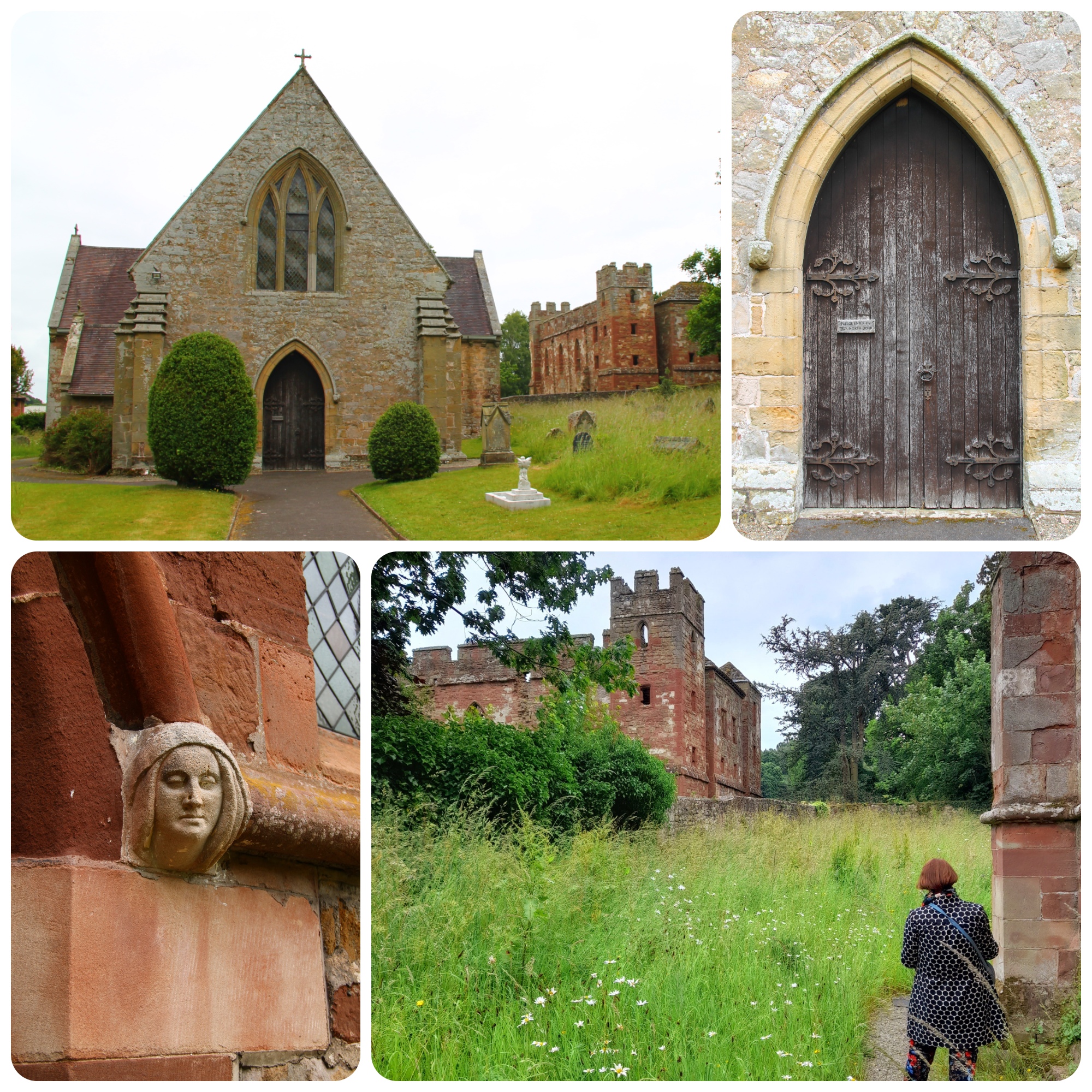
Consulting the map, we decided to pay the English Heritage managed Acton Burnell Castle a visit. The graceful red sandstone shell of the castle, which was built between 1284 and 1293 by Bishop Burnell, Edward I's Lord Chancellor, is tucked away in a quiet part of Shropshire, about half an hour's drive from the cow shed.

By 1420, the castle was abandoned, and it was allowed to decay while a new classical style mansion,  Acton Burnell Hall - now a private school - was built beside it in 1814.

Nonetheless, the castle remains an impressive example of a medieval fortified manor house.


When we arrived, a family was having a picnic inside the ruin, with both children and adults playing a boisterous game involving water guns. Not that you'd notice in the photos, as shooting around people and making it seem that we are the only visitors, is one of my fortes. This involves having lots of patience and a deadly stare! 


Leaving the castle grounds behind, we walked towards St. Mary's Church, the churchyard offering a fine view of the adjacent castle. Like the castle, we owe its existence to the aforementioned Bishop Burnell.

Unusually it remained unaltered from its completion in about 1282 until the addition of a new tower in the 1880s. 


The church's north transept has several fascinating and intricately carved alabaster effigies.

On the west wall is the memorial to Sir Humphrey Lee, who died in 1632 (above, bottom right). Sir Humphrey is shown at prayer facing his wife.  Their children too are shown kneeling, each of them being a miniature version of a parent.


On the right is the impressive monument to Sir Richard Lee, who died in 1591.  He is portrayed as a knight with his wife beside him, 3 sons at his head and feet, the eldest with his hand on the helmet, and his 9 daughters behind him. Interestingly, no two of the girls are identical!  


After leaving the church, we made our way to the enchanting little chapel at Langley, just 5 minutes up the road from Acton Burnell, and also owned by English Heritage.

The Burnells were lords of the manor of Langley and, in 1313, Richard Burnell obtained permission to build a chapel here.  The structure of the present building dates from this time. In 1377, the manor of Langley passed to the Lee family (they of the alabaster memorials), who fitted out the chapel in about 1546. In 1591, Sir Humphrey Lee moved to Langley. He was probably responsible for re-roofing the chapel in 1601 – a date given on the nave roof – and refurnishing it a few years later.


The atmospheric interior of the chapel, which is standing rather bleakly in remote countryside, contains a perfect set of 17th century timber furnishings.

Typical Tudor decorations of roses and fleurs-de-lis appear on the plaster frieze between the roof and south wall (below, bottom left).


By 1700 the chapel had largely fallen out of use, and thus escaped any attempt to re-order the interior according to the more elaborate ‘High Church’ model favoured in the 19th century. The last regular service was held here in 1871.

Having concluded our visit, we returned to our car parked in a lay-by, and attempted to drive back to The Byre. I won't mention the close encounter with a bus on a single track lane, which required us to reverse and half-burrow our car into a hedge, or the fact that our Satnav was trying to get us to take the infamous Burway, a steep and precipitous road crossing the Long Mynd. Having made that mistake once (see here) we weren't about to repeat the experience!


Friday, 4 August 2017

A tale of two walks

We were at the end of the first week of our holiday by now, and the glorious weather of only a couple of days before seemed a long way off.

The sky on Sunday morning was still a dull grey, but it least it was dry, so we wasted no time in doing a walk which had been on our list for a long time.


But first, let's have a look at what I was wearing. I dug one of my vintage tops out of my suitcase to compliment my hard-wearing dark denim trousers. It's got a pink, yellow, blue and green print on a white background, green pearly buttons and slightly puffy sleeves. Look at my hair flower, which compliments the roses scrambling up our cottage's walls!

For the walk itself, I added a green cardie, and later my boring Gore-Tex jacket as it was quite windy.

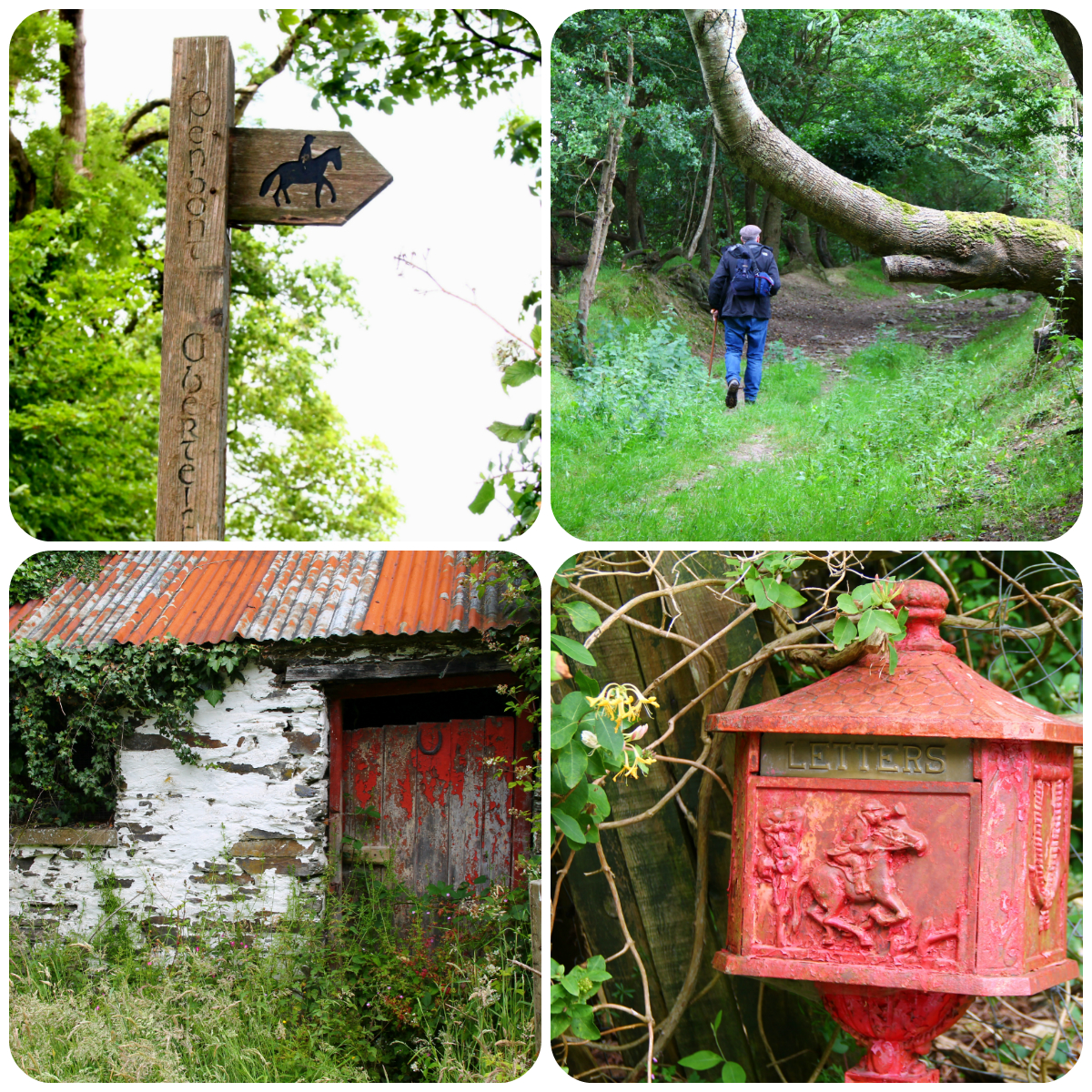
The start of the walk was just across the estuary, in Cardigan, and the walk itself would take us in a loop around and then down to St. Dogmaels, our village, and back.


Right before veering off the main road to St. Dogmaels onto a bridle path, I took the opportunity to photograph a slightly rusty pub sign (the building it's attached to has been converted to housing, but I love it that they kept the sign!) and a derelict petrol pump we'd been passing each day on our way to and from the cottage.


The bridle path took us to an abandoned farm where, after a slight diversion, we passed a flock of persistingly bleating sheep who were alarmed at the sight of us. Behind them, a panoramic view to the estuary and Poppit Sands opened up.

We could even spot our cottage's roof and chimney in the far distance.


The path, which became muddy for a while, ended at a tarmacked lane leading into St. Dogmaels.

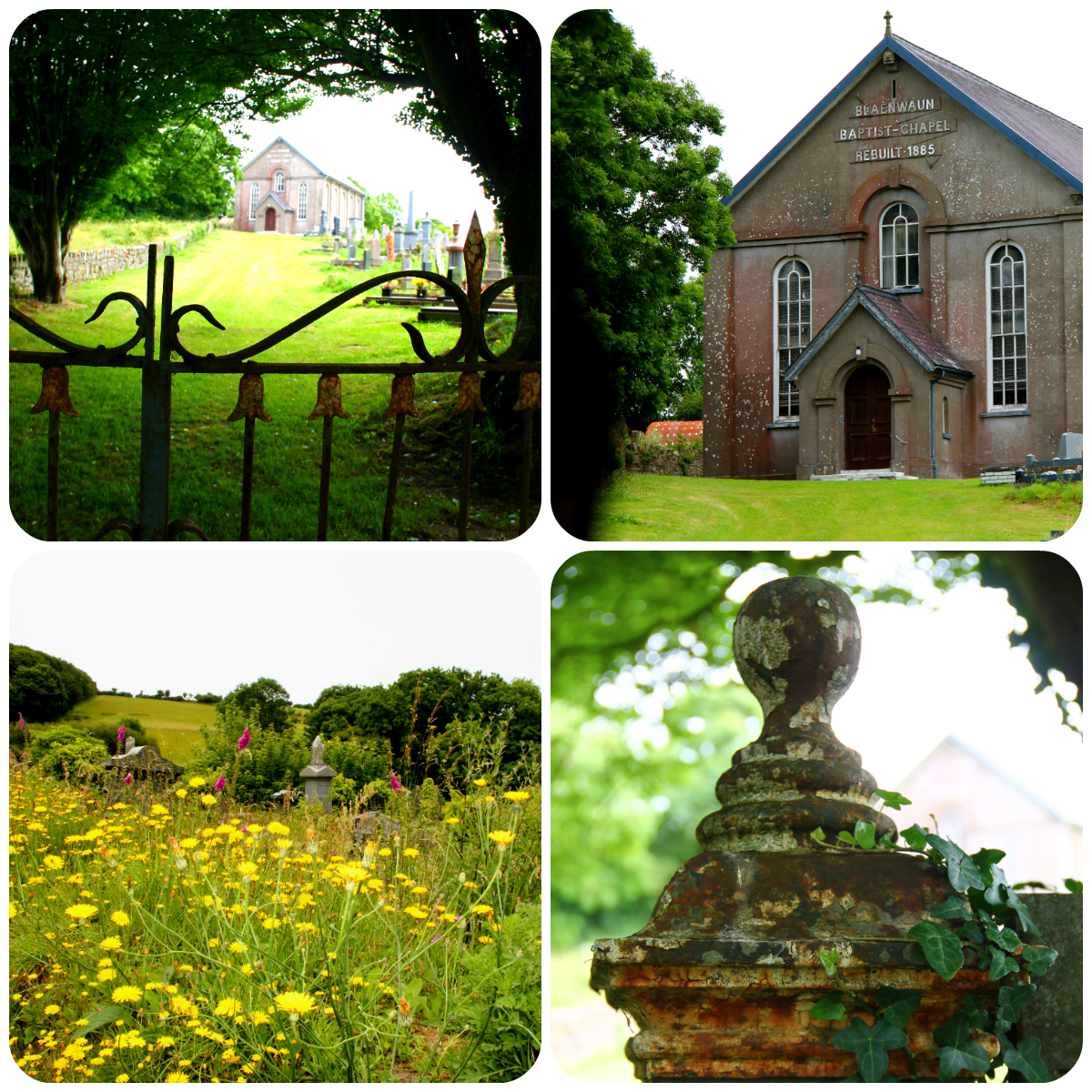
We were supposed to take another path leading off this lane, but as we were searching for it, we got talking to the owners of a lovely yellow painted house, the lady of which turned out to be Dutch. She directed us to a more scenic path, which ran enclosed between banks of trees, eventually ending up at Blaenwaun Baptist Chapel, which is where we were headed.


The chapel is a stark, forbidding looking building squatting in an overgrown churchyard, its graves entangled in brambles and adorned with wildflowers. It must be very bleak here in winter, the starkness of the chapel on top of the hill enough to put the fear of God into you.


We continued on a quiet country lane and eventually ended up on a footpath running next to Cwm Degwel, a wooded ravine, to St. Dogmaels, where we had a cup of coffee at The Coach House,


Fortified by a bar of delicious Welsh chocolate, we returned, by way of fields and stiles to Cardigan.


Much to our surprise, we got a bonus sunny day on Monday. We decided to strike the iron while it was hot, and tick off another walk on our list.

For this one, we had to drive all the way to Whitesands, near St. Davids, a large sandy beach with easy access to the Coast Path.

The walk up to St. Davids Head is a popular one and, in fact, we have attempted to do it before. It was on an equally sunny day, but soon after heading off we were surprised by a stubborn sea mist, forcing us to return before the walk was completed.


In contrast, now it was the clearest of days, with far reaching views across an island-dotted seascape.

With the sun slightly filtered by wisps of clouds, the light wasn't too harsh and therefore perfect for photographs.

The footpath runs up and down but remains close to the coast, passing the beach at Porth Lleuog separated from Whitesands Bay by the rocky promontory of Trwynhwrddyn.


At the crest of a hill Coetan Arthur, a 4000-year-old Neolithic burial chamber, can be seen silhouetted against the sky.


Then the path descends into a valley via broad steps to a spring above the tiny cove of Porth Melgan.


We scrambled up to St. Davids Head itself, taking in the all around view, with Carn Llidi towering behind us trying but not quite succeeding to keep the clouds at bay, and Ramsey Island out to sea.


Then we went in search of Coetan Arthur on the plateau leading off from St. Davids Head, a wild, rugged landscape full of rocky outcrops.


The burial chamber was surprisingly hard to find among the profusion of rocks littering the plateau, but finally Jos spotted it on the ridge to our left.

The massive capstone measures approximately 6 metres by 2,5 metres and its support is 1,5 metres in height. Nevertheless, until you are actually standing next to it, it looks deceptively small.


From there, we searched out a path zig-zagging down to the main coast path, and returned to Whitesands the way we'd come.

Driving back inland, where a thick blanket of grey clouds had gathered in the meantime, we looked back one more time at the receding blue sky near the coast.


Little did we know that this would be the last bit of sunshine and blue sky we'd see during our holiday ...