Showing posts with label Powis Castle. Show all posts

Wednesday, 3 July 2024

Highs and lows

Hello you lovely people! Are you ready for the second installment of my travelogue? I know I am! 

And we were definitely ready for another day of adventure on Monday the 10th of June, even if the weather gods once again did their best to dampen our enthusiasm. Although we were woken up by the rain pitter-pattering on the cowshed's roof, the sun was out when we finally set off to our chosen destination, making our spirits rise and our hearts beat with excitement!

For the third year in a row, we'd ordered a National Trust Touring Pass, which offers excellent value for money. The difference this year was that we no longer had to obtain a physical pass, which could only be done at a limited number of properties. Moving ahead with the times, the Trust had gone digital and entrance to any property was now through a barcode and/or reference number supplied to us by email.


This meant that we weren't obliged to go to Powis Castle to obtain our pass. So, what did we do? Exactly! Same as we did in previous years, our first proper day would be spent at the red castle perched dramatically on a narrow ridge above its world-famous terraced gardens.

The property is just across the border in Wales, and getting there involves a leisurely drive of about half an hour, the road meandering along the border, welcoming us to Wales one minute and back to England the next.

Walking up from the car park to the castle's courtyard, taking a shortcut across a grassy knoll rather than following the tarmacked path (boring!), we were escorted by one of the resident peahens and her brood of pea-babies!


Powis Castle was built in the mid-13th century by a Welsh prince - Gruffudd ap Gwenwynwyn - who wanted to establish his independence from his traditional enemies, the aggressive princes of Gwynedd in the North-West of Wales. 

The castle has been rebuilt several times and underwent intensive renovations by Sir Edward Herbert (1542–95), who acquired the castle in 1587. In the 18th century the title passed to the Clive family, although part of the inheritance stipulated that they should change their name to Herbert.

Further refurbishments followed in the early 19th as well as the early 20th centuries, the latter by George and Violet Herbert. Having lost both sons - in WWI and WWII respectively - there was no immediate heir to inherit the estate, which prompted George to leave the castle, garden and part of the deer park to the National Trust in 1952.


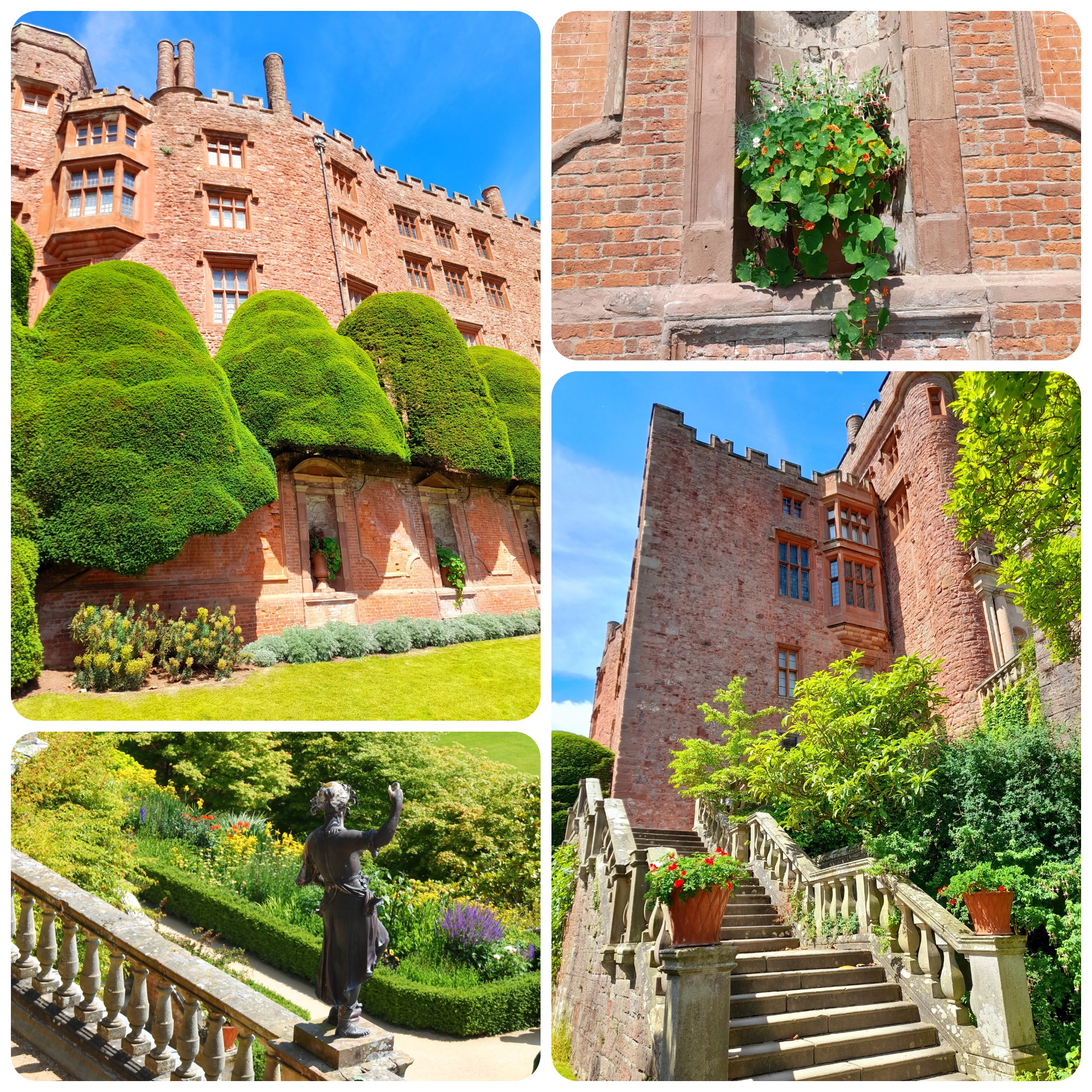
Potted history lesson done and dusted, it was time to descend into the garden and explore the first layers of the garden terraces. Although this was no less than our fifth visit to the castle, we were still mesmerized by the breath-taking panorama with its backdrop of rolling hills, made even more glorious by the dome of blue sky and dramatic cloudscape.

One of the garden's most eye-catching features are its cloud-like clipped yews which tumble over the terraces and date back to the 17th century. In late summer and early autumn the estate gardeners spend several weeks trimming the 14-metre high topiary bushes aided by a hydraulic cherry-picker!

A statue by the famous 18th century garden sculptor John van Nost, of Hercules slaying the Hydra or many-headed serpent, is taking pride of place against the backdrop of cloudy yew hedge.


As our stomachs had started rumbling by now, we interrupted our explorations by climbing back up to the Courtyard Café. Regally striding into our direction was one of the peacocks who rule the roost here. I wonder if it was Colin, Alan or Perry? Or perhaps one of the later additions to the menagerie, Mr. Humphreys or Captain Peacock? Whoever he was, he didn't stop to pass the time of day and nor did he oblige by fanning out his tail feathers.

The moody sky spoke of imminent rain and indeed, while I was safely ensconced into an alcove in the café there was a heavy downpour which made the people who were enjoying cups of tea in the courtyard flee inside for shelter. It was over in less than 5 minutes and in fact Jos, who was queueing for food at the time, hadn't even noticed.


After lunch, it was time for a walk in the wilderness. Or rather: Wilderness, with a capital W, which the wooded ridge opposite the castle is known as.

On previous occasions, we were thankful to take refuge from the heat of the sun by walking under the canopies of the great oaks and exotic trees in this informal part of the garden. Now, at a mere 12°C, we were shivering in spite of wearing many layers under our leather jackets. At one point, I was even lamenting the fact that I'd neglected to bring gloves!

Passing the stable pond and the plunge pool on our way to the pet cemetery on the highest level of the ridge, we were stopped in our tracks by the sight of a giant foot. This is the Patagonian Foot, which was sculpted in 1987 by Vincent Woropay (1951 - 2002). 


As directed by the nice chap at the garden checkpoint, we were making our way to the estate's latest attraction, an impressive tree carving skilfully created by the renowned local artist, Simon O'Rourke. 

We were duly impressed by the two friendly dragons - well, they're wyverns, actually - guarding two eggs from which their offspring are hatching. Both adults carry saddles on their backs, so that you can let your inner child take you on magical adventures.


As we continued our walk in the Wilderness, we kept catching glimpses of the castle perched on the opposite ridge. Then, after making our descent into the lower reaches of the garden, we arrived at the edge of the Great Lawn, offering a magnificent vista of the castle and its frothing layers of terraces. 


The terraces at Powis Castle are said to be the finest surviving example of a 17th century terrace garden in Britain. 

When George Herbert, great-grandson of Clive of India, inherited the title of  Earl of Powis along with the castle and estate in 1891, his wife Violet persuaded him to let her improve the garden. 

The Fountain Garden is one of the additions made by Violet, replacing a kitchen garden which she considered unsightly. On our previous visits, we thankfully made use of the pink and blue deckchairs bearing the National Trust emblem set out on the lawn here. This time around, they were conspicuous by their absence, so we sat down on a sheltered bench soaking up some welcome sunshine.


In 1912, Violet commissioned the spectacular wrought iron gates near the fountain garden as a present for George’s birthday. Above the gate is the Powis coat of arms, and surmounting each pillar is a wyvern (a legendary dragon-like creature), one of which is holding a severed hand in its mouth.

For those who are intrigued, the key difference is that a wyvern has two legs, whereas a dragon has four.


What comes down must go up, so eventually we had to climb up to the courtyard again via several seemingly neverending sets of stone steps. 

At the foot of the steps which lead from the Orangery Terrace to the Top Terrace (below, top right), we met the oldest peacock in residence, dating from the 1800s, cast in lead and with its tail feathers fully fanned. Having arrived at the top, two real life peacocks accompanied us on our way out.


After re-joining our car, we drove back across the border to England for a relaxing evening at the cowshed.

And look, I even braved the sub-standard temperatures to show you what I was wearing underneath that orange leather jacket!


Continuing with the highs and lows, we'd planned a day of charity shopping and sightseeing in Bridgnorth on Tuesday. 

This time, the weather gods tricked us into thinking it would a fair weather day by treating us to full-on sunshine from the moment we got up. More fool us, as we'd hardly started out on our 50-minute journey to our destination when the first drops of rain appeared on our windscreen.

Grey skies and sunny spells, with the odd spot of drizzle thrown in, would be our lot all day, and the prevailing blustery wind made sure that the mercury didn't climb higher than Monday's 12°C.


After parking our car in High Town, we trawled the town's many charity shops, searching in vain for some long-sleeved garments to join my meagre supply of cold-weather clothes. It was in the final shop that I came across this peasant-style embroidered long-sleeved denim blouse, which was new-with-tags from Sainsbury's Tu label.

Mission accomplished, we had lunch at the town's branch of Wetherspoon's, The Jewel of the Severn.


Bridgnorth, which lies in the south-eastern part of Shropshire, sits high on a sandstone cliff with spectacular views of the Severn Valley. The town is actually divided in two – High Town and Low Town.

Our first port of call after lunch was St. Leonard's Church, which stands in a peaceful close of its own at the highest point of the town. While I was taking photographs, Jos was already taking shelter from the biting wind inside the church porch. 


The red Gothic tower of St Leonard's dominates Bridgnorth's skyline. Inside, the church has the airy vastness of a cathedral. Seemingly medieval, it is in fact almost entirely a Victorian restoration. This is because disaster struck during the Civil War when St Leonard's was used by Cromwell's troops as an ammunition store. A cannon shot caused it to explode, and fire swept through the town. The church was repaired, and in the 17th century, the magnificent nave roof was installed. Most of the current church dates from the 19th century.


Eight sets of ancient donkey steps connect High and Low Town and we took the so-called Granary Steps leading down from St. Leonard's to the River Severn. 

We were sheltered from the wind here, so we ambled around the quayside, where I patiently waited for a break in the traffic crossing the Severn Bridge to take a photo of the iconic Ridley Seeds ghost sign.


Next on our itinerary were the sandstone rocks nestling beneath Castle Hill. These contain a number of caves, one of which is known as Lavington’s Hole, a 70 foot tunnel under Castle Hill dug by Colonel Lavington during the Civil War. Knowing that the Royalists stored their gunpowder in St Mary's, his aim was to blow up the church. However, the tunnel was never completed as the Royalists surrendered on the 26th of April 1646.

The tunnel's entrance is still on show today, but due to safety reasons it cannot be entered. Not that my claustrophobia would have allowed me to do so ...


What comes down must go up, part 2. But there was no way that we would attempt another set of those donkey steps! 

As the famous and much-loved Cliff Railway re-opened in March after having been out of action for 14 months, we were obviously raring to return to High Town in style again.


It might look quite steep - in fact it is one of the steepest funicular railways in Britain - but there's nothing to it really, even if going down is a bit more stomach-churning than going up. 

The railway operates two cars on parallel tracks. Connected by steel ropes, the carriages serve to counterbalance each other – as one rises to the top station, the other runs to the bottom station. 

I've made a little video while we were going up to give you some idea.


And surely the panorama which opens up when you're at the top, of Low Town and the Severn Valley beyond, is simply breathtaking ...


It was far too chilly to remove my jacket while we were out and about, but as I couldn't possibly leave you without showing my outfit, we once again briefly stepped outside when back at the cowshed.

I combined my groovilicious maxi skirt - last worn in May, here - with a pink cotton cable-knit jumper, a fuchsia leather belt and my wooden discs necklace from Accessorize. Even layered with a vest and long-sleeved t-shirt and with a cardigan worn on top, I was still feeling the cold ...


We had to be up early the next day as we had some very exciting plans ... but that, my friends, will be for next time.

See you soon!


Tuesday, 12 July 2022

Blue skies at the red castle

Hello my friends, and welcome to the second episode of my Shropshire travelogue. Although, truth be told, we would turn our backs on Shropshire and head for Wales that day ...

After a restful night's sleep, we woke up to sunshine on Monday the 20th of June. Still not quite used to the time difference, we were wide awake before 6 am and were almost blinded by the fiery orange sun rising over the Long Mynd when we sneaked a peek through the curtains. 

But it was far too early to get up, so we snuggled back under the duvet and dozed until 7.45. Then, after enjoying the first of Jos's full English breakfasts, we entered that day's destination into our Satnav and went off.

In the weeks before our holiday we'd tossed around a couple of ideas, which included revisiting old favourites as well as venturing to pastures new. However, we hadn't made any definite plans on how to spend our days, wanting to let the weather and our moods be the deciding factors.


Monday, however, was an exception as, come rain or shine, our destination was set in stone. Preparing for our holiday, we'd ordered a National Trust Touring Pass a couple of weeks ago. As we'd planned to (re)visit quite a few of their properties, we thought that £ 77 for a 14-day pass admitting two was quite good value! We were duly sent a confirmation email which we had to present at our first property in order to get our pass, the only catch being that it could only be collected at a limited number of places. 

We were lucky enough that Powis Castle, which is a hop and a skip across the border in Wales, was among these.

Having visited the castle and its garden both in 2018 and 2019, this would be our third visit and, apart from a false start in June 2018, the sun has always regaled us with her presence here. This time too this beautiful part of the world didn't live up to its Wet Wales moniker!

After having parked our car and chatted to the nice parking assistants, we proceeded towards the ticket office and were promptly issued with our pass, which would prove to be worth its weight in gold. 


Walking up from the car park to the courtyard, we were greeted by the plaintive calls of the resident peacocks who wander among the tables hoping for a handout. The lead statue taking pride of place in the courtyard dates from the early 1700s and depicts the winged female figure of Fame borne by Pegasus. 

As we realized we hadn't brought our walking sticks - which we would definitely need to spare our backs and knees when exploring those terraced gardens - we bought some state-of-the-art extendable trekking poles. Then we joined the queue in the courtyard café and found ourselves a table in an alcove away from the café's hustle and bustle where we sipped cups of cappuccino and shared a Bakewell slice to keep us going.

Note that I was still wearing both my denim jacket and a cardigan at this point as it had seemed rather chilly when we stepped out of our car. With the mercury steadily climbing towards the mid-twenties, we'd be shedding layers as the day progressed!


Suitably restored, we made our way towards the garden's entrance, where we were supposed to show our tickets. If we were looking forward to proudly showing our temporary membership status, we were to be disappointed. The lady at the checkpoint turned out to be one of the parking assistants we'd chatted to earlier and as she remembered us - the perks of being dressed a little differently, I guess - she  waved us through with a smile and without so much as a peek at our spanking new pass!


Even after two previous visits, our first glimpse of the garden still took our breaths away with its theatrical mix of Italianate terraces, which were blasted out of the bare rock, its spectacular herbaceous borders, its mind-blowing topiary and its superb views.

And no, all these superlatives are not exaggerated in the least. After all, the garden is listed in the top twenty of the Great British Gardens guide. Apart from its unique historical setting, there's the skill of the exquisite planting, the estate being kept in impeccable order by a team of six full time gardeners and several volunteers, who ensure that that the garden is a delight in every season. 


From their position high up on the hillside, the views from the terraces across the garden, the deer park, the Severn Valley and, in the distance, the profiles of the Breidden Hills overlooking the nearby town of Welshpool, are truly spectacular. In fact, we found it impossible to tear our eyes away and I'm sure it won't surprise you if I tell you that my camera was working overtime.

Immediately noticeable as you arrive is the dusky red stone that makes the castle so striking, especially when outlined dramatically against a brilliant blue sky. 

Powis Castle was built in the mid-13th century by a Welsh prince - Gruffudd ap Gwenwynwyn - who wanted to establish his independence from his traditional enemies, the aggressive princes of Gwynedd in the North-West of Wales. 


The castle has been rebuilt several times and underwent intensive renovation by Sir Edward Herbert (1542–95), the second son of William Herbert, 1st Earl of Pembroke and Anne Parr (sister of Catherine Parr, the sixth wife of Henry VIII), who acquired the castle in 1587.

In the 18th century the title passed to the Clive family, although part of the inheritance was the stipulation that they should change their name to Herbert.  There was a thorough refurbishment of the castle in the early 19th century, and again in the early 20th century by George and Violet Herbert.  Sadly, they lost their two sons, one in WWI and another in WWII, so, as there was no immediate heir to inherit the estate, George Herbert left the castle, garden and part of the deer park to the National Trust in 1952.


One of the garden's most eye-catching features are its cloud-like clipped yews which tumble over the terraces and shelter rare and tender plants. There is a 30-foot-high yew hedge and 14 "tumps" dating back to the 17th century.

In late summer and early autumn the estate gardeners take to the air in a cherry-picker and spend several weeks trimming the topiary to ensure that the hedges continue to look spectacular for the next 12 months. 


Descending deeper and deeper into the garden, one by one its terraces are revealed like so many layers of an elaborate wedding cake. 

Lead statues of shepherds and shepherdesses are dancing on the balustrade of the Aviary Terrace and I'm travelling back in time to June 2019 when I found treasure beneath the feet of one of them.


The Aviary itself, where we briefly took shelter from the glare of the midday sun, and which once housed birds of prey, forms the centrepiece of the terrace and is arranged as an arcaded structure with 7 bays.

Below the Aviary Terrace is an Orangery with a grand 18th century stone doorway that was once the entrance to the castle itself.


By this time it was past 1 pm and we were getting peckish. Not having had the presence of mind to bring a picnic, there was nothing for it but to climb all the way up again to the courtyard, where we joined an even longer queue for lunch. 

As luck would have it, though, the table in the alcove where we'd had our elevenses was free, so we wasted no time in claiming it, taking the weight off our feet and stuffing ourselves with a couple of chicken salad sandwiches - choice had been rather limited this late in the day - and some soft drinks.


Then it was time for a visit to the castle itself. 

Photography isn't allowed inside, and would have been nearly impossible if it were, due to the heavy Jacobean panelling in many of the rooms and the permanently drawn curtains to prevent the damage caused by ultraviolet light on the precious furnishings.

The parking assistant lady, whom we assured we weren't following around, was now on duty at the castle and once again we were allowed in without having to show our pass.

Her colleague was on duty next door, a the Clive Museum, so we were waved through with a smile of recognition here as well. One of the UK’s most significant collections of Indian objects is displayed here. As major figures in Britain’s colonial East India Company, Robert Clive and his son Edward  looted many of these objects during their seizure of power in India and Myanmar and violent subsequent rule in the 18th century. However exquisite the exhibits are, the circumstances of their acquisition do leave a bit of a bitter taste in one's mouth, and we briefly whizzed through them.


Next up was a walk along the wooded ridge opposite the castle, known as the Wilderness. 

Here, things are far less formal than in the rest of the garden, with wildflowers growing in abundance, including some Spotted Orchids.

This is also the perfect place to admire the view of the castle and its wedding-cake-layer terraces across the Great Lawn.


Doesn't it look properly fairy-tale like - not to mention quite unreal - from this vantage point?

I couldn't resist posing as Lady of the Manor, looking for all the world as if I owned the joint, as someone on Instagram jokingly remarked. 

We were gasping for a cup of coffee by then, and confidently made our way towards the garden coffee shop where we rested our feet on a previous visit ... only to find it closed!


There was nothing for it but to continue with parched throats and weary feet, to arrive at the Fountain Garden,where various lawn chairs were waiting invitingly. 

While Jos was taking 40 winks, I took a closer look at the Bodley gates, flanked by pillars topped with wyverns (a legendary dragon-like creature), one of which is holding a severed hand in its mouth. The gates were commissioned by Violet, Lady Powis in 1912.


As the wife of the 4th Earl of Powis, Violet persuaded her husband to entrust the entire management of the deteriorating gardens at Powis Castle to her in 1911. Over the next 18 years, she effectively recreated the gardens of Powis into the internationally acclaimed ones they are today.


Having climbed all the way up again to the courtyard, we dashed into the café for that long awaited cup of coffee, which we once again had at our very own table in the alcove!

Before returning to our car, we had another browse in the shop, where Jos bought a well-needed compact man bag, and I was seduced into buying a bee brooch, screen printed on FSC certified birch wood. 


Half an hour's drive along the Anglo-Welsh border brought us back to Shropshire, and eventually to the cowshed, where I posed for some proper outfit photos.

The 1980s thin knit cap-sleeved jumper in hot pink patterned with tiny white squares at the yoke and shoulders was the only vintage item in my outfit. The skirt with its jungly green, pink, yellow and orange pattern was a cheeky retail buy a couple of months ago. Having already worn it a couple of times, it is set to become a wardrobe staple.

Both the chunky wooden necklace and green plastic birds brooch were retail buys as well and have been on regular rotation for well over 10 years. The belt was a charity shop find and the gold ballerinas I'd changed into when I got home were a gift from a friend who sadly passed away in 2019.

So, that's it for day 2. I hope you'll join me again for the next installment in a couple of days.


Sunday, 21 July 2019

Summertime and the living is easy

The weather gods must have finally taken pity on us, as the view framed by our cottage's window on Thursday was bathing in plenty of sunshine.

This prompted me to wear one of my favourite frocks, a vintage red checked wrap dress sprinkled with white flowers and edged with white rickrack. If that already sounds delightful, what about butterfly sleeves? Check! The dress is fit and flare and has revealing tendencies, so vintage slip to the rescue! My Clarks Cloudsteppers, the most comfortable shoes ever, were a perfect match.


We'd slept a bit longer than usual so that we reached our destination, which was an hour's drive from the cowshed, by late morning only.

Oswestry, a charming little country town close to the Welsh border, is in the North of Shropshire, an area we hadn't visited before. However, it was by no means the first time that I had been there! As a 15-year-old, while travelling to Wales with my parents and siblings, it was the first UK town I ever set foot in. Not that we stayed there for long: on passing a little corner shop, my Dad stopped the car and sent me to buy groceries.


Back in the here and now, we easily found a parking spot near the town centre and, halfway up the High Street, we perched ourselves on a bench in the town park, Cae Glas Park, to get our bearings.

The war poet Wilfred Owen (1893-1918) was born in Oswestry, and although he only spent a few years of his life here, his family's connection with the town goes back generations, and his grandfather was once mayor of the town. In 2018, a statue to him, created by local artist Tim Turner, was unveiled in the park.


Just a short stroll on the High Street takes you to St. Oswald's Church, which was completed in the early 1670s. Oswestry is said to be named after king and saint Oswald, and the name is thought to be a corruption of "Oswald's Tree".


Oswestry is a traditional market town with award-winning markets, both indoor and outdoor, drawing visitors from all parts of Shropshire and Mid Wales.


The town has an eclectic mix of independent shops selling anything from bric-a-brac to books, as well as quirky antique shops and galleries.

The sculpture of the man chasing a chicken was aptly displayed above USA Fried Chicken in Willow Street.


Lunch was had at the local Wetherspoon, named after the war poet, and housed in an ugly 1960s/1970s monstrosity of a building, which we believe used to be the post office. Inside, it was light and airy, and the fish and chips we had was delicious. I made a photo of both our plates as proof to Vix that Jos didn't have his usual jacket potato!


There were charity shops galore as well, and I think we visited them all, finding treasure in many.

My finds included two cotton summer tops and a pair of wide-legged trousers, which you can catch a glimpse of on the bottom right. I also found the first of my brooches, a delighful Lucite one. The chap volunteering in that particular shop was a bit of a brooch collector himself resulting in a good chat about the subject. 

Then I found Jos this amazing pinstriped linen H&M jacket, just as he was lamenting the fact that he hadn't packed a light-weight jacket.


Things were starting to heat up on Friday, when temperatures reached heights of about 25° Celsius.

The perfect day for a visit to another National Trust property and an amble through its gardens. 

Powis Castle is just across the border in Wales, the road meandering along the border, welcoming us to Wales one minute and back to Shropshire the next.


We visited this magnificent medieval castle, built on a rock above its terraced gardens, last year as well. This was on a day with a rainy start, from which we sheltered by starting with a visit to the castle itself to view its amazing collection of paintings, sculpture, furniture and tapestries. 

This time, we decided to visit the gardens only, but not before making the acquaintance of Captain Peacock, his wife and their peababy, who were begging for crumbs in the courtyard.


Here's a look at my outfit, which might very well be my favourite of our holiday. I felt fantastic in my vintage waxed cotton maxi skirt combined with a cotton peasant top I bagged in the New Look sales last Summer. A red vinyl belt, oval vintage brooch bearing a portrait of a lady and ivory coloured beaded necklace completed by outfit. Oh, and my faithful Cloudsteppers, which really make me feel as if I am walking on air.


The world-famous garden, overhung with clipped yews, shelters rare and tender plants. Laid out under the influence of Italian and French styles, it retains its original lead statues and an orangery on the terraces. 

I was photographing details of one of the lead statues, when I spotted this stone of joy painted with the cutest of ladybirds from @stonesofjoy1. I was thrilled to bits. I'm still not sure if I will rehide it here in Belgium, as I am very tempted to keep it as a souvenir. 


There were some curious objects hidden away in the trees, like this pair of shoes, which bore a note in both English and Welsh that they were Betty's. These were part of a children's trail laid out in relation to a project about a group of pupils and teachers from the Ashford Welsh Girls School, Middlesex, who were evacuated to the castle in 1939.

Exploring the garden, we wandered the Italianate terraces and marvelled at those spectacular yew hedges and lavish herbaceous borders. 


Arriving at the bottom level, we briefly sat down in one of the deckchairs on the lawn, but the sun had become too hot by then, so that after a visit to the lavs (there was a queue!) we sought out the shade once more.


This we found in the woodlands opposite the castle, where several walks have been laid out. Our weary limbs, and my rebelling knee in particular, dictated that we take the least streneous one, which at one point passed a tranquil, reed bordered pond. Here, I left Jos sitting on a rough-hewn wooden bench, following a path that brought me to the igloo shaped ice house!


Retracing our steps to the garden coffee shop, we grabbed the last shady table and sat down with cups of cappuccino. Here, more crumb-begging was being done by this funny chap, which we'll call Mr. Humphries.*


The sun still blazing, hazing the view towards the mighty Welsh mountains, we said our goodbyes to Powis Castle and drove back to England.

*Back in early Spring, two new peacocks arrived at Powis Castle and those who follow the castle's Facebook page like I do were asked to choose names for them. By popular vote, they were named Captain Peacock and Mr. Humphries (my choice as well) after the characters of the legendary British sitcom Are You Being Served. I'm not sure if I got the names of the actual peacocks we met right.

Finally, even if I'm not exactly wearing shorts, and it's Sunday already, I am linking to Nancy's Fancy Friday.