Showing posts with label Ironbridge. Show all posts

Monday, 15 July 2024

A day on the tiles

It's been a bit of a hectic week since I last posted here, with most of it taken up by the demands of my day job as well as the preparations for yesterday's flea market. I'll be telling you all about the latter in a future post, but for now let's once again set the time machine's satnav to last month's Shropshire holiday.

By Friday morning - we were the 14th of June by now - all traces of the previous evening's stormy weather had gone, although it was still a grey sky which greeted us when we drew the curtains. Fully expecting a repeat of Thursday's rainy weather and seriously under par temperatures, I dressed warmly, adding one of the pairs of Snags from Vix's goody bag, as well as my black and white dotty Phase Eight raincoat. The latter was bought on a similarly rainy day in at Church Stretton charity shop back in 2018.


With my raincoat, at least I matched some of our destination's black and white half-timbered architecture, but with highs of about 17°C, I didn't need all the layers this time around!

We'd chosen Shrewsbury as a shopping destination that day, and as always we were fully planning to make use of the town's excellent park and ride facilities, the nearest to the cowshed being Meole Brace. So, imagine our consternation when after negotiating the rather tricky roundabout at Meole Brace Retail Park we found the car park's entrance closed. After fruitlessly driving around in circles and asking one or two locals for directions, we finally made it to the new entrance to the south of the retail park and made it onto the waiting bus with minutes to spare.


Not expecting delays, we'd once again made a late start, so that it was almost midday when we got off the bus at The Square. From here, we hurried along into the direction of the post office on Pride Hill, as it was due to close at 1 pm. Here, we were faced with another setback in the form of a long and slowly proceeding queue, which was serviced by a single, flustered-looking employee. But there was nothing for it but to play the waiting game - something I'm notoriously bad at - as I'd brought along some books to post to Vronni

Then, after a quick lunch at the nearby M&S café, we were ready for a rummage at the town's numerous charity shops. I was on the lookout for long-sleeved tops in particular - note to Beate: it being or supposed to be Summer, there weren't any decent woollen jumpers to be had. Apart from a couple of t-shirts for layering purposes, a short-sleeved jumper and an aubergine Breton top I found these two peasant-style blouses, from Zara (top left) and M&S (bottom right) respectively.


There was also a new-with-tags Cath Kidston bag as well as no less than eight brooches, three of which were picked up from the delightful Mummas Emporium below.

Touted on Facebook as Shrewsbury's latest best kept secret and located  above Vision Express on Pride Hill, it's a cozy café and antiques shop combined. We enjoyed our customary cappuccinos with yummy sticky Belgian chocolate cake, which obviously we just needed to taste.


We then trudged up to the Park & Ride bus stop further along on Pride Hill, where we had a chat with a lovely lady during the rather long wait.

Saturday looked set to be a total washout and it was so dark that we needed to have breakfast with the lights on. When finally at around 10.30 the rain started petering out, we made a dash for our car and entered the day's destination into our satnav.


During the 50 minute or so drive it took us to get to Jackfield, in the Ironbridge Gorge, not only did it stop raining, we were even treated to one or two sunny spells.

Nevertheless, our journey wasn't exactly a smooth one, as it took us on seriously pot-holed roads and through the odd minor flood. To say that we were in need of some caffeine by the time we arrived at the Jackfield Tile Museum is quite an understatement.


Apart from a couple who had just ordered some toasted sandwiches, we were the only customers. However, with only one guy being in charge of everything, it took absolutely ages before we'd been served with our coffees and a shared slice of Victoria sponge. We thanked our lucky stars that we'd had the foresight to bring a picnic, so that we wouldn't have to starve to death while waiting for lunch to be dished up!


Appropriately caffeinated, we then pushed our way through the double doors leading to the museum proper and started our explorations.

We were urged to check out the old offices first, where we made use of an old-fashioned telephone to listen to the accounts of former employees.


The museum is housed within the premises of Craven Dunnill, a working tile factory which is still producing decorative tiles on site to this day. It showcases the British decorative tile industry between 1840 to 1960, the era which was the heyday of Craven Dunnill and its neighbours Maw & Co. 


After giving up its Jackfield premises, Craven Dunnill moved to nearby Bridgnorth in 1950. The Ironbridge Gorge Museum Trust purchased the site in 1983 and tile manufacture restarted at Jackfield in 1989, with Craven Dunnill taking over the business again in 2001.


The museum lies in the village of Jackfield, near Broseley, on the south bank of the River Severn in the Ironbridge Gorge, the birthplace of the Industrial Revolution, and now a World Heritage Site. It is one of ten Ironbridge Gorge museums administered by the Ironbridge Gorge Museum Trust.


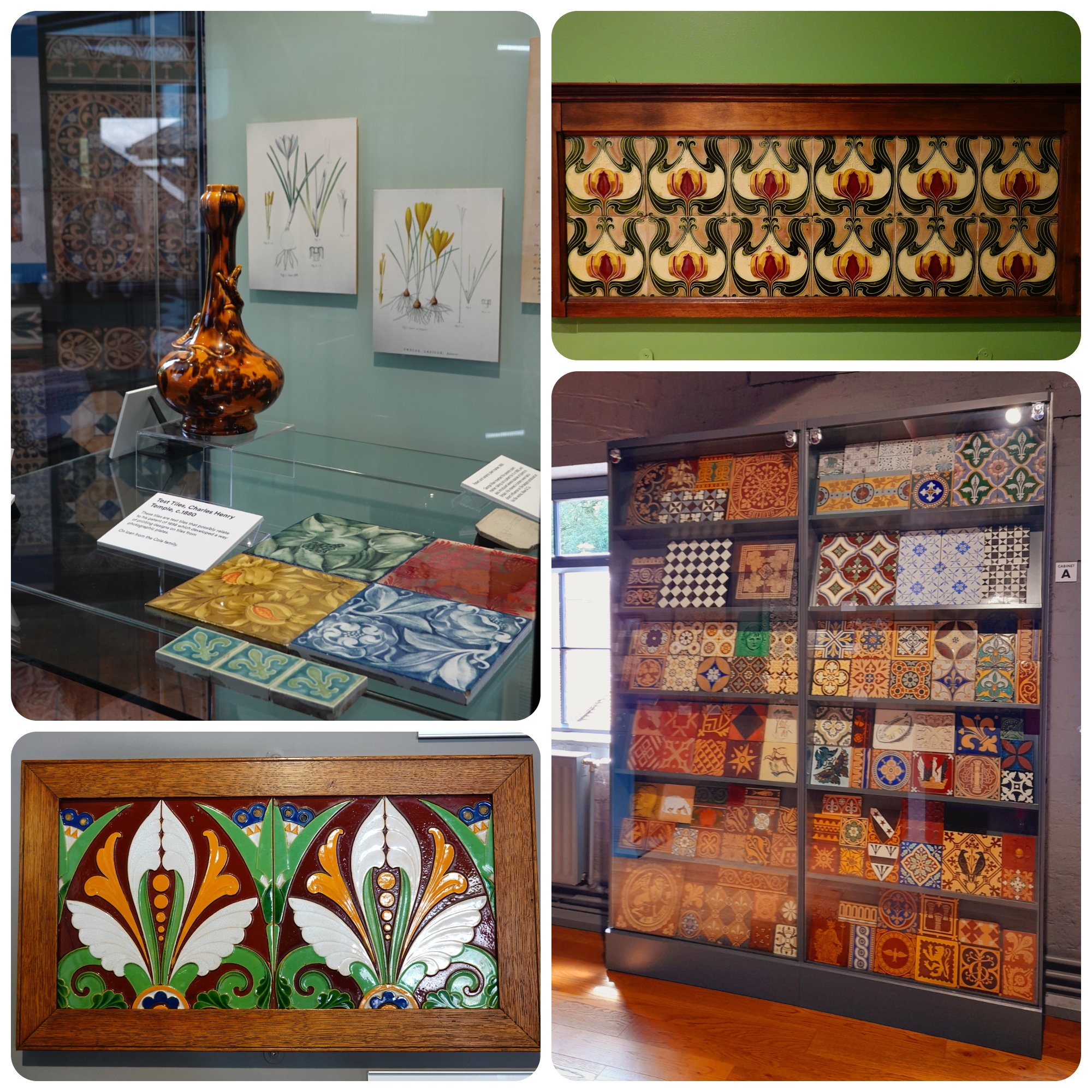
Jackfield Tile Museum is a treasure-trove of British ceramic design, fabulously curated and displayed in period room settings and beautiful galleries where the tiles are clearly labelled, both by period and style.

Like the Victorian Radicals exhibition we visited a couple of days prior, there was so much to take in that this definitely won't be our last visit.

I'm sure you won't be surprised that the Arts & Crafts tiles and ceramics, and particularly those produced by William de Morgan (including Antelope, ca. 1880, above, bottom right) were my absolute favourites.


One of the highlights of the museum is the collection of around 1700 tiles donated to the museum in 2013 by John Scott (1935-2020), who had been collecting Victorian tiles since the 1960s. Apparently, there's a book about the John Scott tile collection, which I definitely must seek out.


The museum also has some faithfully recreated premises, like a traditional butcher's shop (above, top left), a church interior (above, bottom left) and a Victorian pub with its curved tiled bar (below), all showcasing the creative use of tiles in the Victorian era.


The iconic glazed tiles used in several London tube stations — Covent Garden among them — were produced at this site, so it was only natural that this mock platform was included in the exhibits. 


The museum also has a huge room full of historic moulds, which enables the company to recreate the designs and thus assist with restoration works at historical properties. 


Some of the machinery and equipment used in tile-making, as well as the remains of the ancient kiln, can be viewed outside in the courtyard.

If you noticed the absence of other visitors in the photos, this time it definitely wasn't the result of my patience. In fact, we often had the rooms completely to ourselves!


By then, the sun was out in full force and had made short shrift with the remaining rain clouds. As we had our picnic waiting in the car, that's where we were headed, taking pity on the handful of people who were making their way to the Peacock Café.

Before heading to our next destination, less than ten minutes up the road, here's a little hint in the form of one of the tiles I photographed in the museum!


It is in fact the famous Iron Bridge, in a small town of the same name, which lies on the River Severn, at the heart of the Ironbridge Gorge. The town developed beside and took its name from the 30-meter cast iron bridge which spans the gorge.


Opened in 1781, it was the first major bridge in the world to be made of cast iron. Its success inspired the widespread use of cast iron as a structural material, and today the Grade I listed bridge is celebrated as a symbol of the Industrial Revolution.


In 1934 it was designated a scheduled monument and closed to vehicular traffic. Tolls for pedestrians were collected until 1950, when the bridge was transferred into public ownership. 

Having previously visited here in 2019, we reacquainted ourselves with the town, photographing the bridge, which was restored to its former glory in 2017 and 2018, from all angles. We even ended up kissing under the iron bridge (a reference to the Smiths' song, Still Ill - here on YouTube), something we neglected to do back in 2019.


After wandering around the town and having a peek in a tiny bric-a-brac shop selling vintage Craven Dunnill and Maw & Co. tiles at eye watering prices, we finished our visit with - you guessed it - cups of cappuccino, before travelling back to the cowshed by way of those potholed roads.


The day ended as it had begun, with torrential rain, which would last until half-way through the night.

And I'm ending this post as it began too, with a peek at my outfit. I was wearing the same denim midi skirt and the same mock croc ankle boots. My blouse is from the Belgian Who's That Girl label by way of a charity shop and my orange stretchy belt - a retail buy - was last seen here on our trip to Birmingham with Vix and Jon.

Although I've obviously got a couple more travel posts up my sleeve, I might take a brief break from them by a catch-up of what else has been happening in my life and what I've been wearing lately. 

See you soon!


Wednesday, 17 July 2019

Under the iron bridge we kissed

It was a rain-drenched landscape that greeted us on the Tuesday morning of our first week, and the rain wasn't showing any signs of a let-up while we were having breakfast. So, we moped around the cottage, anxiously watching the skies from all windows and hoping for a gap in the clouds.

We'd decided to go charity shopping in Shrewsbury, but the rain was quite torrential, so that there was nothing for it but to wait it out. When by 10.30 there was a brief lull in the downpour, we grabbed our coats and made a dash for the car.

The quiet country lanes had become quite treacherous to negotiate, especially where at one point the road climbs up to a plateau, which normally offers fabulous views of the rocky outcrops of the Stiperstones ridge. Now, low hanging clouds had wiped out any visibility and, after descending from these lofty heights, we even had to contend with a partially flooded road.


No, your eyes aren't deceiving you! As a nod to the atrocious weather conditions, I was wearing trousers. Again!

This is one of a pair (the other one's red) which I bought from an outlet shop a couple of years back.
They are my travelling trousers to be worn on bad weather days, just like this one. In order to keep them "me", I wore them with a vintage long-sleeved flower print shirt and my dotty Phase Eight raincoat charity shopped in Shropshire last year.


Mercifully, it had ceased raining the minute we stepped out of our car at the Park & Ride car park.

We always try and make use of the Park & Ride system when visiting larger towns, in order to avoid having to negotiate the often complicated one-way systems in search of a suitable place to park. In this case, we were especially glad that we did, as there seemed to be major roadworks in progress.


It was lunchtime by now, so we grabbed a quick bite to eat at the M&S café, as Jos wanted to buy some essentials at the shop.

Afterwards, we trawled the charity shops, most of which seemed to be concentrated in and around a street called Mardol. We also spent some time browsing a treasure trove of a shop called Memory Lane Antiques and Vintage.


As for the weather, I'm glad to report that it remained dry for the rest of the afternoon. We were even treated to some watery sunshine!

In order to make up for the weather, the charity shop and vintage gods treated us to kindly, as I found a pair of pristine navy Hotter shoes, a Welsh wool purse, a butterfly sleeve top and an Indian made maxi skirt. Jos was in luck too, as he found a boxed Kodak Bantam camera, complete with its instruction leaflet.


No sunshine, not even of the watery kind, on Wednesday, but we counted our blessings as at least the rain seemed to have packed up and left us. Admittedly, it was a bit chilly, with highs of only about 16° Celsius.

But wait, I can hear you thinking, what about that iron bridge you kissed under? Some of you might have recognized the title as a snippet of the lyrics of a certain Smiths song, but what's the link to this post, you might wonder.

Well, our destination of the day was a place called Ironbridge, and the song just inadvertently keeps popping into my head whenever I hear or see the name.


Ironbridge is a small town on the River Severn, at the heart of the Ironbridge Gorge. The town developed beside and took its name from the Iron Bridge, a 30-meter cast iron bridge which spans the gorge and was opened in 1781.

As early as 1934 it was designated a Scheduled Ancient Momument and closed to vehicular traffic. Tolls for pedestrians were collected until 1950, and it was at the old tollhouse that our journey across the bridge started.


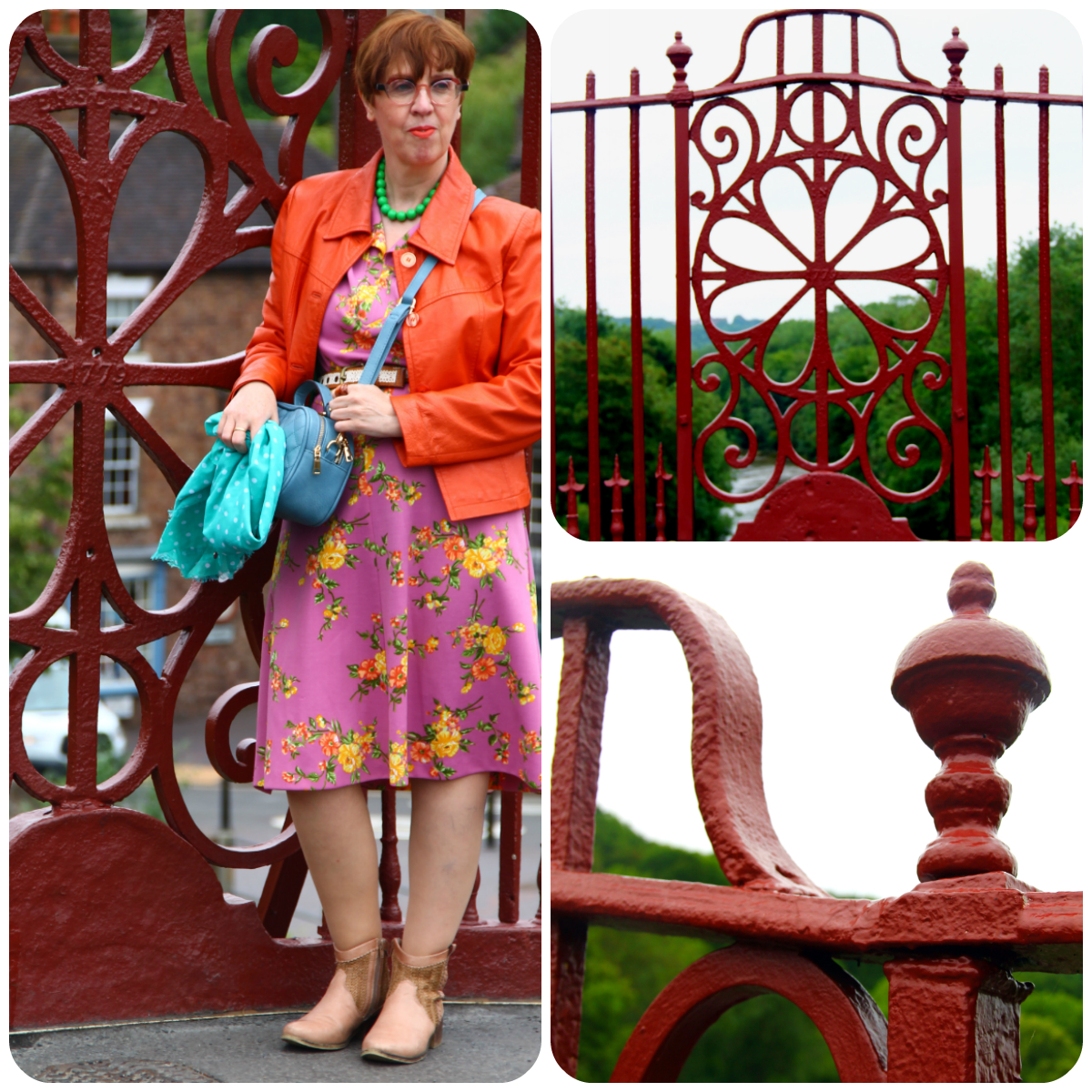
Now is as good a time as any to show you what I was wearing. In order to combat the greyness of the weather, one of my Diolen delights, in a dusky pink sprinkled with an orange, yellow and green flower print, came out to play. On top, my orange leather jacket, an adequate and welcome protection against the chilliness of the wind.


The bridge, the first major bridge in the world to be made of cast iron, is a Grade I listed building and together with the Ironbridge Gorge it forms a UNESCO World Heritage Site.

The area around Ironbridge is often described as the "birthplace of the industrial revolution", owing to the fact that in the nearby village of Coalbrookdale, a certain Abraham Darby perfected the technique of smelting iron with coke, allowing for a much cheaper production of iron.


To this day, the Bridge remains an important symbol of the dawn of the industrial age.

In 2017 and 2018, English Heritage undertook a £ 3.6 million conservation project on the bridge, restoring it to its formal glory.  

The Ironbridge Gorge is home to several interesting museums, which we have yet to visit. On a rainy day perhaps?


We'd brought a picnic which we ate in our car, before undertaking the 10-minute drive to our next destination.

There's a scenic but streneous walk from here to Ironbridge and back, descending into the gorge and then climbing out of it again by way of a series of wooden steps, but we decided to give it a miss, and just visit the delightful National Trust property called Benthall Hall.


Entrance is through a lychgate, and past the quaint little church of St Bartholomew’s, which has recently been acquired by the National Trust. 

I found the approach to the church, by way of a path leading through what looked like a miniature wildflower meadow, particularly charming.


The current house was built in 1535 but there have been Benthalls living on this site since the medieval period. The house is still tenanted by the Benthall family today.

The family sold the house in 1844, but then bought it back several generations later, before passing it to the National Trust on condition that the family continue to live here.


The interior is stunning, with a carved oak staircase, decorated plaster ceilings and oak panelling, but photography was only partially allowed.

The cabinet on the top left is a so-called Antwerp cabinet. The room's volunteer proudly told us its story, especially after hearing that we lived near Antwerp. The cabinet dates from the 17th century and is quite rare. It was converted in the Victorian period, when drawers were put in to display a collection of butterflies and moths. 

We were astonished to learn that the figurine under its glass dome on the bottom left was made from beeswax!


The gardens accomodate a kitchen garden and a carefully restored and terraced plantsman's garden, including a rockery and rose garden.

The formal garden's exhuberantly overgrown appearance was due to filming which would take place during Summer, but we actually rather liked it that way!


There's a wild garden too, which was a delight to stroll through, with a working beehive set amongs the grasses and wildflowers, which included the most exquisite Turk's Cap Lilies, and glimpses of an enchanting but unreachable thatched summer house.


We concluded our visit by having the first cream teas - the full works, consisting of scones with jam and clotted cream - of our holiday which, being us, we had with coffee instead of tea. 

Sitting outside in the secluded tea room garden on this gloomy and chilly afternoon, we were sending up prayers to the weather gods for slightly warmer temperatures.

Do join me again in the next episode to find out whether our prayers were answered.