Showing posts with label Flanders Fields. Show all posts

Saturday, 12 July 2025

Natural healing

I know, I know: it's been a week since I last posted and I'm sure you're all waiting impatiently for episode # 2 of my mini-travelogue. It's been a busy week, as most of my spare time has been spent preparing for tomorrow's flea market. At the time of writing, everything is priced and labelled and our dining room has temporarily morphed into a vintage shop, with not one but two rails full of colourful attire. Fingers crossed that people will be seduced into buying at least some of it.


But that is now, and this was then: the morning of our first full day at our lakeside cottage in Belgium's west country. My diligently kept diary tells me that this was Monday the 16th of June which - eek - is just under a month ago already.

We woke up to glorious sunshine and a bright blue sky which greeted us upon drawing our curtains. Stepping onto the balcony, we breathed in lungfuls of delicious Summer air and watched the antics of the resident moorhens and their young who were frolicking in the duckweed covered pond. I instantly spotted the heron, who is a regular visitor here. You can see him waiting for his breakfast to float by while sitting quite regally on a tangle of dead branches halfway across the pond (above,top right). 


We'd only made the vaguest of plans for our last-minute holiday, apart from letting nature heal our battered souls. This being our first day, we decided to ease ourselves into things gently by going for a stroll around the castle domain in Zonnebeke, a 20-minute drive from the cottage. Established on the site of a former Augustinian abbey (1072-1796), it incorporates the Passchendaele Museum which tells the harrowing history of the Battle of Passchendaele, fought between July and November 1917. The battle is known as one of the most horrific ones from the First World War, with almost 600.000 casualties for a movement of the frontline of only eight kilometres.

After parking our car, we made our way into the heart of the domain, passing the 8-metre-tall pou maumahara (memorial carving) honouring the role of New Zealand’s Māori in the First World War. 


The museum and information centre are located in a lake-fronted Normandy-style mansion which was built in 1922 to replace a castle bombarded into rubble during the war. Here, Jos rested his feet on a bench on the verandah, while I wandered inside to pick up a map of the domain. 


In spite of this only being a smallish domain and we were carrying a map, I'm sure that you won't be all that surprised that we succeeded in getting ever so slightly lost the first time we were here in September 2021. Vowing to do better this time, we confidently took the path skirting the pond, passing a posse of sunbathing ducks along the way. 

Faced with a choice of woodland paths, we selected one at will, which soon brought us to a grassy clearing dotted with random pools of red picket fences. These are the Passchendaele Memorial Gardens, a series of eight poppy-shaped remembrance gardens created for the Battle of Passchendaele's centenary in 2017, each one designed by one of the nations that took part in the battle.


Set somewhat aside from the others is the New Zealand garden (above), its centre piece a hollow concrete column, the scale of the door requiring visitors to bend low to enter, echoing the physical confinement of the battlefield trenches. The entrance was so low that even vertically challenged yours truly managed to bump her head on the door's concrete lintel on her way out ...


With its abundant planting of pale pink roses and bright yellow Verbascum thapsus (commonly known as great mullein) towering above me, the United Kingdom's garden offered the perfect backdrop to show you my outfit. My beloved zig-zag patterned skirt, charity shopped in the Summer of 2021, has been a faithful travelling companion ever since. This time I combined it with a parrot-patterned top from the Belgian Sweet Soda label, which was a charity shop find back in October. You can see a close-up of its pattern below. The stretchy belt, which is the latest of such belts to join my collection, was a € 3 Think Twice sales bargain on my final working day before the holiday.

The haori-style cover-up, yet another charity shop find from a couple of years ago, is a firm favourite. I only recently found out that its origins lie in a fast fashion shop I wouldn't be seen dead in ...


The UK garden, being the only one in possession of a bench, also offered the perfect place to have our picnic of cheese sandwiches with an accompaniment of crisps. The poppy napkins - which we found in a drawer in the cottage - couldn't have been a better choice for the job. 


Although we briefly visited all of the gardens, we couldn't help noticing that some of them were looking quite untended and overgrown, particularly when compared to our previous visit.

The only remaining one worth photographing was the Belgian garden, which has artwork by the artist-sculptor Rik Ryon from Poperinge (°1950) who mainly works with debris of war.  Absolutely striking is the incorporation of some Belgian military gravestones. Designed by Brussels architect Fernand Simons, they have never been used for any military burials. They are containing messages of peace in all three of Belgium's national languages (Flemish, French and German).


There's also the final stanza of the poem Pozières and Passchendaele by the Australian war poet Oscar Walters (1889-1948). 

After visiting the poppy gardens, we made our way back to the car park, passing a rather sinister looking pond. The castle grounds being in the middle of the former battlefield, this is not a natural feature of the landscape, but a crater which owes its existence to detonated mines.


After stopping at the supermarket to pick up the ingredients of our evening meal, we drove back to the cottage where we spent the rest of the afternoon and evening reading and relaxing. We ended our day as it began, sitting on the balcony, and watching the sun go down over our own private and peaceful pond.


Tuesday the 17th of June promised to be another day on which the mercury would climb to the mid-twenties. After a restful night and a leisurely breakfast, we were ready for another dose of natural healing. This we found in a cluster of woods collectively known as the Sixtusbossen, about 5 kilometers from where we were staying.


There's a convenient car park which is the starting point for a number of walks based on one of the famous numbered walking maps of the area. This of course offers no guarantee that we won't get lost at least once. Au contraire!

In spite of the fact that the car park was inundated with road workers and their infernal machinery, we managed to grab a spot in the shade of a small tree. Armed with a map and our picnic, we set off, stubbornly refusing to follow any numbers at all by selecting the shadiest path of all. Soon we came across some delightful wood carvings, which made us realize we'd been here before (in September 2020, or so my blog tells me). 


And look, here's the  giant swing set in the middle of the woods I just had to have a go on back then. 

Long-forgotten childhood moments were once again revived by swinging blissfully to and fro.


I was wearing the chambray maxi skirt picked up from Think Twice in May 2023, another one which always accompanies me on my travels. My cotton Mer du Nord blouse was charity shopped one year earlier, while my haori-style cover-up (yes, I've got more than one!) was a gift from my friend Inneke last year.


Still stubbornly insisting on following our noses rather than the numbered markers, we soon passed this shady bench in a grassy clearing (above, bottom right), which would have been perfect for our picnic if it hadn't been far too early for lunch. On the top left, Jos is fruitlessly looking for a four-leaf clover. In case you were wondering :-)


Shortly afterwards, we came to a minor tarmacked road, which we crossed, following a sign to Dozinghem Military Cemetery which lies at the end of a single track lane. The cemetery, which was designed by Sir Reginald Blomfield (1856-1942), contains 3174 Commonwealth as well as 65 German war graves from the First World War.


In preparation for the Third Battle of Ypres in 1917, the British army set up a number of extra field hospitals behind the lines. There were three such hospitals in this area, and the soldiers who died of their wounds were buried here. The place Dozinghem does not actually exist. It is the name given to one of the casualty clearing stations by the troops, the others being called Mendinghem and Bandaghem.

Visiting these military cemeteries - which are par for the course here in Flanders Fields - is always a sobering experience. 

Leaving the cemetery, we finally saw sense and followed a couple of numbered markers until we arrived back at our starting point where we had our picnic sitting on a bench in the woods. Then we drove back to the cottage for a little siesta and spending some time with my current read.

Ernt Allbright, a former POW, comes home from the Vietnam war a changed and volatile man. When he loses yet another job, he makes an impulsive decision: he will move his family north, to Alaska, where they will live off the grid in America’s last true frontier. The novel primarily focused on thirteen-year-old daughter Leni. 


But the day wasn't finished just yet. As some of you may remember, my brother and his girlfriend moved to a cottage on an old brewery estate less than 10 minutes from our holiday cottage back in 2023. We visited them and had a tour of the brewery and their ecological vegetable garden in September of that year. Not being very communicative and hardly ever switching on his phone, we hadn't been able to contact him and tell him we would be in the area so, on the off-chance they would be at home, we set out. The cottage looked strangely deserted and as we got no response after knocking repeatedly on their front door, we dropped a note through their letter box, expecting to hear from them when they got home eventually.

We waited and waited some more, but no message from them was forthcoming.  How strange! Would they have missed our note? Or were they on a holiday of their own, perhaps?

I'm leaving you with a cliffhanger here, so be sure to come back for episode # 3!


Saturday, 21 September 2024

City of patience

I had it all planned so well. After publishing my first travel post last Sunday, I would be making a start with the second one on Monday evening after work, selecting photos and assembling a couple of collages each day, ultimately finishing and publishing the thing on Friday. 

Well, what can I say? Courtesy of a stressful week, which left me tired and uninspired, things didn't quite work out that way. Other than catching up with blogland, everything else was put on the back burner until at last I made a half-hearted start with browsing my photos on Wednesday. The first batch of collages was made on Thursday, while the rest followed on Friday. And that's before I was able to put pen to paper, so to speak. 

In other words, it soon became clear that there was no way I'd be meeting my self-imposed deadline, so thank you for your patience and for bearing with me.


Unfortunately, this wasn't the only plan that went awry! 

Originally, a trip across the border to France was on the menu for Tuesday the 3rd of September. However, one look through our window confirmed the forecasted weather for that day. The sky was sulking and denying the sun a look-in. What's more, according to our phone's weather app there would be rain on the horizon.

The day's highs of 23°C didn't sound too bad, though, so I selected my linen-blend Zara skirt (Vix has its twin!) from my travel capsule and paired it with a charity shopped short-sleeved King Louie jumper.


My travel capsule also contained a selection of accessories, which have found the perfect home in this gorgeous patchwork washbag, a present from my lovely friend Claire. I just had to take a picture of it sitting on our balcony's railing and send it to her!

Seeing our plans for our trip to France thwarted once more, we opted for a visit to Ypres. Only twenty minutes up the road, the town has has plenty of wet weather options if needed. So, after breakfast, we kindly asked Truus, our Dutch-speaking Satnav, to take us the free car park at the town's station.

Although we've used this car park many times before, it just wasn't our lucky day. As all available spaces seemed to be taken, we started driving around in circles until a kind local directed us to another car park which admittedly she wasn't sure was still in use. According to her directions we would have to pass a level crossing, which strangely enough we never did. But then our patience finally paid off and we were able to park our car on a largely abandoned plot with weeds growing between its cobbles, where we joined a handful of other cars and some mobile homes. It had actually taken us longer to find parking space than it did to drive over to Ypres!


Crossing the road, we soon arrived at one of the entrances to the ramparts. These are among the best preserved in the country and now provide a green belt which garlands most of the historic town centre.

Although taking the main roads leading to the town centre would have taken us a mere 15 minutes or so, the 2,6 kilometer walk which meanders along the ramparts makes for a much more pleasant approach.

Almost instantly, remnants of the First World War can be found in a pair of British pillboxes, concrete structures with loopholes through which weapons could be fired. It is thought that the name "pillbox" derives from their similarity to the kind of circular cardboard box in which chemists of the time supplied pills.


Soon afterwards we came across the Peace Bridge. Opened in April 2023 and constructed from weathering steel, its guard rails are artistically embellished with the word "peace" in 86 languages: a statement of universal tolerance reinforcing Ypres’s message of peace.

The path then meanders past lakes and ponds, which are the remains of the moat, and the walk is an absolute delight: a perfect blend of nature and history, with the odd work of art thrown in.


Initially, the ramparts were little more than an earth wall with a moat. Later, stone walls and towers were added, until it was developed into a complex structure with bastions, advance redoubts, moats and walls.

In the photos (above, top left, and below, bottom left and right), Jos is standing on the edge of the Predikherentoren (Preacher's tower), which wasn't something vertigo-suffering me was quite comfortable with. 

If it doesn't look much like a tower, it's because in the French era both of the towers which were part of the 14th century Burgundian ramparts were lowered and transformed into artillery platforms.


A modern set of stone steps descends to the bottom of the tower. After having been closed off for many years, we were delighted to find the entrance gate once again opened to the public. You can spot a Lilliput yours truly (above, top left) snapped by Jos with his phone's camera. It's a good thing I'd had the presence of mind to wear a bright orange cardigan!


Idyllically situated on the banks of the moat is Ramparts War Cemetery, a small British cemetery where 198 Commonwealth soldiers, of which 188 are identified casualties, are resting.

From February 1915 to April 1918 Ramparts Cemetery was used by Commonwealth Forces. Most of the casualties buried here were killed in February, March and April and then in July and August of that year. The casualties from 1917 include a number of Australian and New Zealand soldiers.


This is just one of the literally hundreds of military cemeteries which arose in Flanders Fields after the First World War, reminding us of the staggering human toll the conflict took.


As always after having visited one of these moving sites, it was in a somewhat subdued frame of mind that we continued our walk. In these beautiful surroundings, however, nature soon managed to soothe our souls.

As we neared our destination, we came across the entrance to an ice house, a Madonna and Child in a cobwebbed shrine, a sculpture of Tibeert the cat and Reynaert the fox - characters from a major work of Middle Dutch literature dating from 1250 - and an Indian Memorial dedicated to the 130.000 troops of the Indian Forces who served in Flanders during the Great War. Oh, and there was a playful red squirrel too!


The Ramparts Route ends at the iconic Menin Gate, the sight of which always halts us in our tracks. This time, however, we were totally unprepared to see the Memorial covered in scaffolding. Designed by Sir Reginald Blomfield and unveiled on 24 July 1927, it is undergoing a two-year restoration programme, started in April 2023.

Here and here you can see what it looked like on some of our previous visits.


Having finally reached the town centre, our first priority was filling our rumbling stomachs and find a place to have lunch. Obviously, there's plenty of choice on and around the Market Place, but we opted for Café Les Halles, where we'd eaten on our last visit in September 2021. 


Popular with both tourists and locals on their lunch break, we needed to exercise patience as we had a rather long wait until our food arrived. This was somewhat redeemed, however, by our view of the newly renovated Cloth Hall, not to mention the fact that Jos's favourite alcohol free beer was on the menu.


After 18 months of renovations which were completed earlier this year, the front of the Cloth Hall can once again be admired in all its glory 

The Cloth Hall was built in the Gothic style in the 13th century and epitomised the wealth generated by the cloth industry that was heavily reliant on the wool trade with England. One of Europe's largest Gothic civil buildings, it served as a covered market and storage depot for Flemish cloth, a fabric prized across the continent.

The building - as in fact was most of the town - was completely destroyed during the First World War when the city stood at the heart of the Great War battlefields. It was rebuilt after the conflict and only completed as recently as 1967.  


She was a city of patience; of proud name,
Dimmed by neglecting Time; of beauty and loss;
Of acquiescence in the creeping moss.
But on a sudden fierce destruction came
Tigerishly pouncing: thunderbolt and flame
Showered on her streets, to shatter them and toss
Her ancient towers to ashes. Riven across,
She rose, dead, into never-dying fame.
White against heavens of storm, a ghost, she is known
To the world's ends. The myriads of the brave
Sleep round her. Desolately glorified,
She, moon-like, draws her own far-moving tide
Of sorrow and memory; toward her, each alone,
Glide the dark dreams that seek an English grave.

- Laurence Binyon, Ypres, 1918 - 


It was when we were proceeding towards the Cloth Hall after lunch that it started drizzling. We ducked inside the passage running under the Cloth Hall, emerging on the other side in front of the Gothic St. Maartenskathedraal (St. Martin's Cathedral). Admiring its soaring interior, it's almost impossible to believe that the church - which like the Cloth Hall was reduced to rubble after the war - was actually completely rebuilt in the 20th Century!


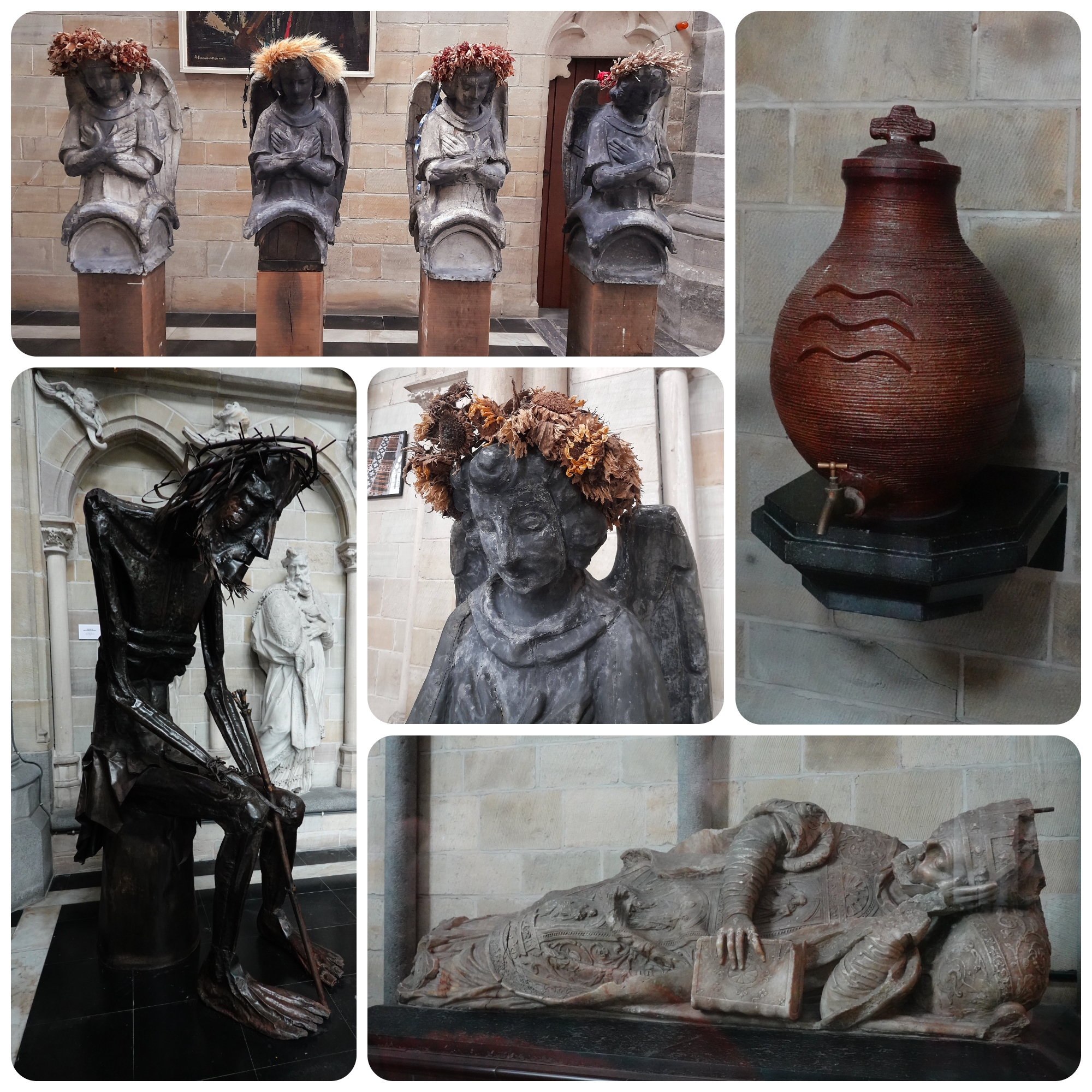
While Jos took a breather, me and my camera explored the church and marvelled at its glorious architectural details as well as the modern artwork which was on display.

The wrought iron sculpture, The Suffering Christ by local artist Adhémar Vandroemme (1917-2009) is particularly haunting and has received its permanent place here since Good Friday 2018.

I loved the row of angels - dating from 1934 but looking much older than their 90 years - with their dried flower headdresses, and was intrigued by the barrel on the top right. Holy water on tap, perhaps?


Outside the drizzle still continued so we made our way back to the Market Place and around the corner to the Ypres Museum, which had a temporary exhibition going on called Vrij, Vrolijk en Vunzig (transl. Free, Jolly and Filthy), lauded as a multifaceted discovery of the Middle Ages.


I thought the layout was rather confusing and, combined with the fact that it was quite warm and airless inside the venue, I'm afraid we rather rushed through.

It boggles my mind that one was able to walk at all and not trip up wearing those long pointed shoes, called poulaines. Apparently all the rage for men, they originated in the 13th century and reached extreme proportions in the 15th century. The points became longer while jackets got shorter. Poulaines were highly impractical and demonstrated that you were a man of leisure.

The object on the bottom left is the runner of a so-called jaw sledge for children, which was made by mounting a wooden board on the lower jawbone of a horse. 


The drizzle had turned into full-blown rain when we left the museum so any further plans for the day were shelved. Instead, we returned to the car park via the shortest route, hoping that our car would still be there. Much to our relief it was!


The weather gods, however, were having the last laugh that day, parting the clouds for a September sunset, illuminating the hop fields across the road and the hills across the border in France.

And look who was patiently waiting at the bottom of the stairs for her dinner!


Sunday, 15 September 2024

Westward ho!

The weather has definitely taken a turn for the worse since we came back from our trip to Belgium's west country last Sunday. Without so much as a by your leave we have suddenly been plunged into Autumn with the temperature having taken a dive to barely into double figures. Bar the odd exception, the days have been dark and wet which did nothing to alleviate our end-of-yet-another-holiday blues.

The contrast with Sunday the 1st of September couldn't have been greater! 

We were a tiny bit too early for the 3 pm check-in into our holiday cottage so we drove over to Poperinge's town centre to get our bearings and do some food shopping. 

However, when we were hit by a sweltering 32°C upon getting out of our airconditioned car, we decided to just pick up some pre-packed salads and a baguette for our evening meal and call our host, Marino, to see if the cottage was ready. It was, so, after purchasing a loaf of bread for our host, which he'd kindly asked us to do - we have been on friendly terms with him for years! - we continued our journey to the cottage on the outskirts of the town. 


It was our 13th stay here and the 9th since I've started my blog so I'm sure the cottage - an all-in first floor studio situated above Marino's carport in a charming thatched wooden building - doesn't need further introduction. 

It's got everything you can think of but unfortunately there's only overhead lighting by way of spotlights placed at the very top of the roof beams, which makes reading after dark a bit of a struggle. In order not to strain my eyes even further, we brought our own reading lamp, bought from IKEA back in August. Therefore, Jos's first job upon arrival was assembling the thing!


One of the reasons we keep on returning to our little cottage opposite one of the town's hop fields is the view from the balcony, which never fails to delight us. We can actually see all the way to France - the undulating countryside on the horizon (above, bottom right) is part of the Franco-Flemish hills - and the view across the domain's lake is truly unsurpassable. The latter is teeming with wildlife: we love watching the antics of the coots and other waterfowl, the herons waiting patiently for their next meal to come along and the myriads of dragonflies dancing in front of our eyes.

But wait, what do we have here? This tiny kitten was meowing at us pitifully. You can see just what a little scrap of a thing it is sitting beneath the cottage balcony in the below collage on the top left. Can you spot it?


It kept us company while we were sitting outside but it scuttled away under the hedge if we tried to get closer. As it was still hanging around the next morning - and was actually waiting for us on the stairs leading up to the cottage - we called Marino to ask if it was his. Much to our dismay, it wasn't. He told us it always seemed to be sitting out there and admonished us not to feed it. I think you can guess how that turned out ...


Anyway, back to Sunday. Once the heat of the day had somewhat come down, I posed for outfit photos in front of our own very posh wrought iron entrance gates ...


... and crossed the road to have a closer look at the hop poles dripping with hop cones, which we knew from experience would be harvested before the week was over. From as long ago as the 8th century, the month of September has been dedicated to hop picking here.

Poperinge is Belgium's hop growing capital and the characteristic hop fields are a typical feature of Poperinge's summer landscape. There are no less than 160 hectares of them, all cared for by 18 hop farmers. A handful of hop farms can be visited, which we did back in 2021 (see here and here). 

I played around with one of the photos I've taken, so there's nothing wrong with your eyes, you are actually seeing things double here!


We woke up to a sunny yet slightly cooler day on Monday, its highs of 25°C perfect for the day's planned activity. We'd slept like the proverbial logs and had taken our time getting ready and having breakfast. Having ditched our original plan to explore a little town on the other side of the border, we decided to stay local instead and go for a walk in the woods.

As due to our late-ish start this would involve a picnic, we needed to drive into Poperinge for provisions first. Mission accomplished, we walked around the corner to the tourist information office in the basement of Poperinge's neo-Gothic town hall to pick up some brochures. As you can see, it was quite windy ...


In the courtyard at the back of the town hall, the death cells and execution pole, where deserters faced the firing squad, can be visited. Quite a chilling and sobering experience, especially as in one of the cells you can see a cinematic impression of a soldier waiting to be shot at dawn. You can also see some of the graffiti left by the prisoners.


As with so many of the sites here in Flanders Fields, one cannot help but be moved, so we were quite annoyed by a group of sniggering youngsters who were visiting at the same time as us. 


It's definitely not the first time I find myself standing dreamily on the town hall steps. History is so tangible here, the now so peaceful region still bearing witness to the one million soldiers from more than 50 different countries which were wounded, missing or killed in action here. 


Back at the cottage, we made some sandwiches, grabbed a drink, and set off for the day's ultimate destination, which was only five minutes or so up the road.

Having exhausted most of the local nature walks - some of which we've done more than once - I was thrilled to find that part of the woods belonging to castle ‘t Couthof, had recently been opened to the public after it had been acquired by the Flemish nature conservation agency, Agentschap Natuur en Bos.


A walking trail has been laid out through the historic estate. Red arrows are pointing the way while information boards are telling you about the rich history of the castle and its woods. These are the oldest in the area and used to belong to Henri d’Udekem d’Acoz, the uncle of Queen Mathilde of Belgium, our current king's wife.

We were lamenting the absence of any benches to have our picnic on, when Jos spotted this conveniently located fallen tree, its trunk smoothed by the passage of time. It was the perfect spot, not just to sample our sandwiches, but to sit and listen to the sound of silence only punctuated by bird calls. 


Hunger pangs sated, we continued our walk on those woodland paths until we came to a clearing. Here, the information board told us, were the remains of a motte and bailey (above, bottom right) and the ruins of a hunting lodge (above, top right). There was talk, too, of Poperinge's oldest oak tree, planted around 1795. However, we couldn't decide which of the ancient trees surrounding us it might have been, as there were quite a few mighty oaks among them, our feet crunching on the acorns which had been scattered around liberally.


Before rejoining the woods for the final stretch of our walk, a folly awaited us. 

Standing menacingly in the middle of a field, cows placidly chewing the cud at its feet, this protected monument is locally known as "de Galge" (trans. the gallows).  Contrary to its name, however, nobody was ever hanged here. 

The neo-Gothic brick arcade used to be the orientation point of an elaborate hedge maze created between 1860 and 1870 by baron Jules Mazeman de Couthove, who owned the castle at the time.

The landmark was considered a symbol of the lord of the castle's jurisdiction, hence its sinister nickname.


The rest of the afternoon and evening were spent chilling out at the cottage ... and watching the domain's lawnmowers at work.

I'll be back with more soon. Hope to see you again in a couple of days!