Sunday, 17 July 2022

To the manor born

It was Day 3 of our holiday and the weather gods were still on their best behaviour. Wanting to make the most of both the glorious weather and our National Trust Touring Pass, we decided to leave Shropshire behind once more and visit a property which had been on our list for absolutely ages.

This time, our chosen destination was a bit further afield, involving a drive of about an hour and fifteen minutes in easterly direction, to the outskirts of Wolverhampton in the West Midlands.

The marshmallow clouds floating in a bright blue sky and the predicted highs of a balmy 24°C couldn't have been more perfect for what was officially the first day of Summer.


After driving through the varied landscape of South and South-East Shropshire, passing the wonderful high-and-low town of Bridgnorth along the way, we crossed the border into Staffordshire and were then welcomed to Wolverhampton, where our car's Satnav neatly deposited us at the approach to Wightwick Manor.

After some head scratching by the lady at the ticket office, who had clearly never seen a Touring Pass before, we were admitted to the property. We were told, however, that only the downstairs rooms were open and that sadly the Malthouse Gallery would also be closed that day due to a shortage of volunteers. 

She must have seen the disappointment on my face, so she took us aside and advised us to speak to one of the volunteers inside the house and explain that we'd come all the way from Belgium to see the De Morgan exhibition and then, perhaps, they'd find someone to open the gallery for us.


Instead of going straight to the house, however, we went for a walk around the woodland bordered lake lying to the west of the house to stretch our legs and get our bearings. 

Then we strolled towards the house, taking in its plethora of gorgeous architectural details, the front door leading to the porch and hall beyond standing invitingly open.


The superbly crafted rambling manor house was built in 1887 for Theodore Mander, a partner in the local varnish and paint-making firm of Mander Brothers. His architect was Edward Ould. The elaborate timber-framed exterior, with deliberate asymmetrical groupings, features barley twist brick chimneys, oriel windows and carved quatrefoils, which are four-leaved ornaments or apertures common in Gothic architecture.

In 1893 Ould added an east wing with the help from the Pre-Raphaelite glass-designer Charles Kempe, who produced some fine painted glass for the house as well as advising on its decoration.


Wightwick Manor - the name is pronounced as wittick - was built primarily as a family dwelling. Like many affluent Victorians, Theodore and his wife, Flora, wanted to move their growing family out of an industrial town to a healthier location. Although Wightwick was rural, it was only a mere three miles from the Mander Brothers factory in Wolverhampton!

The Manders wanted a comfortable home that reflected their aspirations and tastes, and the house combined exquisite period details - we lacked several pairs of eyes to take them all in - and traditional craftsmanship with modern technology. It had central heating, a modern kitchen and bathrooms and electric light throughout by 1893.


Having finally had our fill of the charming wood carvings - the bat and the owl being particular favourites - we took deep breaths and stepped inside, where we were greeted by a friendly and knowledgeable volunteer, who bade us welcome and proceeded to introduce us to the house and its extraordinary collection of Pre-Raphaelite art.

As soon as I could get a word in edgewise, I told her that we were from Belgium and were gutted that the gallery wasn't open, as a local friend (Vix!) had waxed lyrical about the De Morgans and had urged us to go and visit it.


At first, our ploy didn't seem to have worked (whereupon I shrugged, sighed "Oh well" and walked away), but a couple of minutes later she came running after us, telling us to hang around as she was trying to get someone to open the gallery for us. Result!

We continued our tour of the ground floor, making sure not to venture too far away, and trying but failing to take in room after room of period furnishings and decor, not to mention the volume of Pre-Raphaelite art. It immediately became clear to us that we wouldn't be able to cover everything in one single visit, and that we'd have to return one day.


When Theodore Mander commissioned the building of Wightwick Manor in Old English style in 1887,  he started the Mander family's love for Victorian art and design. However, following his untimely death in 1900, his eldest son Geoffrey inherited the property, entering both the family firm and local politics. After his first marriage in 1906, he and his wife, Florence, became notable advocates of women’s suffrage, holding meetings in the drawing room.

Wightwick as we now know it, however, developed only after Geoffrey’s second marriage - the first having ended in divorce - in 1930. His new wife, Rosalie Glynn Grylls, gave up her ambitions to be a Liberal MP and focused her attention on English literature and art. Starting with a biography of Mary Shelley, her surroundings at Wightwick soon inspired her to research the Pre-Raphaelites, especially Rossetti.


Sir Geoffrey and Lady Mander began to collect works associated with the movement, especially by those artists who had been friends of William Morris: Rossetti, Burne-Jones, their pupils and, interestingly, the Pre-Raphaelite women - principally Evelyn De Morgan and Lizzie Siddal. Their first acquisition was a portrait of Jane Morris by Rossetti. She is the striking red head above the piano in the previous collage. That's her husband William Morris's silhouette on the bottom right in the same collage, as well as one of his iconic wallpaper designs, Pimpernel.


Other works which caught our eye are the luscious portrait of Jane Hughes, Mrs. Nassau Senior (1858) by George F. Watts (top left), Fair Rosamond (1869) by Henry Treffry Dunn (bottom centre) and Music, Sweet Music (Saint Cecilia) by Evelyn De Morgan (1889) on the top right.


Lady Mander also had an eye for a bargain and made canny purchases, not just of art but of items from the Morris & Co range, such as the Trellis wallpaper in the previous collage, Acanthus (above, bottom left) and Daisy (above, top right).

I loved the fact that the chairs you were allowed to sit down on were indicated by cat cushions, a tribute to Rosalie, Lady Mander, who adored cats! 


In 1937, Geoffrey Mander gifted Wightwick Manor, its contents, and a financial endowment to the National Trust. It was the first house given under the recently introduced Country House Scheme. which meant that a family donating their property to the Trust did not have to pay death duties but could continue to live in the property rent free for two generations. In return, the property would be, at least partly, opened to the public.

Thus, Sir Geoffrey and Lady Mander continued to live in the house, opening it to the public on Thursday afternoons. As the property got more popular the National Trust provided helpers to welcome guests and offer guided tours.


We were gasping over the stunning Great Parlour, modelled on the medieval great hall - which you can catch a glimpse of in the photo above the collage - when our helpful volunteer came seeking us out, telling us that she'd found someone and that we were to follow her. She quickly whizzed us through the rest of the ground floor, opening a couple of secret doors to allow for shortcuts, and out through the servants' wing.

After waiting a couple of minutes in front of the gallery (below, top left) a young volunteer appeared, took us up the flight of stairs, produced the all-important key, and let us in. It was quite special having the place completely to ourselves and being able to admire the works of William and Evelyn De Morgan unhindered by other visitors.


William De Morgan (1839-1917) was a friend of William Morris, and the foremost ceramic artist of the Arts and Crafts Movement in the latter half of the 19th century.  That's his portrait dating from 1909 on the bottom right, holding one of his lustreware vases (c.1900) . The portrait was painted by his wife, Evelyn. 

He began his formal training as a fine artist, before being led by his scientific and mathematical investigations to the decorative arts, creating stained glass, designing his own kilns, undertaking investigations in chemistry to create innovative lustre glazes and, finally, enjoying a second career as an author of popular fiction.


Evelyn De Morgan (1855-1919) was a painter who defied the expectations of her class and gender to become one of the most impressive artists of her generation. Her richly coloured canvases featuring beautifully draped figures, deliver messages of feminism, spirituality and the rejection of war and material wealth, making them incredibly relevant today.


From top to bottom: The Cadence of Autumn (1905), Love's Passing (1883-84) and The Garden of Opportunity (1892).


A firm favourite was Demeter Mourning for Persephone, dating from 1906.

Demeter was the Greek goddess of the earth, and particularly of the fruits of the fields, and as usual she is represented here as the corn-goddess. Her hair is covered with ears of corn, from which poppies drop around her. Her daughter, Persephone was kidnapped by Hades and taken beneath the earth to his kingdom. Inconsolable at the loss of her daughter, Demeter refused to allow the earth to be fruitful.

You can see the painting in detail on the website of the De Morgan Collection here.


Our heads still reeling from all that splendour, we made our way to the tearooms for a late lunch. Contrary to the tearooms at Powis Castle, there weren't any queues, and we had the pick of the tables.
We both opted for jacket potatoes (Jos's favourite) with cheese, salad and coleslaw, which were absolutely delicious. 

Afterwards, we returned to the house to continue our explorations and to thank the lovely volunteer for her efforts. We were recognized by another volunteer, who asked us if we were back for round two. When we told her about the gallery, at first she misunderstood and was all set to call around to see if she could find someone to open it for us! 


It was mid afternoon when we finally made it outside but were lacking the stamina to properly explore the grounds and gardens. Yet another reason to come back another time ...

Instead we walked to the terraced garden, swooning over the black and white half-timbering and bay windows of Wightwick Manor's East Wing.


Then we strolled to the formal garden, where several peacock topiary are ruling the roost.

Apparently, new building development in the surrounding area has led to increased water run off through the gardens, which their Victorian drainage system is struggling to cope with. Therefore they are fundraising to develop a long term solution so that the beautiful gardens are not washed away. For this purpose, peacock topiary pins are sold for £ 3. We both bought one and as you can see, Jos started wearing his one straight away!


After another Lady of the Manor pose, it was time for a restorative cup of coffee before driving back to the cowshed.

I was wearing my beloved curtain couture maxi skirt, which I combined with an orange cap sleeved top patterned with tiny black and white dots. Both were ancient Think Twice finds and it was certainly not the first time they were worn together. My haori style cover-up was charity shopped and proved to be my best friend for a couple of days. Both the stretchy belt and my trusted Clarks Cloudsteppers were retail buys.

I'll be back with further adventures as soon as I've recovered from the extreme temperatures which have been predicted for the next days! If you're in the same boat, do stay cool!


Tuesday, 12 July 2022

Blue skies at the red castle

Hello my friends, and welcome to the second episode of my Shropshire travelogue. Although, truth be told, we would turn our backs on Shropshire and head for Wales that day ...

After a restful night's sleep, we woke up to sunshine on Monday the 20th of June. Still not quite used to the time difference, we were wide awake before 6 am and were almost blinded by the fiery orange sun rising over the Long Mynd when we sneaked a peek through the curtains. 

But it was far too early to get up, so we snuggled back under the duvet and dozed until 7.45. Then, after enjoying the first of Jos's full English breakfasts, we entered that day's destination into our Satnav and went off.

In the weeks before our holiday we'd tossed around a couple of ideas, which included revisiting old favourites as well as venturing to pastures new. However, we hadn't made any definite plans on how to spend our days, wanting to let the weather and our moods be the deciding factors.


Monday, however, was an exception as, come rain or shine, our destination was set in stone. Preparing for our holiday, we'd ordered a National Trust Touring Pass a couple of weeks ago. As we'd planned to (re)visit quite a few of their properties, we thought that £ 77 for a 14-day pass admitting two was quite good value! We were duly sent a confirmation email which we had to present at our first property in order to get our pass, the only catch being that it could only be collected at a limited number of places. 

We were lucky enough that Powis Castle, which is a hop and a skip across the border in Wales, was among these.

Having visited the castle and its garden both in 2018 and 2019, this would be our third visit and, apart from a false start in June 2018, the sun has always regaled us with her presence here. This time too this beautiful part of the world didn't live up to its Wet Wales moniker!

After having parked our car and chatted to the nice parking assistants, we proceeded towards the ticket office and were promptly issued with our pass, which would prove to be worth its weight in gold. 


Walking up from the car park to the courtyard, we were greeted by the plaintive calls of the resident peacocks who wander among the tables hoping for a handout. The lead statue taking pride of place in the courtyard dates from the early 1700s and depicts the winged female figure of Fame borne by Pegasus. 

As we realized we hadn't brought our walking sticks - which we would definitely need to spare our backs and knees when exploring those terraced gardens - we bought some state-of-the-art extendable trekking poles. Then we joined the queue in the courtyard café and found ourselves a table in an alcove away from the café's hustle and bustle where we sipped cups of cappuccino and shared a Bakewell slice to keep us going.

Note that I was still wearing both my denim jacket and a cardigan at this point as it had seemed rather chilly when we stepped out of our car. With the mercury steadily climbing towards the mid-twenties, we'd be shedding layers as the day progressed!


Suitably restored, we made our way towards the garden's entrance, where we were supposed to show our tickets. If we were looking forward to proudly showing our temporary membership status, we were to be disappointed. The lady at the checkpoint turned out to be one of the parking assistants we'd chatted to earlier and as she remembered us - the perks of being dressed a little differently, I guess - she  waved us through with a smile and without so much as a peek at our spanking new pass!


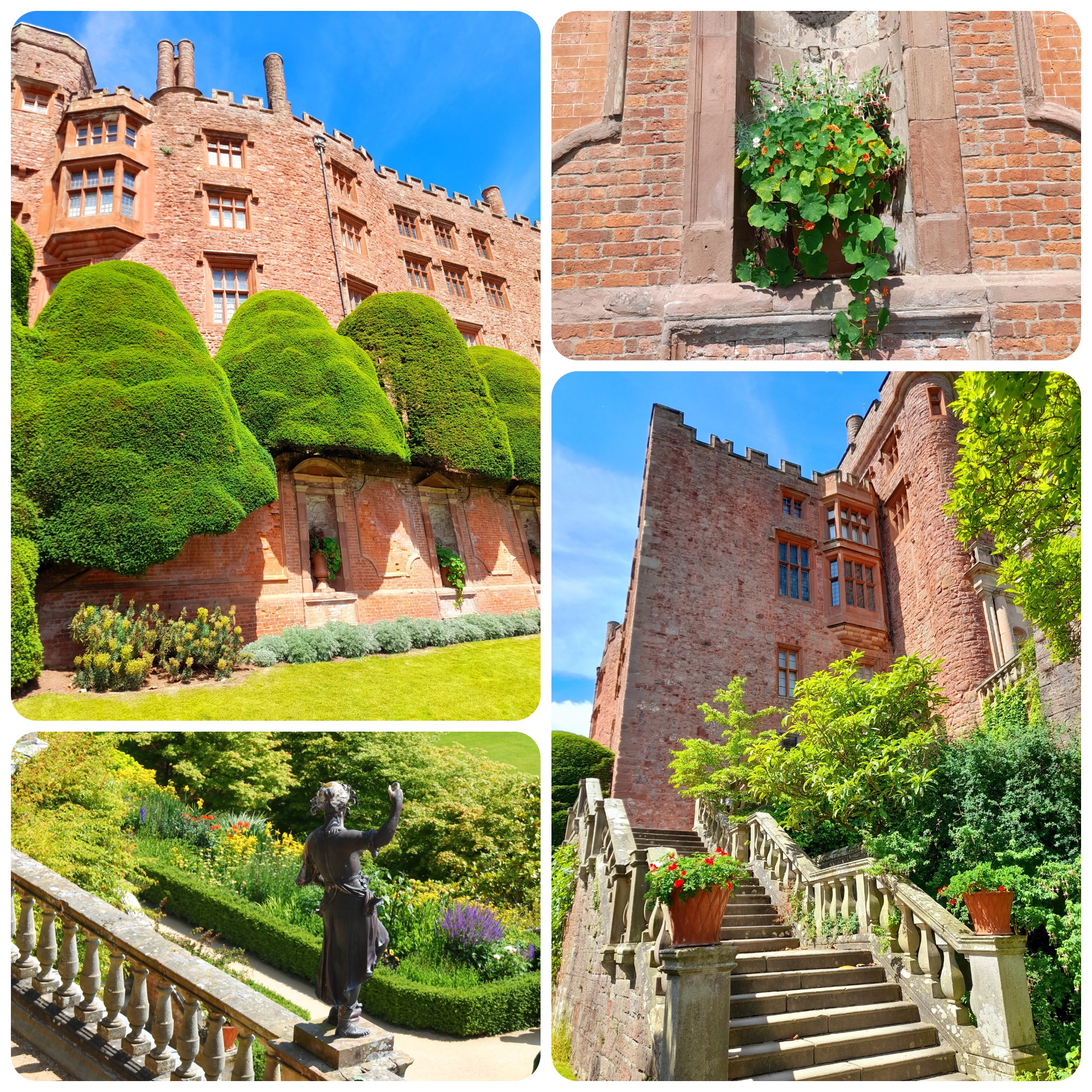
Even after two previous visits, our first glimpse of the garden still took our breaths away with its theatrical mix of Italianate terraces, which were blasted out of the bare rock, its spectacular herbaceous borders, its mind-blowing topiary and its superb views.

And no, all these superlatives are not exaggerated in the least. After all, the garden is listed in the top twenty of the Great British Gardens guide. Apart from its unique historical setting, there's the skill of the exquisite planting, the estate being kept in impeccable order by a team of six full time gardeners and several volunteers, who ensure that that the garden is a delight in every season. 


From their position high up on the hillside, the views from the terraces across the garden, the deer park, the Severn Valley and, in the distance, the profiles of the Breidden Hills overlooking the nearby town of Welshpool, are truly spectacular. In fact, we found it impossible to tear our eyes away and I'm sure it won't surprise you if I tell you that my camera was working overtime.

Immediately noticeable as you arrive is the dusky red stone that makes the castle so striking, especially when outlined dramatically against a brilliant blue sky. 

Powis Castle was built in the mid-13th century by a Welsh prince - Gruffudd ap Gwenwynwyn - who wanted to establish his independence from his traditional enemies, the aggressive princes of Gwynedd in the North-West of Wales. 


The castle has been rebuilt several times and underwent intensive renovation by Sir Edward Herbert (1542–95), the second son of William Herbert, 1st Earl of Pembroke and Anne Parr (sister of Catherine Parr, the sixth wife of Henry VIII), who acquired the castle in 1587.

In the 18th century the title passed to the Clive family, although part of the inheritance was the stipulation that they should change their name to Herbert.  There was a thorough refurbishment of the castle in the early 19th century, and again in the early 20th century by George and Violet Herbert.  Sadly, they lost their two sons, one in WWI and another in WWII, so, as there was no immediate heir to inherit the estate, George Herbert left the castle, garden and part of the deer park to the National Trust in 1952.


One of the garden's most eye-catching features are its cloud-like clipped yews which tumble over the terraces and shelter rare and tender plants. There is a 30-foot-high yew hedge and 14 "tumps" dating back to the 17th century.

In late summer and early autumn the estate gardeners take to the air in a cherry-picker and spend several weeks trimming the topiary to ensure that the hedges continue to look spectacular for the next 12 months. 


Descending deeper and deeper into the garden, one by one its terraces are revealed like so many layers of an elaborate wedding cake. 

Lead statues of shepherds and shepherdesses are dancing on the balustrade of the Aviary Terrace and I'm travelling back in time to June 2019 when I found treasure beneath the feet of one of them.


The Aviary itself, where we briefly took shelter from the glare of the midday sun, and which once housed birds of prey, forms the centrepiece of the terrace and is arranged as an arcaded structure with 7 bays.

Below the Aviary Terrace is an Orangery with a grand 18th century stone doorway that was once the entrance to the castle itself.


By this time it was past 1 pm and we were getting peckish. Not having had the presence of mind to bring a picnic, there was nothing for it but to climb all the way up again to the courtyard, where we joined an even longer queue for lunch. 

As luck would have it, though, the table in the alcove where we'd had our elevenses was free, so we wasted no time in claiming it, taking the weight off our feet and stuffing ourselves with a couple of chicken salad sandwiches - choice had been rather limited this late in the day - and some soft drinks.


Then it was time for a visit to the castle itself. 

Photography isn't allowed inside, and would have been nearly impossible if it were, due to the heavy Jacobean panelling in many of the rooms and the permanently drawn curtains to prevent the damage caused by ultraviolet light on the precious furnishings.

The parking assistant lady, whom we assured we weren't following around, was now on duty at the castle and once again we were allowed in without having to show our pass.

Her colleague was on duty next door, a the Clive Museum, so we were waved through with a smile of recognition here as well. One of the UK’s most significant collections of Indian objects is displayed here. As major figures in Britain’s colonial East India Company, Robert Clive and his son Edward  looted many of these objects during their seizure of power in India and Myanmar and violent subsequent rule in the 18th century. However exquisite the exhibits are, the circumstances of their acquisition do leave a bit of a bitter taste in one's mouth, and we briefly whizzed through them.


Next up was a walk along the wooded ridge opposite the castle, known as the Wilderness. 

Here, things are far less formal than in the rest of the garden, with wildflowers growing in abundance, including some Spotted Orchids.

This is also the perfect place to admire the view of the castle and its wedding-cake-layer terraces across the Great Lawn.


Doesn't it look properly fairy-tale like - not to mention quite unreal - from this vantage point?

I couldn't resist posing as Lady of the Manor, looking for all the world as if I owned the joint, as someone on Instagram jokingly remarked. 

We were gasping for a cup of coffee by then, and confidently made our way towards the garden coffee shop where we rested our feet on a previous visit ... only to find it closed!


There was nothing for it but to continue with parched throats and weary feet, to arrive at the Fountain Garden,where various lawn chairs were waiting invitingly. 

While Jos was taking 40 winks, I took a closer look at the Bodley gates, flanked by pillars topped with wyverns (a legendary dragon-like creature), one of which is holding a severed hand in its mouth. The gates were commissioned by Violet, Lady Powis in 1912.


As the wife of the 4th Earl of Powis, Violet persuaded her husband to entrust the entire management of the deteriorating gardens at Powis Castle to her in 1911. Over the next 18 years, she effectively recreated the gardens of Powis into the internationally acclaimed ones they are today.


Having climbed all the way up again to the courtyard, we dashed into the café for that long awaited cup of coffee, which we once again had at our very own table in the alcove!

Before returning to our car, we had another browse in the shop, where Jos bought a well-needed compact man bag, and I was seduced into buying a bee brooch, screen printed on FSC certified birch wood. 


Half an hour's drive along the Anglo-Welsh border brought us back to Shropshire, and eventually to the cowshed, where I posed for some proper outfit photos.

The 1980s thin knit cap-sleeved jumper in hot pink patterned with tiny white squares at the yoke and shoulders was the only vintage item in my outfit. The skirt with its jungly green, pink, yellow and orange pattern was a cheeky retail buy a couple of months ago. Having already worn it a couple of times, it is set to become a wardrobe staple.

Both the chunky wooden necklace and green plastic birds brooch were retail buys as well and have been on regular rotation for well over 10 years. The belt was a charity shop find and the gold ballerinas I'd changed into when I got home were a gift from a friend who sadly passed away in 2019.

So, that's it for day 2. I hope you'll join me again for the next installment in a couple of days.


Thursday, 7 July 2022

Back to Shropshire - and back again!

Oh my, that went fast, didn't it! One minute we were packing our bags at a searing and brain-melting 35°C, and the next we're back home, spending the final two days of my leave in a whirlwind of unpacking, doing several loads of washing, catching up with blogland and making a start with writing this post. After all, being due back at the office on Tuesday, there was no time to lose!

Oh, and of course, whole chunks of those two days went to extensive cuddling sessions with Bess, who has hardly let us out of her sight since we walked through the front door on Saturday night.


Now, let's backtrack to the early morning of the 18th of June, when we set off just before 6 am - with the mercury still nudging the mid-twenties - to arrive at the Channel Tunnel terminal in Calais around two hours later. 

We had decided to splurge on the more expensive Flexiplus option, which gave us the freedom to turn up and board whenever we wanted, with guaranteed fast track check-in. Not to mention having the use of exclusive lounge facilities, rather than having to share the big terminal with what we half-jokingly called the plebs. So, having successfully passed border control - using our travel passports for the very first time - we enjoyed complimentary cups of coffee in an almost empty lounge, and filled a bag with fruit juice, pastries and other delicacies to be savoured during our journey.


Our train left at 8.50 on the dot, and arrived in Folkestone around 8.25. And no, that isn't a typing error. The train only takes 35 minutes to cross, and as we obviously have to set back our clocks one hour, our arrival was 25 minutes earlier than our departure. Surely, that's the closest thing to travelling back in time!

While we were travelling to Shropshire the temperature gradually dropped below 20°C and soon the first of the forecasted rain was tickling our windscreen. By the time we crunched our way down the lane leading into our valley below the Long Mynd, the thermometer indicated a measly 10°C.

Our cottage was actually freezing cold, so that we had to put the heating on. Something we couldn't even have imagined doing less than 24 hours earlier.


The cottage - called The Byre, as it's a converted former cow shed - was as charming as ever and, apart from a couple of minor details, nothing much had changed since we waved it goodbye in early July 2019. Little did we know back then that it would be three years before we'd be back!

If in the weeks before our holiday I fully expected to choke up at finally being in our beloved England again, strangely enough it didn't happen. In fact, it felt utterly normal to be back and, as I walked into the cottage with its ever-changing views towards the majestic Long Mynd, it was as if we'd only left yesterday.


With the rain lashing against the windows, we made ourselves at home, eating the ready meals we'd bought in the tiny Waitrose at Warwick services, then plonking ourselves down on the sofa, reading and listening to music until we dropped off. Then it was time to climb between the sheets of our bedroom's four poster!

We slept like the proverbial logs but woke up early as we were too excited and raring to start our holiday adventures. Drawing back the curtains revealed the Long Mynd bathing in some hesitant early morning sunshine.


We hadn't made any definite plans for the day, but needed to do some food shopping to tide us over for a couple of days so, after bacon and eggs for breakfast, we drove to  Bishops Castle, a delightful 15-minute drive along a succession of country lanes.

En route, we stopped at the top of our lane, looking back towards the valley with its huddle of farm buildings, our cow shed being one of them. In order to offer you a peek of what I was wearing, I even climbed the rickety stile giving access to Adstone hill.  As the temperature wasn't expected to climb much higher than 16°C, I wore a pair of floral slacks, a retail buy from H&M several years ago, and a black and white dotted Phase Eight raincoat picked up in a charity shop in nearby Church Stretton in June 2018.


Bishop's Castle is a small but perfectly formed ancient market town nestling amid the South Shropshire Hills, only a handful of miles from the Welsh Border.

After having parked our car, we emerged onto the town's high street and walked into the direction of St. John's Church, which is situated literally at its lower end.

The church was built towards the end of the 13th century, but only the tower remains of the original church, which was completely re-built in 1869-70. The tower has an unusual one-handed clock, apparently a leftover from the days before we needed to know the time down to the minute. Is it a wonder that time seems to go slower here?


The atmospheric churchyard, with its lichen encrusted, time-worn and tumbledown gravestones, strikes the right balance between maintained and semi-wilderness and is an absolute joy to stroll through.

It is part of Caring For God's Acre, which supports groups and individuals to care for and enjoy churchyards and burial grounds, aiming to protect and rejuvenate these beautiful havens of heritage and wildlife.

It was here that the tears finally came. Tears of happiness to be back where I feel I belong. My adopted country which often feels more like home than my actual home country. It was a good thing I was in a churchyard rather than anywhere else where people would give me the side-eye for crying in public.


After our ramble around the churchyard, we proceeded uphill: the gradient of the town's High Street is 1 in 6, a stiff climbed for our rusty limbs. At its upper end is the House on Crutches Museum (below, top right) which is situated in a quirky timber framed building dating back to Elizabethan times.

The town is at a junction of several old drover’s routes which led travellers, farmers and stock to the markets. In recent years, they have brought in artists, authors, musicians and free thinkers of every hue. As a result the town is famous for its welcome to visitors, its pubs, microbreweries, independent shops, and - last but not least - its slightly eccentric demeanour. Which meant that for once we didn't stick out like the proverbial sore thumbs :-)


Having climbed all the way up, we were gasping for a cup of coffee, so we ducked into one of the few establishments which were open on a Sunday. Yarborough House, its façade painted a cheerful orange, combines a tiny tea shop with a large second hand book and record shop.

Then we stocked up on provisions in the tiny local Co-op and whizzed back up those country lanes to enjoy a leisurely lunch at the cottage. 


The dark, rain-pregnant clouds which had been scudding across the sky all morning had decided to take their liquid load elsewhere and here and there a gap appeared through which a whisper of blue could be glimpsed. By then it had even warmed up a degree or two.

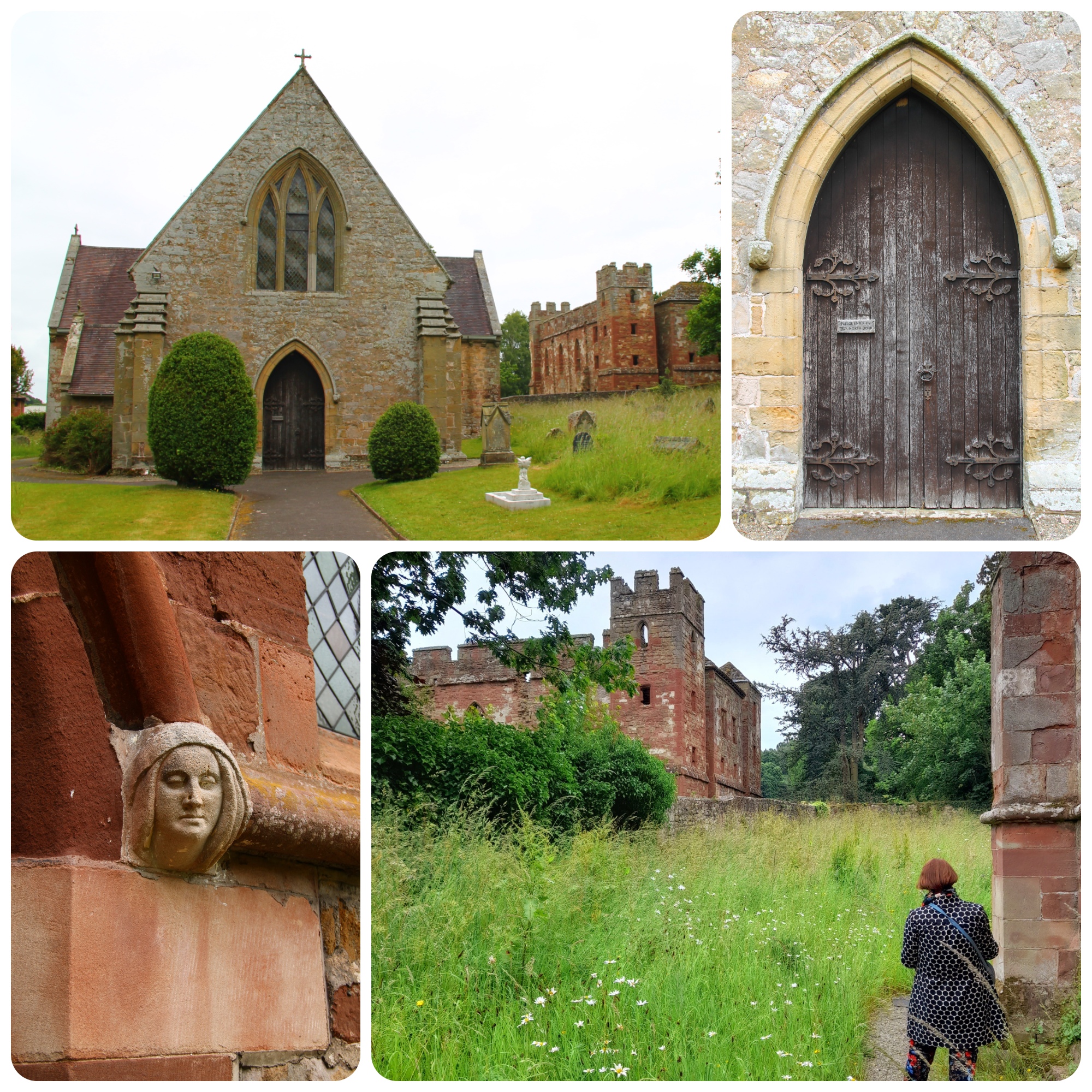
Consulting the map, we decided to pay the English Heritage managed Acton Burnell Castle a visit. The graceful red sandstone shell of the castle, which was built between 1284 and 1293 by Bishop Burnell, Edward I's Lord Chancellor, is tucked away in a quiet part of Shropshire, about half an hour's drive from the cow shed.

By 1420, the castle was abandoned, and it was allowed to decay while a new classical style mansion,  Acton Burnell Hall - now a private school - was built beside it in 1814.

Nonetheless, the castle remains an impressive example of a medieval fortified manor house.


When we arrived, a family was having a picnic inside the ruin, with both children and adults playing a boisterous game involving water guns. Not that you'd notice in the photos, as shooting around people and making it seem that we are the only visitors, is one of my fortes. This involves having lots of patience and a deadly stare! 


Leaving the castle grounds behind, we walked towards St. Mary's Church, the churchyard offering a fine view of the adjacent castle. Like the castle, we owe its existence to the aforementioned Bishop Burnell.

Unusually it remained unaltered from its completion in about 1282 until the addition of a new tower in the 1880s. 


The church's north transept has several fascinating and intricately carved alabaster effigies.

On the west wall is the memorial to Sir Humphrey Lee, who died in 1632 (above, bottom right). Sir Humphrey is shown at prayer facing his wife.  Their children too are shown kneeling, each of them being a miniature version of a parent.


On the right is the impressive monument to Sir Richard Lee, who died in 1591.  He is portrayed as a knight with his wife beside him, 3 sons at his head and feet, the eldest with his hand on the helmet, and his 9 daughters behind him. Interestingly, no two of the girls are identical!  


After leaving the church, we made our way to the enchanting little chapel at Langley, just 5 minutes up the road from Acton Burnell, and also owned by English Heritage.

The Burnells were lords of the manor of Langley and, in 1313, Richard Burnell obtained permission to build a chapel here.  The structure of the present building dates from this time. In 1377, the manor of Langley passed to the Lee family (they of the alabaster memorials), who fitted out the chapel in about 1546. In 1591, Sir Humphrey Lee moved to Langley. He was probably responsible for re-roofing the chapel in 1601 – a date given on the nave roof – and refurnishing it a few years later.


The atmospheric interior of the chapel, which is standing rather bleakly in remote countryside, contains a perfect set of 17th century timber furnishings.

Typical Tudor decorations of roses and fleurs-de-lis appear on the plaster frieze between the roof and south wall (below, bottom left).


By 1700 the chapel had largely fallen out of use, and thus escaped any attempt to re-order the interior according to the more elaborate ‘High Church’ model favoured in the 19th century. The last regular service was held here in 1871.

Having concluded our visit, we returned to our car parked in a lay-by, and attempted to drive back to The Byre. I won't mention the close encounter with a bus on a single track lane, which required us to reverse and half-burrow our car into a hedge, or the fact that our Satnav was trying to get us to take the infamous Burway, a steep and precipitous road crossing the Long Mynd. Having made that mistake once (see here) we weren't about to repeat the experience!