Sunday, 21 July 2019

Summertime and the living is easy

The weather gods must have finally taken pity on us, as the view framed by our cottage's window on Thursday was bathing in plenty of sunshine.

This prompted me to wear one of my favourite frocks, a vintage red checked wrap dress sprinkled with white flowers and edged with white rickrack. If that already sounds delightful, what about butterfly sleeves? Check! The dress is fit and flare and has revealing tendencies, so vintage slip to the rescue! My Clarks Cloudsteppers, the most comfortable shoes ever, were a perfect match.


We'd slept a bit longer than usual so that we reached our destination, which was an hour's drive from the cowshed, by late morning only.

Oswestry, a charming little country town close to the Welsh border, is in the North of Shropshire, an area we hadn't visited before. However, it was by no means the first time that I had been there! As a 15-year-old, while travelling to Wales with my parents and siblings, it was the first UK town I ever set foot in. Not that we stayed there for long: on passing a little corner shop, my Dad stopped the car and sent me to buy groceries.


Back in the here and now, we easily found a parking spot near the town centre and, halfway up the High Street, we perched ourselves on a bench in the town park, Cae Glas Park, to get our bearings.

The war poet Wilfred Owen (1893-1918) was born in Oswestry, and although he only spent a few years of his life here, his family's connection with the town goes back generations, and his grandfather was once mayor of the town. In 2018, a statue to him, created by local artist Tim Turner, was unveiled in the park.


Just a short stroll on the High Street takes you to St. Oswald's Church, which was completed in the early 1670s. Oswestry is said to be named after king and saint Oswald, and the name is thought to be a corruption of "Oswald's Tree".


Oswestry is a traditional market town with award-winning markets, both indoor and outdoor, drawing visitors from all parts of Shropshire and Mid Wales.


The town has an eclectic mix of independent shops selling anything from bric-a-brac to books, as well as quirky antique shops and galleries.

The sculpture of the man chasing a chicken was aptly displayed above USA Fried Chicken in Willow Street.


Lunch was had at the local Wetherspoon, named after the war poet, and housed in an ugly 1960s/1970s monstrosity of a building, which we believe used to be the post office. Inside, it was light and airy, and the fish and chips we had was delicious. I made a photo of both our plates as proof to Vix that Jos didn't have his usual jacket potato!


There were charity shops galore as well, and I think we visited them all, finding treasure in many.

My finds included two cotton summer tops and a pair of wide-legged trousers, which you can catch a glimpse of on the bottom right. I also found the first of my brooches, a delighful Lucite one. The chap volunteering in that particular shop was a bit of a brooch collector himself resulting in a good chat about the subject. 

Then I found Jos this amazing pinstriped linen H&M jacket, just as he was lamenting the fact that he hadn't packed a light-weight jacket.


Things were starting to heat up on Friday, when temperatures reached heights of about 25° Celsius.

The perfect day for a visit to another National Trust property and an amble through its gardens. 

Powis Castle is just across the border in Wales, the road meandering along the border, welcoming us to Wales one minute and back to Shropshire the next.


We visited this magnificent medieval castle, built on a rock above its terraced gardens, last year as well. This was on a day with a rainy start, from which we sheltered by starting with a visit to the castle itself to view its amazing collection of paintings, sculpture, furniture and tapestries. 

This time, we decided to visit the gardens only, but not before making the acquaintance of Captain Peacock, his wife and their peababy, who were begging for crumbs in the courtyard.


Here's a look at my outfit, which might very well be my favourite of our holiday. I felt fantastic in my vintage waxed cotton maxi skirt combined with a cotton peasant top I bagged in the New Look sales last Summer. A red vinyl belt, oval vintage brooch bearing a portrait of a lady and ivory coloured beaded necklace completed by outfit. Oh, and my faithful Cloudsteppers, which really make me feel as if I am walking on air.


The world-famous garden, overhung with clipped yews, shelters rare and tender plants. Laid out under the influence of Italian and French styles, it retains its original lead statues and an orangery on the terraces. 

I was photographing details of one of the lead statues, when I spotted this stone of joy painted with the cutest of ladybirds from @stonesofjoy1. I was thrilled to bits. I'm still not sure if I will rehide it here in Belgium, as I am very tempted to keep it as a souvenir. 


There were some curious objects hidden away in the trees, like this pair of shoes, which bore a note in both English and Welsh that they were Betty's. These were part of a children's trail laid out in relation to a project about a group of pupils and teachers from the Ashford Welsh Girls School, Middlesex, who were evacuated to the castle in 1939.

Exploring the garden, we wandered the Italianate terraces and marvelled at those spectacular yew hedges and lavish herbaceous borders. 


Arriving at the bottom level, we briefly sat down in one of the deckchairs on the lawn, but the sun had become too hot by then, so that after a visit to the lavs (there was a queue!) we sought out the shade once more.


This we found in the woodlands opposite the castle, where several walks have been laid out. Our weary limbs, and my rebelling knee in particular, dictated that we take the least streneous one, which at one point passed a tranquil, reed bordered pond. Here, I left Jos sitting on a rough-hewn wooden bench, following a path that brought me to the igloo shaped ice house!


Retracing our steps to the garden coffee shop, we grabbed the last shady table and sat down with cups of cappuccino. Here, more crumb-begging was being done by this funny chap, which we'll call Mr. Humphries.*


The sun still blazing, hazing the view towards the mighty Welsh mountains, we said our goodbyes to Powis Castle and drove back to England.

*Back in early Spring, two new peacocks arrived at Powis Castle and those who follow the castle's Facebook page like I do were asked to choose names for them. By popular vote, they were named Captain Peacock and Mr. Humphries (my choice as well) after the characters of the legendary British sitcom Are You Being Served. I'm not sure if I got the names of the actual peacocks we met right.

Finally, even if I'm not exactly wearing shorts, and it's Sunday already, I am linking to Nancy's Fancy Friday.

Wednesday, 17 July 2019

Under the iron bridge we kissed

It was a rain-drenched landscape that greeted us on the Tuesday morning of our first week, and the rain wasn't showing any signs of a let-up while we were having breakfast. So, we moped around the cottage, anxiously watching the skies from all windows and hoping for a gap in the clouds.

We'd decided to go charity shopping in Shrewsbury, but the rain was quite torrential, so that there was nothing for it but to wait it out. When by 10.30 there was a brief lull in the downpour, we grabbed our coats and made a dash for the car.

The quiet country lanes had become quite treacherous to negotiate, especially where at one point the road climbs up to a plateau, which normally offers fabulous views of the rocky outcrops of the Stiperstones ridge. Now, low hanging clouds had wiped out any visibility and, after descending from these lofty heights, we even had to contend with a partially flooded road.


No, your eyes aren't deceiving you! As a nod to the atrocious weather conditions, I was wearing trousers. Again!

This is one of a pair (the other one's red) which I bought from an outlet shop a couple of years back.
They are my travelling trousers to be worn on bad weather days, just like this one. In order to keep them "me", I wore them with a vintage long-sleeved flower print shirt and my dotty Phase Eight raincoat charity shopped in Shropshire last year.


Mercifully, it had ceased raining the minute we stepped out of our car at the Park & Ride car park.

We always try and make use of the Park & Ride system when visiting larger towns, in order to avoid having to negotiate the often complicated one-way systems in search of a suitable place to park. In this case, we were especially glad that we did, as there seemed to be major roadworks in progress.


It was lunchtime by now, so we grabbed a quick bite to eat at the M&S café, as Jos wanted to buy some essentials at the shop.

Afterwards, we trawled the charity shops, most of which seemed to be concentrated in and around a street called Mardol. We also spent some time browsing a treasure trove of a shop called Memory Lane Antiques and Vintage.


As for the weather, I'm glad to report that it remained dry for the rest of the afternoon. We were even treated to some watery sunshine!

In order to make up for the weather, the charity shop and vintage gods treated us to kindly, as I found a pair of pristine navy Hotter shoes, a Welsh wool purse, a butterfly sleeve top and an Indian made maxi skirt. Jos was in luck too, as he found a boxed Kodak Bantam camera, complete with its instruction leaflet.


No sunshine, not even of the watery kind, on Wednesday, but we counted our blessings as at least the rain seemed to have packed up and left us. Admittedly, it was a bit chilly, with highs of only about 16° Celsius.

But wait, I can hear you thinking, what about that iron bridge you kissed under? Some of you might have recognized the title as a snippet of the lyrics of a certain Smiths song, but what's the link to this post, you might wonder.

Well, our destination of the day was a place called Ironbridge, and the song just inadvertently keeps popping into my head whenever I hear or see the name.


Ironbridge is a small town on the River Severn, at the heart of the Ironbridge Gorge. The town developed beside and took its name from the Iron Bridge, a 30-meter cast iron bridge which spans the gorge and was opened in 1781.

As early as 1934 it was designated a Scheduled Ancient Momument and closed to vehicular traffic. Tolls for pedestrians were collected until 1950, and it was at the old tollhouse that our journey across the bridge started.


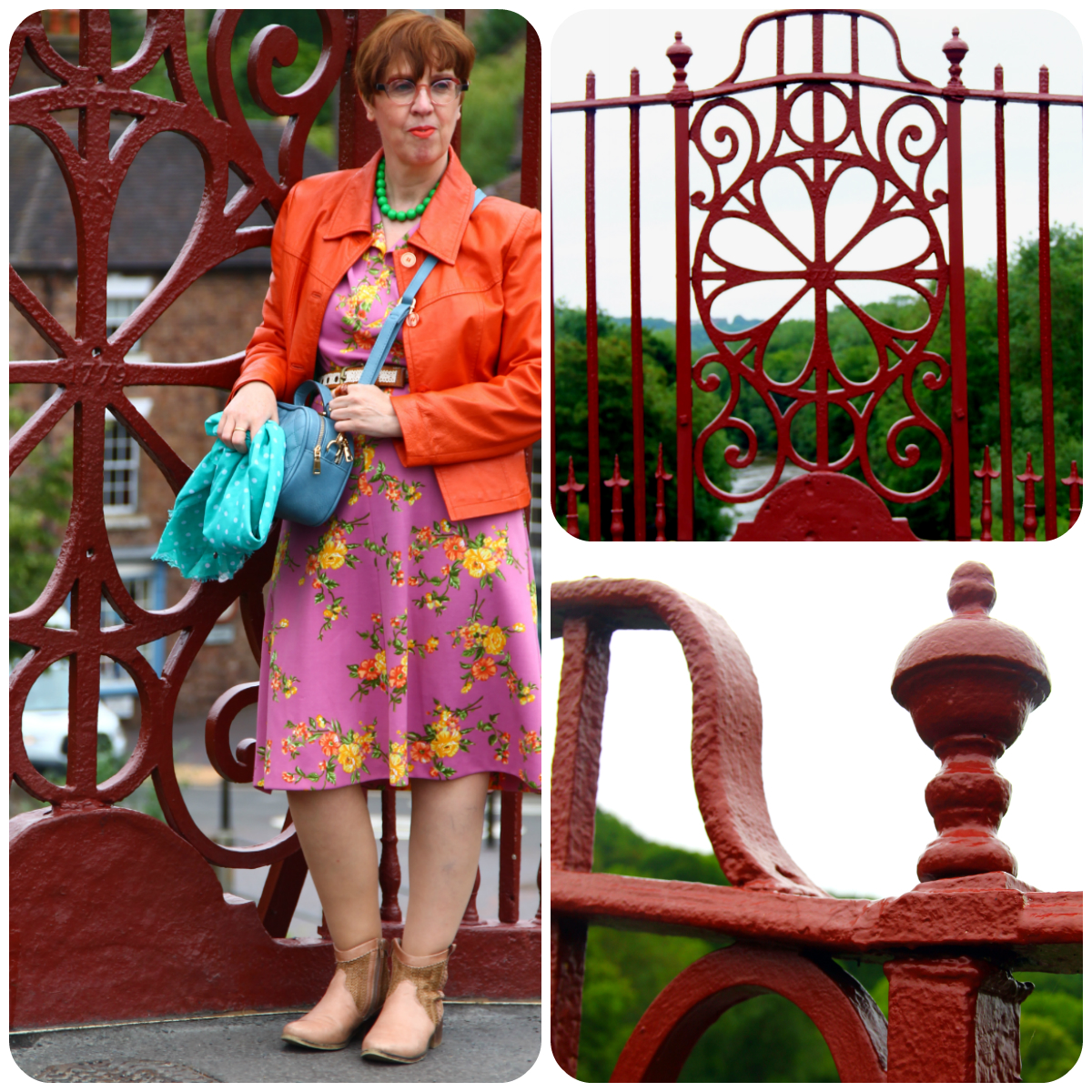
Now is as good a time as any to show you what I was wearing. In order to combat the greyness of the weather, one of my Diolen delights, in a dusky pink sprinkled with an orange, yellow and green flower print, came out to play. On top, my orange leather jacket, an adequate and welcome protection against the chilliness of the wind.


The bridge, the first major bridge in the world to be made of cast iron, is a Grade I listed building and together with the Ironbridge Gorge it forms a UNESCO World Heritage Site.

The area around Ironbridge is often described as the "birthplace of the industrial revolution", owing to the fact that in the nearby village of Coalbrookdale, a certain Abraham Darby perfected the technique of smelting iron with coke, allowing for a much cheaper production of iron.


To this day, the Bridge remains an important symbol of the dawn of the industrial age.

In 2017 and 2018, English Heritage undertook a £ 3.6 million conservation project on the bridge, restoring it to its formal glory.  

The Ironbridge Gorge is home to several interesting museums, which we have yet to visit. On a rainy day perhaps?


We'd brought a picnic which we ate in our car, before undertaking the 10-minute drive to our next destination.

There's a scenic but streneous walk from here to Ironbridge and back, descending into the gorge and then climbing out of it again by way of a series of wooden steps, but we decided to give it a miss, and just visit the delightful National Trust property called Benthall Hall.


Entrance is through a lychgate, and past the quaint little church of St Bartholomew’s, which has recently been acquired by the National Trust. 

I found the approach to the church, by way of a path leading through what looked like a miniature wildflower meadow, particularly charming.


The current house was built in 1535 but there have been Benthalls living on this site since the medieval period. The house is still tenanted by the Benthall family today.

The family sold the house in 1844, but then bought it back several generations later, before passing it to the National Trust on condition that the family continue to live here.


The interior is stunning, with a carved oak staircase, decorated plaster ceilings and oak panelling, but photography was only partially allowed.

The cabinet on the top left is a so-called Antwerp cabinet. The room's volunteer proudly told us its story, especially after hearing that we lived near Antwerp. The cabinet dates from the 17th century and is quite rare. It was converted in the Victorian period, when drawers were put in to display a collection of butterflies and moths. 

We were astonished to learn that the figurine under its glass dome on the bottom left was made from beeswax!


The gardens accomodate a kitchen garden and a carefully restored and terraced plantsman's garden, including a rockery and rose garden.

The formal garden's exhuberantly overgrown appearance was due to filming which would take place during Summer, but we actually rather liked it that way!


There's a wild garden too, which was a delight to stroll through, with a working beehive set amongs the grasses and wildflowers, which included the most exquisite Turk's Cap Lilies, and glimpses of an enchanting but unreachable thatched summer house.


We concluded our visit by having the first cream teas - the full works, consisting of scones with jam and clotted cream - of our holiday which, being us, we had with coffee instead of tea. 

Sitting outside in the secluded tea room garden on this gloomy and chilly afternoon, we were sending up prayers to the weather gods for slightly warmer temperatures.

Do join me again in the next episode to find out whether our prayers were answered.


Saturday, 13 July 2019

A story of love and neglect

After our long journey to Shropshire on Saturday, followed by the whirlwind of a day spent with Vix and Jon on Sunday, we didn't feel like venturing too far on Monday.

Sleeping in just that little bit longer was bliss, and the thought of having the whole of our holiday still stretched out in front of us was heavenly. So much so that even the cloudy sky we glimpsed when we drew our curtains couldn't put a damper on it.


We lingered over the first of Jos's famous English breakfasts, then decided to exchange the cowshed for the stables.

Not just any old stables, obviously. These Georgian ones, built around a cobbled courtyard, belong to the nearest National Trust property to our cowshed, Attingham Park!


If the name sounds familiar, it might be because both Vix and I have blogged extensively about the property last year, as it was the location of our previous meet-up.

However, the 18th century mansion and its estate are well worth a repeat visit, especially as last year most of our time was taken up with chatting to and enjoying the company of our fellow visitors.


All visits to Attingham Park start at the stable courtyard where a plant sale, a café with inside and outside seating and a shop are located. There's even a reasonabley priced second hand bookshop tucked away into one corner, which is well worth browsing.


A 10-minute walk takes you to the walled garden and orchard, strolling through part of what is known as the "pleasure grounds". This includes the so-called Mile Walk and was originally planted and landscaped for the Lord Berwicks and their society guests to enjoy a stroll amongst nature.

Passing this delightful cottage, we mused about moving into it. On second thought though, it might be a bit busy with all those passers-by, as the number of annual visitors to the estate soared to half a million last year!


Once in the sheltered walled gardens, planted abundantly with both colourful flower borders and fruit and vegetables, we strolled and explored, taking in the soul-soothing sights and scents.

Deckchairs had been put out on the lawns for all - including the local magpies - to enjoy! We made a beeline for the only ones not occupied by a visiting party of school children, who fortunately didn't hang around for long.

At one point, Jos tried his hand at using one of the vintage gardening contraptions.


The day, which had made a cloudy start, remained mercifully dry, and with temperatures in the low twenties, it eventually turned warm enough to shed my light-weight flower embroidered denim jacket.

And here's a rare sight of me wearing trousers! I loved wearing this pair of wide-legged ones so much that I picked up another pair in a charity shop a couple of days later. But don't worry, frocks and skirts are bound to remain my favourite items of clothing!

You can catch a glimpse of the vintage blouse I'm wearing underneath the jacket in the opening photo of this post. 


Attingham's kitchen garden is an excellent example of a late 18th century Georgian kitchen garden which, unusually, wasn't "modernised" during Victorian times, nor demolished during the 1950s and 1960s when many historic gardens were deemed economically unviable. 

A restoration programme is returning the garden to its original function, producing food and flowers for the people at Attingham and its many visitors.


After lunch at the Carriage House Café in the stable courtyard, we made our way towards the house for the second part of our visit.

The Berwicks have left a fine Georgian mansion with intricate decoration, Regency furniture and art, all set in 4000-acre estate in a fertile valley of the River Severn. 


Both the mansion and the estate were shaped by a story of love and neglect. The same could be said about Dove Cottage, albeit on a much smaller scale. No wonder we did feel quite at home!

Built for the first Lord Berwick in 1785, Attingham Hall and its beautiful parkland were owned by five generations of the same family for more than 160 years, their accumulated fortune dwindled by overspending, ultimately leading to financial ruin. This, obviously, is where the comparison with Dove Cottage ends!


The creators of Attingham were Noel and Anne Hill, 1st Lord and Lady Berwick, and the design of the house adopted the French fashion of a masculine and a feminine side in terms of decoration.

The drawing room (above, top left) and the boudoir (above, top and bottom right) with its exquisite guilding and beautifully painted flowers, birds and Cupid's arrows, are part of the feminine side.


The masculine side, with its strong colours, family portraits and other manly objects, include the library and the dining room.


In the dining room, the table was laid out for a Regency banquet, atmospherically lighted by candelabra as it would have been back in the day.

The friendly and knowledgeable volunteer in this room told us that wine wasn't poured at the dinner table. Instead, glasses would have been brought to the guests by a footman every time a drink was required. I'm rather hoping that the footman in question would have had a good head on his shoulders, unlike the dummy displaying the footman's uniform on the bottom left.


Meanwhile, in the picture gallery, there was an exhibition of portraits on loan from the National Portrait Gallery. Called Faces of Change: Nature's Champions, the exhibition includes portraits of environmental activists, poets, artists, politicians, campaigners, gardeners, broadcasters and scientists.

Beatrix Potter is on the left, while the chap on the right is the one and only Willian Morris!


The picture gallery was added in 1807-10 by the important Regency architect John Nash for the 2nd Lord Berwick, and includes a magnificent top-lit staircase, which I'd rather taken a fancy to last year. It certainly lived up to its expectations this time around.


Our visit ended in the servants' quarters in the basement, where we admired the collection of copper pans in the kitchen and did our very best not to eat cook's food!

Nor did we run off with the well-thumbed and dog-eared set of Mrs. Beeton's books on household management displayed on the housekeeper's desk!


Tired of all that trudging around the house and garden, I gratefully made use of a conveniently placed chair. I'm just guarding the family silver, honestly. 


At the end of this well-spent day, we drove back to the cowshed, half an hour away on quiet country roads, at the end of which we found our view of the Long Mynd veiled in a light layer of fog. 

It definitely looked and smelled like rain and faint rumblings of thunder could be heard in the distance.

Did the weather gods send us any more rain? You will find out in the next installment of my travelogue.


Monday, 8 July 2019

Look left, look right, the hills are bright*

Isn't it heartbreaking how time seems to whizz past when you're on holiday?

Getting up at the crack of dawn to start your journey on what is essentially the first day of your  holidays, those two weeks you have been looking forward to seem like an eternity.

All too soon, though, it's time to pack up again and return to the daily grind.

All that's left are memories and photographs - over a thousand photographs in my case - which will give you pleasure for years to come.

Blogging about it all has the added bonus of re-living your holiday, so let's get this started, shall we?


After our long journey, which started at 4.45 am on June 22nd, we arrived in Shropshire by mid afternoon. Our holiday cottage is tucked away in a tiny hamlet nestling in a valley below the Long Mynd mountain range, and is reached by a winding and rather bumpy single track road, 1,2 miles from the nearest two-lane one and just over a mile from the nearest village.

We were delighted to have the sun with us as we'd been hearing tales of torrential rains and floods in the weeks before our departure. We'd even driven through a partially flooded road on our way up.


The cottage, formerly a cowshed, is part of a working sheep farm and apart from the hypnotizing soundtrack provided by the bleating of sheep, the chirping of birds and the buzzing of insects, it is peacefully quiet.

The view is magnificent too, with a different part of the Long Mynd visible from each window.


We'd booked the same cottage as last year, so we knew what to expect. Still, it was a nice surprise to find most of the cottage redecorated, making it even lovelier than before.


After the initial excitement of our arrival, it was time to wind down and have a nap, as we were quite exhausted by then.


No rest for the wicked, though, as we were up bright and early again the next morning.

Although the sun was there to greet us, it was a bit chilly, and the weather forecast was yet again indicisive so, taking no chances, I wore a long sleeved blouse with the maxi skirt I'd chosen for the occasion. The occasion in question was the long-awaited yearly blogger meet-up with Vix and her partner Jon.

I'm sure you can see how excited I was!


Almost equidistant from both Vix's and Jon's home and our temporary one, the town of Bridgnorth is where we'd chosen to meet.

Bridgnorth is a market town which was founded in the 11th century and is virtually unique in England, being a town of two halves, with High Town perching on a sandstone cliff overlooking the River Severn, and Low Town built along the river's banks.

We met up in High Town and, after lots of squealing, exclaiming and of course, hugging, we made our way into the town centre where - oh joy of joys - quite a few charity shops were open for business in spite of this being a Sunday. They must have known we were coming!


As you've probably noticed, I was already in luck, as I found both the pristine pair of red Clarks shoes and the top I am holding up above.


High Town and Low Town are connected by several steep flights of steps, although the less able or energetic can make use of the funicular, or Cliff Railway, the oldest (it opened on 7th July, 1892), and steepest one in England, which makes the dizzying journey countless times a day, from 8 am to 8 pm from Monday to Saturday.


I bet Jon was secretly pleased that it only opens at 12 am on a Sunday!

Beyond the cliff railway terminal in High Town, there are wonderful views of Low Town and the Severn valley from Castle Walk, which leads all the way to the landscaped Castle Grounds.


Here, all that remains of the once mighty castle, a gigantic fragment of the Norman keep, leans at an impossible angle courtesy of the Parliamentarians in the Civil War.


Back in town, it was time for lunch, which obviously was had in the local Wetherspoon, the delightfully named Jewel of the Severn.


After lunch, and before we made our way to our cars for the next part of the day, it was time for some state portraits, posed in front of one of the 12 artfully decorated locomotive sculptures, which form the Bridgnorth Art Trail project. This one is called Platform Severn.

You can see our portrait here in Vix's post.


But as I already hinted, the day wasn't finished yet. It was time for some culture, to be found a mere 10 minutes' drive away at Dudmaston, a National Trust property which comprises a stately home with galleries, gardens and parkland.

As it was quite late in the day, we only had time to visit the house, which dates from the 17th century, and adjoining galleries. 

The estate was passed to the National Trust by its last owner, Rachel, Lady Labouchere, in 1976.
Sir George and Lady Labouchere started collecting Modern Art in the 1950s while Sir George was working for the British Embassy in Brussels. The Laboucheres installed the galleries you can see at Dudmaston today.


Having completed a tour of the house and galleries, we were gasping for a drink, so we plonked ourselves down at one of the picnic tables in the orchard for restorative cups of coffee and tea.

It had become quite overcast by then, and the air was turning oppressive, threatening rain. I was rather envious of Vix's airy Summer dress, which she'd had the forethought to wear, feeling more than just a tad overdressed in my long sleeves. 

All too soon and with heavy hearts, it was time for goodbyes, as Vix and Jon were leaving for Glastonbury the next day.


The weather gods, who had been kind to us throughout the day, regaled us with the first drops of rain the minute we stepped into our cars, unleashing torrents of rain on our way back, requiring the use of our windshield wipers at full tilt.

Back in our single track lane, we found our lovely view almost totally obscured.


Having arrived back safely, it was time to unpack our presents. 

Jos's included a Harris Tweed hat to add to his collection, a pocket square and an amazing vintage photo album. Mine were two fabulous frocks and the most darling wooden handled fabric bag with a plastic cherries brooch pinned to it.

Those of you who follow me on Instagram might have seen that I already wore the dress for one of our outings. Yes, you have read that right. It wasVix who gave me the final push to join Instagram, so that you can now follow me @polyester_princess61.

I hope you'll join me again for the next installment of my travelogue.

* From A Shropshire Lad, by A.E. Housman